
Loading, please wait...
LOT 0530
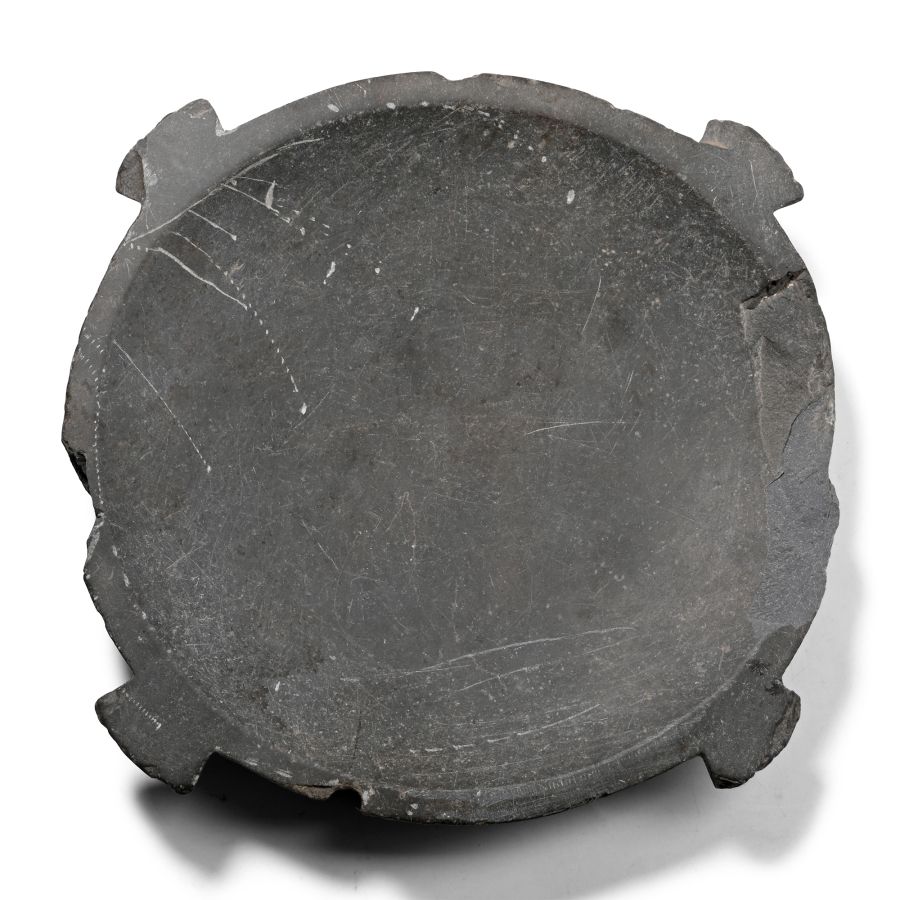
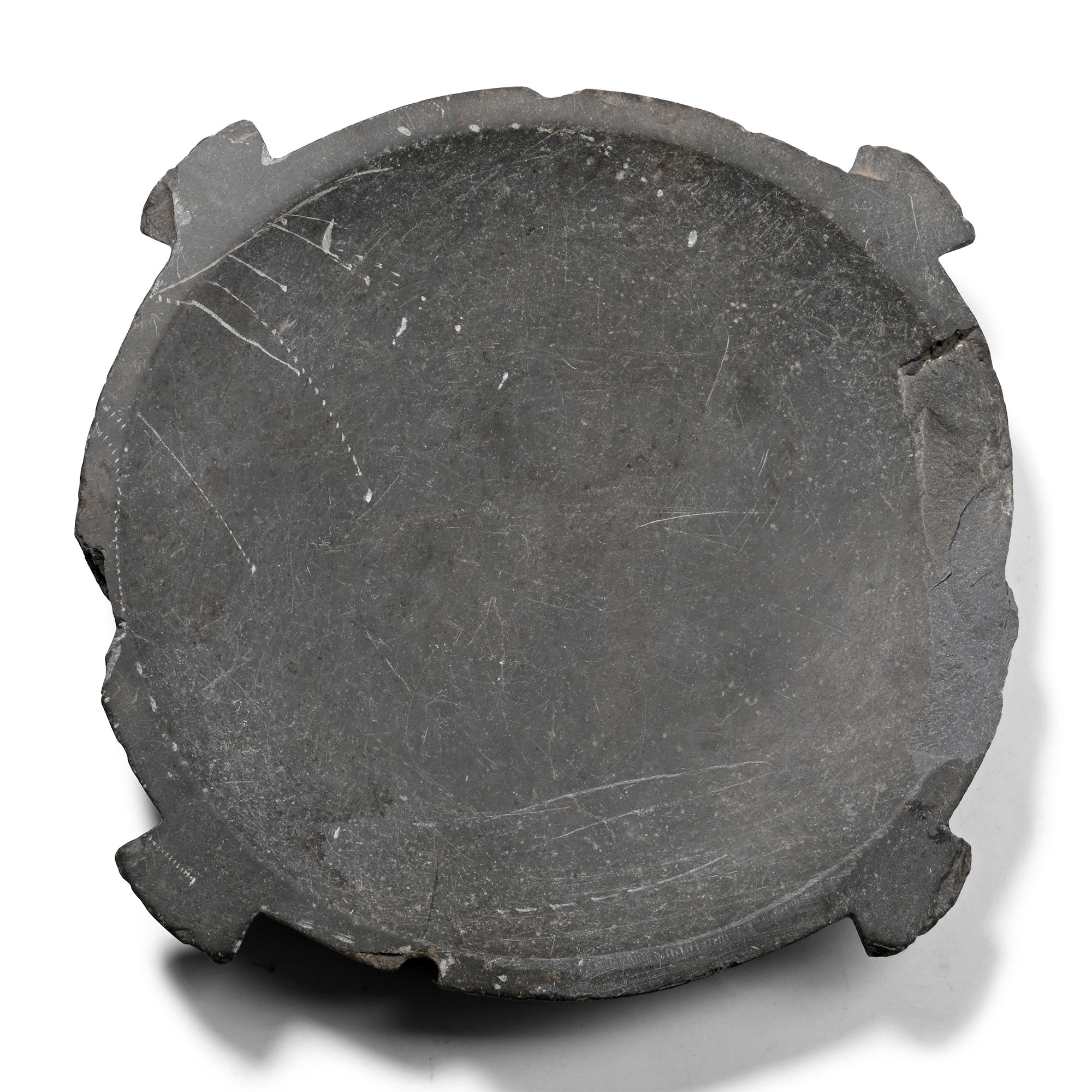
Egyptian Schist Cosmetic Mortar
LATE PERIOD, 25TH-26TH DYNASTY, 754-525 B.C.
6 1/2 in. (450 grams, 16.4 cm).
Discoid palette with rounded underside and flat base, dished central field, flat rim with four radiating trapezoidal projections.
ProvenanceAcquired in the mid 1980s-1990s.
Private collection, Switzerland, thence by descent.
Private collection, since the late 1990s.
Accompanied by a copy of an Art Loss Register certificate no.S00038135.
Cf. Aston, B.G., Ancient Egyptian Stone Vessels: Materials and Forms, SAGA 5, Heidelberg, 1994, pl. 164, type 3.12, for the form.
CONDITIONTimeLine Auctions follows a vetting process to ensure the authenticity and legality of all items, reinforcing our commitment to integrity and responsible trading. Each antiquity, antique, and coin lot undergoes thorough examination by a vetting committee of at least ten external specialists, professional trade association members, scientists, and archaeologists: Our Vetting Process
AUCTIONS:
TimeLine is a leading auction house specialising in antiquities, ancient art, collectables, natural history, coins, medals, and books. Our auctions offer museums, collectors, historians, and enthusiasts the opportunity to acquire unique and historically significant pieces.
LOT 0530
Egyptian Schist Cosmetic Mortar
Estimate £600 - 800€700 - 930 (for guidance only)$810 - 1,080 (for guidance only)
Opening Bid
£300 (EUR 348; USD 405) ‡+BP*
-
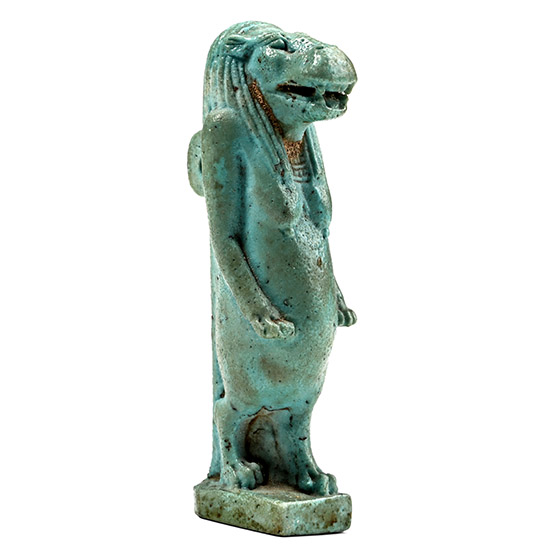
Egyptian Turquoise Blue Glazed Faience Amulet of Taweret
Late Period, circa 664-332 B.C.Estimate: £600 - 800 (+bp*)
Bids: 11 | Current Bid: £220
Amuletic pendant with the deity's characteristic hybrid animal elements, dominated by its hippopotamus head, with a plain dorsal pillar with a loop. 16.58 grams, 61 mm
Received as a gift from archaeologist Cyril Aldred, April 1970, when expecting their son Rupert. From the private collection of Peter Clayton, FCILIP, Dip, Arch, FSA, FRNS, Hemel Hempstead, Hertfordshire, UK; formed since the late 1950s. Accompanied by an old handwritten information card by Peter Clayton, collection no.124.
Taweret is an ancient Egyptian goddess associated with fertility, childbirth, motherhood, and protecting women during pregnancy and labour. She is depicted as a composite being with animal features and stands out as one of the most distinctive and striking deities in the Egyptian pantheon. Taweret’s name derives from the Egyptian word for "great" or "large" (tꜣwꜣrt), emphasising her formidable and protective nature. Cyril Aldred (1914-1991) was a British Egyptologist and art historian who served at the Royal Scottish Museum, Edinburgh, from 1937 until his retirement in 1974. He published widely on Egyptian art, including Old Kingdom Art in Ancient Egypt (1949) and Akhenaten, Pharaoh of Egypt (1968), and became a leading authority on Amarna Period art, notably through his 1973 Brooklyn Museum exhibition catalogue, Akhenaten and Nefertiti. -
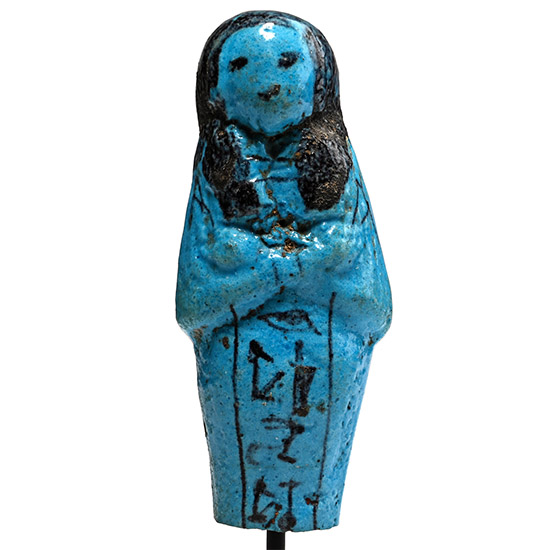
Egyptian Bright Blue Glazed Faience Shabti of Wennefer
New Kingdom, circa 1292-1069 B.C.Estimate: £600 - 800 (+bp*)
Bids: 2 | Current Bid: £10
Upper half of a mummiform figure (feet missing), with a black-painted tripartite wig, crossed arms subtly modelled in relief, and hands holding hoes rendered in black; two globular water pots (?) on the back, with a bold black line beneath; a hieroglyphic text on the lower body, reading: 'The Osiris Wennefer'; mounted on a display stand. 61 grams total, 11 cm including stand
Acquired from the Egyptian Exploration Society, 30th June 1965, for 2 shillings and sixpence. From the private collection of Peter Clayton, FCILIP, Dip, Arch, FSA, FRNS, Hemel Hempstead, Hertfordshire, UK; formed since the late 1950s. Accompanied by an old handwritten information card by Peter Clayton, collection no.118.
Wennefer, a common name, particularly in the New Kingdom and the Third Intermediate Period, which loosely translates as 'the perfect being', was also an epithet of Osiris. -
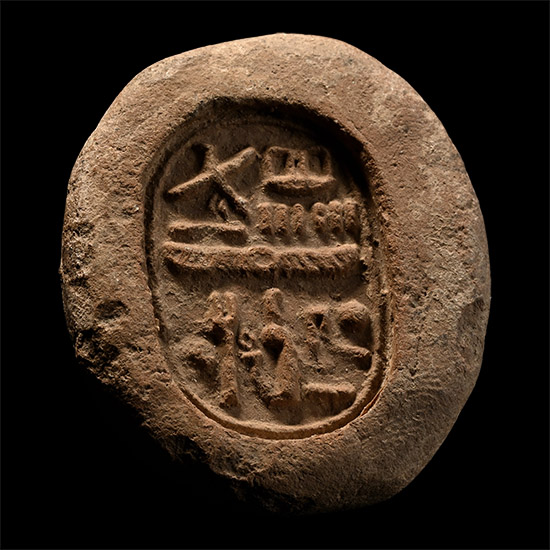
Egyptian Terracotta Mould with Impression of the Cartouche of Pharaoh Ramesses II
New Kingdom, 19th Dynasty, circa 1237-1235 B.C.Estimate: £600 - 800 (+bp*)
Bids: 5 | Current Bid: £240
Oblate type with an impressed cartouche recording the sixth Heb-Sed (jubilee) of Ramesses II. 27.4 grams, 46 mm
Acquired 7th February 1962. From the private collection of Peter Clayton, FCILIP, Dip, Arch, FSA, FRNS, Hemel Hempstead, Hertfordshire, UK; formed since the late 1950s. Accompanied by an old handwritten information card by Peter Clayton, collection no.85.
By the time of Ramesses II, the royal Heb-Sed festival was already about two thousand years old. He celebrated his first Heb-Sed in his 30th year and his sixth in his 45th year.
