
Loading, please wait...
LOT 0515
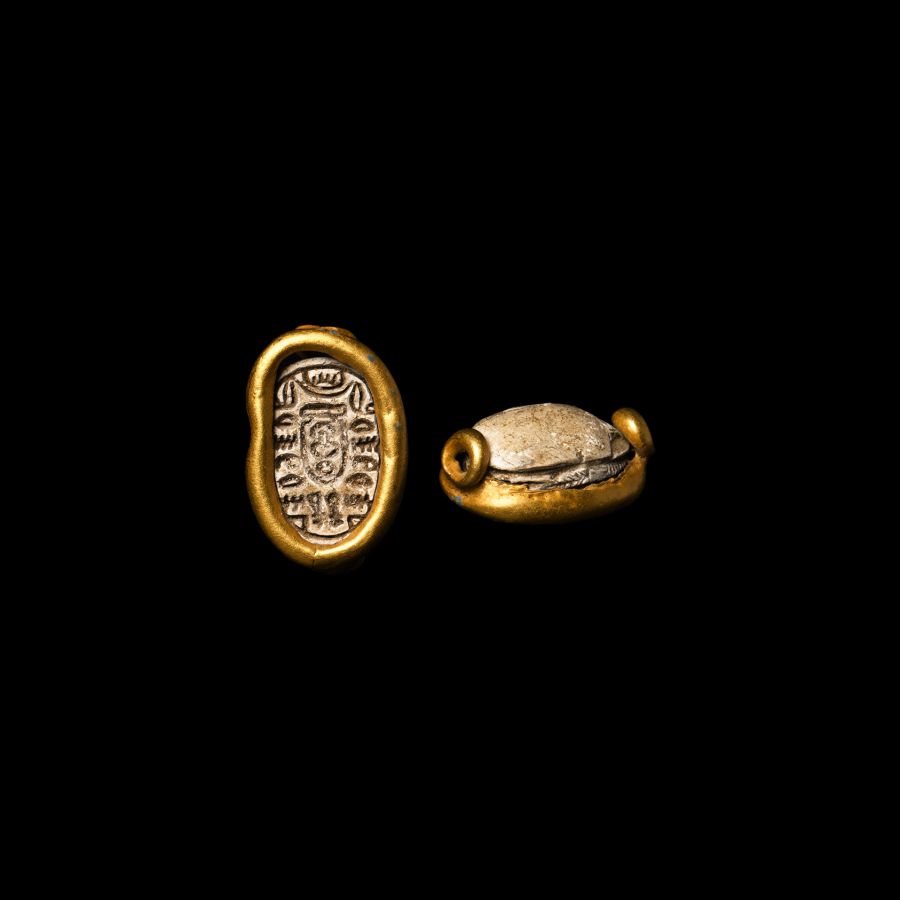
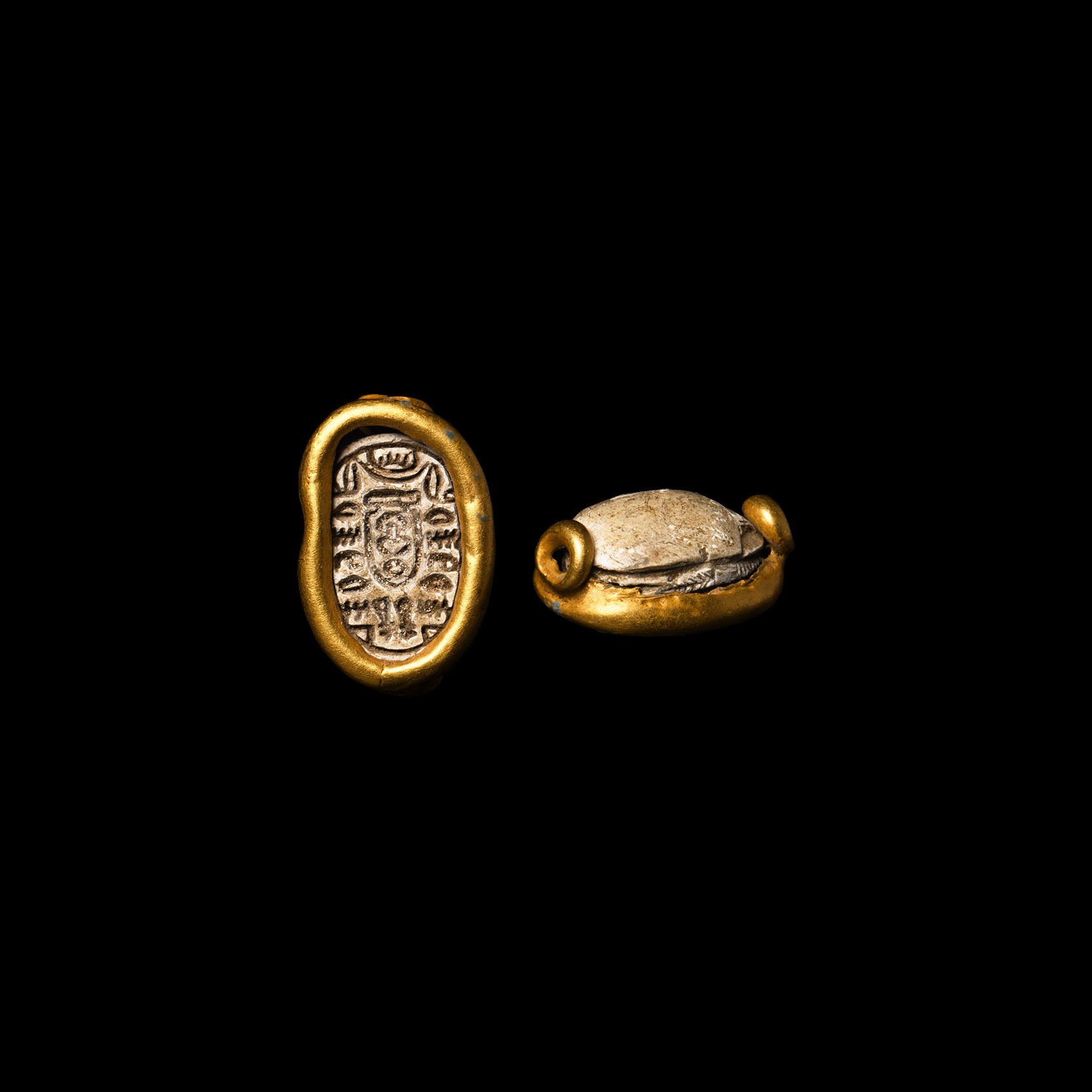
Egyptian Scarab in Gold Mount
NEW KINGDOM, CIRCA 1500 B.C. OR EARLIER
3/4 in. (2.34 grams, 18 mm).
A glazed composition scarab with detailed serrated legs and with a-n-r, nub and nefer signs around a cartouche containing the incomplete name of Thutmose III to the underside; set in a later gold mount for suspension.
ProvenanceAcquired 1969-1999.
London collection of the late Mr S.M., thence by descent.
Cf. Ben-Tor, D., The Scarab: A Reflection of Ancient Egypt, Jerusalem, 1993, p.32, for a discussion of the a-n-r symbolism on scarabs.
FootnotesThe sign groups surrounding the cartouche are indicative of Asiatic scarab production of the Second Intermediate Period, where the craftsmen did not understand the meaning of hieroglyphs and used them for purely decorative reasons. This suggests that either the beetle and sun-disc signs in the cartouche are unintentionally similar to those of Thutmose III, or that this is a later scarab with an inaccurately rendered name of the king
CONDITIONTimeLine Auctions follows a vetting process to ensure the authenticity and legality of all items, reinforcing our commitment to integrity and responsible trading. Each antiquity, antique, and coin lot undergoes thorough examination by a vetting committee of at least ten external specialists, professional trade association members, scientists, and archaeologists: Our Vetting Process
AUCTIONS:
TimeLine is a leading auction house specialising in antiquities, ancient art, collectables, natural history, coins, medals, and books. Our auctions offer museums, collectors, historians, and enthusiasts the opportunity to acquire unique and historically significant pieces.
-
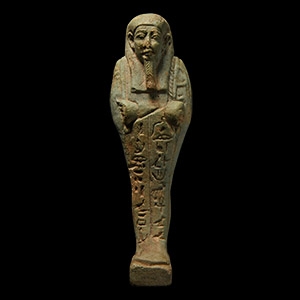
Egyptian Pale Blue Shabti for an Imy-Khent Priest
Late Period, 30th Dynasty, circa 380-343 B.C.Sold for (Inc. bp): £1,820
A pale blue glazed mummiform shabti for an Imy-Khent priest, modelled standing on a rectangular base, arms crossed over the chest and holding a pick and a hoe, seed bag over the left shoulder, wearing a tripartite wig and false beard; two vertical columns of hieroglyphs to the front of the body, plain dorsal pillar; some of the hieroglyphs spelling the owner's name are poorly rendered, but appears to be Ba-ankh-sa-sobeky. 99 grams, 13.5 cm high
From a Worcester deceased estate. Property of a Cambridgeshire gentleman. Accompanied by an academic report by Egyptologist Paul Whelan.
Although the name of the shabti’s owner and, in particular, that of his parent, are rather unclear, the titles are clearly written and inform us that Ba-ankh-sa-sobeky served as an ‘Imy-khent priest’ associated with the Delta city of Mendes, where the principal deity was the sacred ram god Ba-neb-djedet (meaning ‘Ram, lord of Djedet’). The hieroglyph of the standing ram (Ba) forms the first part of the priest’s name. From the Late Period onwards the priestly title of the nearby city of Hermopolis Parva, ‘One who Separates the Two Gods’, also appears in Mendesian title strings, perhaps indicating that Hermopolis Parva and its religious cults had come under the control of Mendes; indeed, Mendes is thought to have been the capital of Egypt during the 29th Dynasty. The crocodile god Sobek was also worshipped at Mendes in later periods and Ba-ankh-sa-sobeky’s name appears to reflect both this reptilian deity and the traditional ram god of the city. -
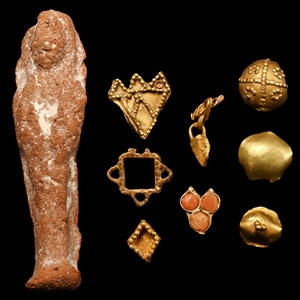
Egyptian and Other Artefact Collection
1st millennium B.C. and laterSold for (Inc. bp): £195
A mixed group comprising: a miniature glazed composition shabti; two gold domed discs, one with a granule cluster to the apex; a gold lozenge cell with granulation to the rim; a square gold cell with flanking loops and granulation; a gold triangular panel with granulated dividers, triangles to the upper edge; a gold domed disc with quartered design and rosettes, granulated; a gold leaf-shaped pendant and chain links; three gold cells with carnelian inlays. 5.35 grams total, 6-46 mm
Acquired 1990s. English private collection. Property of an Essex gentleman. -
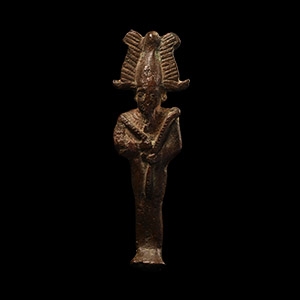
Egyptian Osiris Statuette
Late Period, 664-525 B.C.Sold for (Inc. bp): £780
A bronze votive figurine of Osiris, portraying the god standing, wearing a close-fitting mummiform garment and Atef crown, false beard, hands held at the centre of the chest holding the royal crook and flail; possibly from Saqqara. 37.1 grams, 80 mm high
From an old UK collection. From the private collection of Alf Baxendale (1941-2016) part 2, keen Egyptologist, member of the Egyptology Society, trustee of the Amarna Trust; thence by descent. Accompanied by an identification display card. Accompanied by a copy of his obituary published in Horizon, The Amarna Project and Amarna Trust newsletter, Issue 18, 2017, p.21, by Barry John Kemp, CBE, FBA, Professor Emeritus of Egyptology at the University of Cambridge and directing excavations at Amarna in Egypt.
Osiris was the foremost of the Egyptian funerary gods and ruler of the underworld.
