
Loading, please wait...
LOT 0007
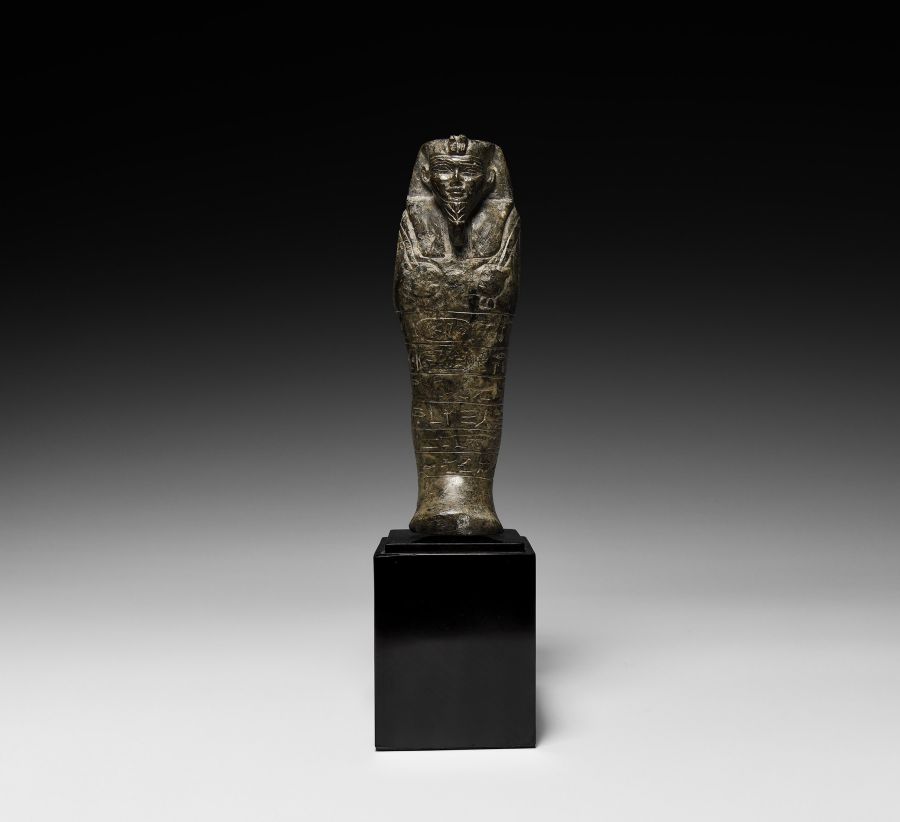
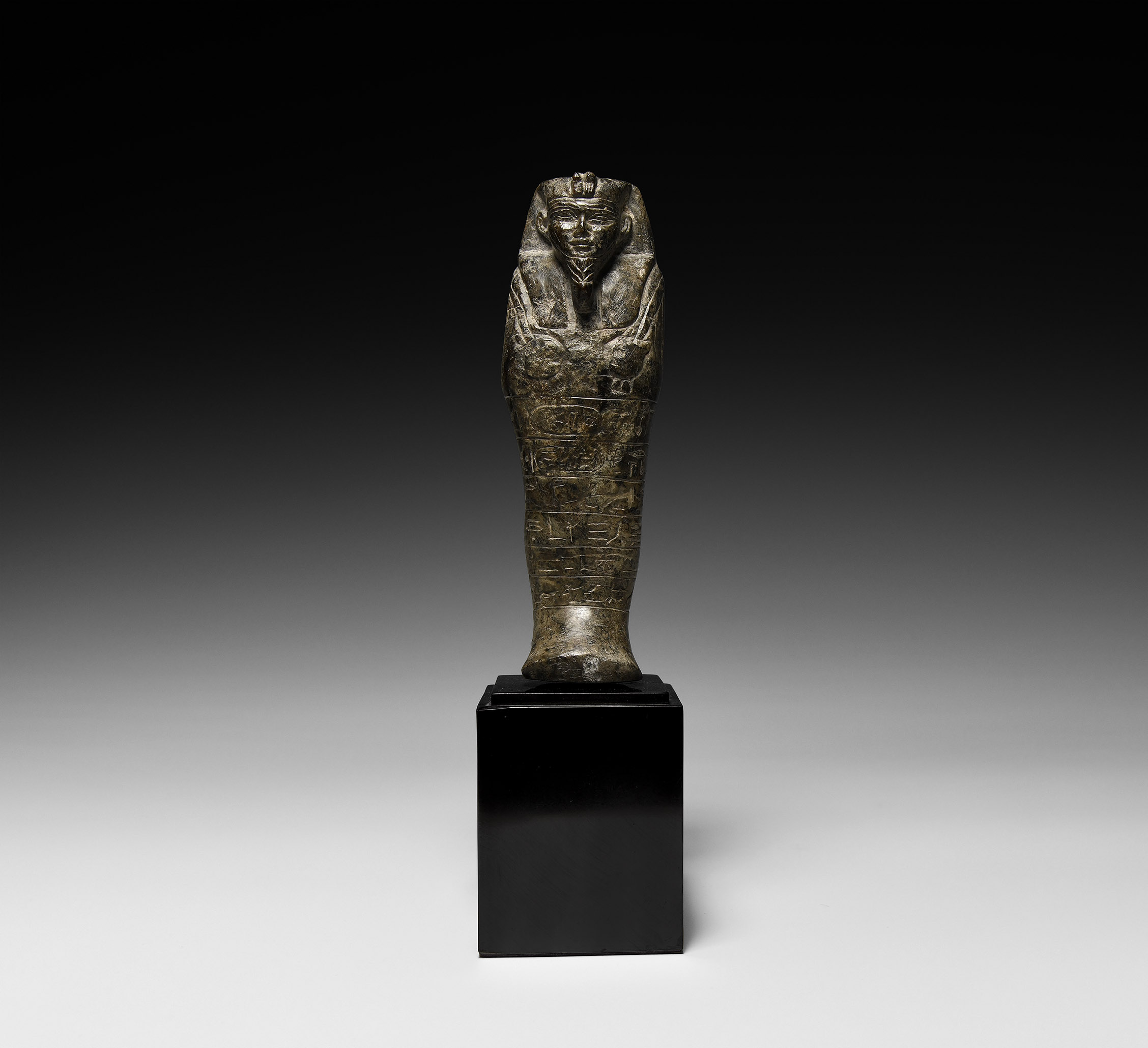
Egyptian Rhyolite Shabti for King Senkamanisken
NAPATAN PERIOD, 643-623 BC
9" (622 grams total, 22.5cm including stand).
A rhyolite shabti with mummiform body, arms crossed over the chest, the right hand holding a narrow-bladed hoe, the left hand holding a broad hoe, seed bag with tassel slung over the left shoulder; wearing a nemes headdress, double uraeus and false plaited beard with chin straps; six incised horizontal registers of hieroglyphs from Chapter Six of the Book of the Dead; incised 'footmarks' to the base.
ProvenanceFrom a UK private collection formed in the 1980s; with Bluett and Sons, London, and also Sheppard & Cooper in 1979; formerly the property of a UK private collector who acquired it from J.J. Klejman of Madison Avenue, New York, in the 1960s; accompanied by a scholarly note TL 5285 by Dr Ronald Bonewitz; this lot has been checked against the Interpol Database of stolen works of art and is accompanied by AIAD certificate number no.163503-10052.
LiteratureCf. The Collector's Eye, Masterpieces of Egyptian Art from The Thalassic Collection, Ltd., p.130 for context; Museum of Fine Art Boston, accession number: 21.11818, for type; see Wildung, Dietriche (ed.)., SUDAN. Ancient Kingdoms of the Nile, Paris, 1997, pp. 224-5, the detailed catalogue of a major exhibition held at the Institut du monde arabe, Paris, 1997.
FootnotesIn 591 BC the pharaoh Psamtik invaded Egypt, ending the 25th (Kushite, Nubian) Dynasty which had its capital at Thebes, 716-656 BC. They withdrew to Nubia (modern Sudan) to found the royal Napata and Meroe dynasties. Their pharaohs continued Egyptian traditions, building a great temple to the god Amun at Gebel Barkal and making their royal burials at Nuri and Mero under brick-built pyramids with steeper sides than their Egyptian forerunners. These were excavated by Professor George A. Reisner directing the Harvard-Boston Museum of Fine Arts Expedition, 1916-23. The pyramids had been robbed in antiquity and were much denuded but important finds were made, notably ushabtis which the ancient robbers had ignored.
The Pharaoh Senkamanisken (643-623 BC) of the Napata Dynasty (656-575 BC), was the son of Atlanersa and Queen Maloteral and third after the great pharaoh Taharqo; he was buried in Pyramid Nuri 3 at Nuri. In February 1917, Reisner found 1,277 shabtis of the king divided into five groups made of serpentine (here now properly identified as rhyolite, a black igneous rock), and faience. Despite the large numbers of shabtis there are very few available in the art market. Large numbers lie in serried ranks in storage trays in the Boston Museum of Fine Arts. Some were donated to major museums and a few were given to several societies with religious connections. Over the years these societies have rationalized their collections and most of the few shabtis in the market originate from those societies’ disposals and then passing through private collectors’ hands.
Unlike Egyptian royal shabtis those of Senkamenisken and his grandfather Taharqo (he had 1,070 in Pyramid Nuri 1) have portrait features. An example similar to the present lot was sold at Christie's, New York, 8 June 2003, for USD138,000.
TimeLine Auctions follows a vetting process to ensure the authenticity and legality of all items, reinforcing our commitment to integrity and responsible trading. Each antiquity, antique, and coin lot undergoes thorough examination by a vetting committee of at least ten external specialists, professional trade association members, scientists, and archaeologists: Our Vetting Process
AUCTIONS:
TimeLine is a leading auction house specialising in antiquities, ancient art, collectables, natural history, coins, medals, and books. Our auctions offer museums, collectors, historians, and enthusiasts the opportunity to acquire unique and historically significant pieces.
Third Intermediate Period, 1069-702 BC
Lot No. 0590 Opening bid: £540
6th-4th century BC
Lot No. 0621
Sold for (Inc. premium): £121
3rd-6th century AD
Lot No. 0627
Sold for (Inc. premium): £216
