
Loading, please wait...
_900x900.jpg "Egyptian Revival Bronze Cross")
_200x200.jpg "Egyptian Revival Bronze Cross")
.jpg "Egyptian Revival Bronze Cross")
LOT 2097
Egyptian Revival Bronze Cross
LATE 19TH-EARLY 20TH CENTURY A.D.
1 5/8 in. (5.6 grams, 43 mm).
Cruciform pendant with integral loop, obverse with impressed cartouche and hieroglyphs, reverse with hatching. [No Reserve]
ProvenanceFrom the collection of a gentleman, acquired on the London art market in the 1990s.
CONDITIONTimeLine Auctions follows a vetting process to ensure the authenticity and legality of all items, reinforcing our commitment to integrity and responsible trading. Each antiquity, antique, and coin lot undergoes thorough examination by a vetting committee of at least ten external specialists, professional trade association members, scientists, and archaeologists: Our Vetting Process
AUCTIONS:
TimeLine is a leading auction house specialising in antiquities, ancient art, collectables, natural history, coins, medals, and books. Our auctions offer museums, collectors, historians, and enthusiasts the opportunity to acquire unique and historically significant pieces.
-
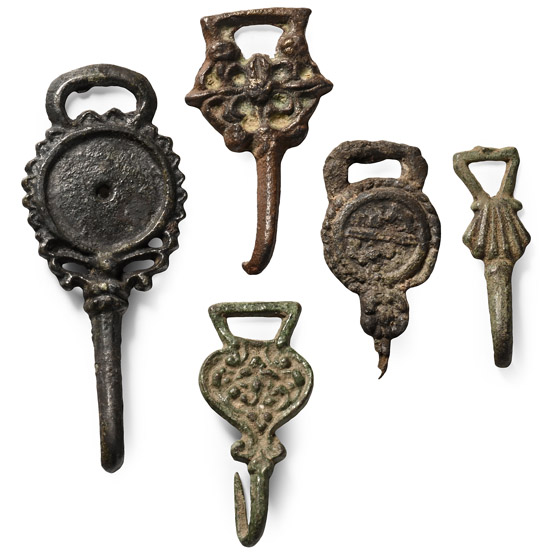
Tudor Bronze Clothes Hook Fastener Group
16th century A.D.Sold for (Inc. bp): £26
A mixed group of hooked fasteners including disc-shaped, leaf-shaped, shell and foliage plaque; each with suspension lug. 18.87 grams total, 31-56 mm
From the private collection of the late Graham Slater (1927-2024), Cambridge, UK, acquired 1980s-1990s. -
.jpg)
Post Medieval Black Stone Ram's Head Amulet
20th century A.D.Estimate: £200 - 300 (+bp*)
Opening Bid: £150
Carved in the round with two openings for suspension hole to rear. 13.39 grams, 32 mm
Private collection, England. -
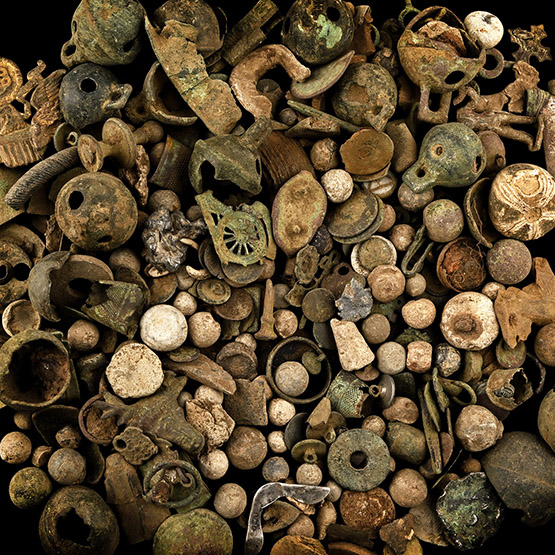
Tudor and Later Artefact Group
Circa 16th-21st century A.D.Sold for (Inc. bp): £98
Including crotal bells, coins, lead shot, military badges, thimbles and other items. 1.89 kg total, 8-55 mm
Found Suffolk, UK. (UK buyers only, not for export)
