
Loading, please wait...
_900x900.jpg "Egyptian Relief with List of Offerings")
_200x200.jpg "Egyptian Relief with List of Offerings")
.jpg "Egyptian Relief with List of Offerings")
LOT 0005
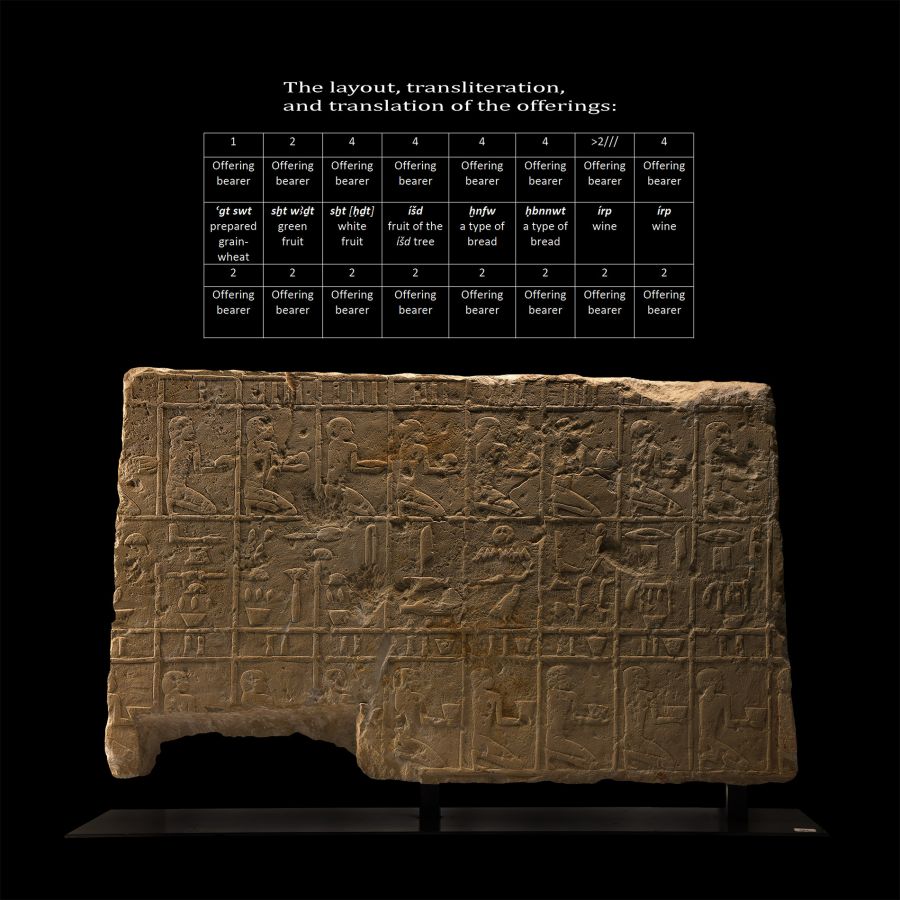
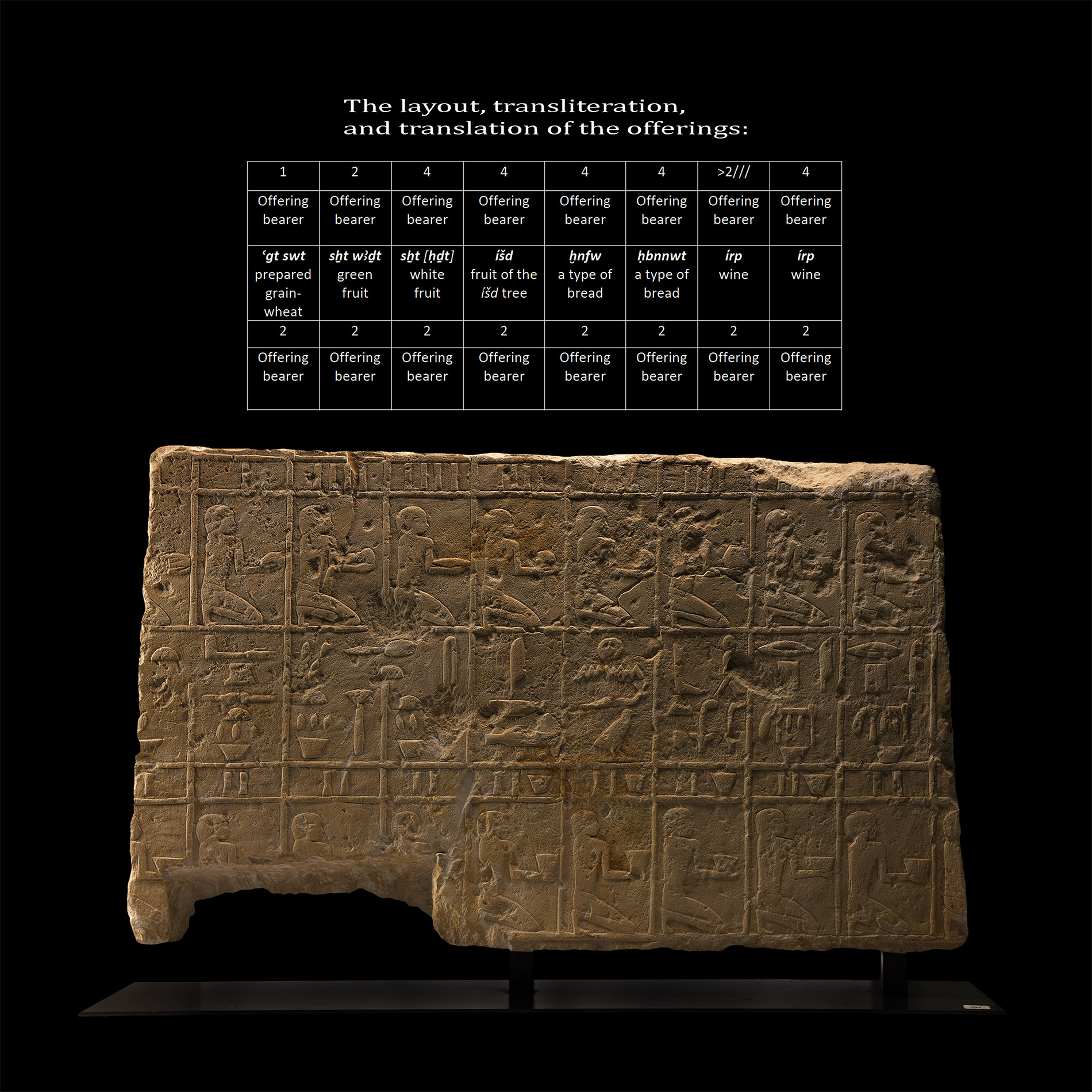
Egyptian Relief with List of Offerings
LATE OLD KINGDOM, 5TH-6TH DYNASTY, 2495-2181 B.C.
29 1/4 in. (40 kg total, 74 cm wide).
A section of tomb wall with a central register of eight rectangular panels each containing hieroglyphs naming offerings for the deceased; the top and bottom groups of eight rectangular panels each contain a depiction of a kneeling offering-bearer; all carved in high-relief; mounted on a custom-made display stand.
ProvenanceNorth American gallery, 1981-1990s.
with Pierre Bergé & Associés, Paris, France, 1st December 2007, lot 384.
London collection, 2016.
Accompanied by an academic report by Egyptologist Paul Whelan.
This lot has been checked against the Interpol Database of stolen works of art and is accompanied by search certificate no.11942-209839.
Cf. Paget, R.F.E. and Pirie, A.A., The Tomb of Ptah-hetep, ERA II, London, 1898, pl.XLI, for a similar offering list.
CONDITIONTimeLine Auctions follows a vetting process to ensure the authenticity and legality of all items, reinforcing our commitment to integrity and responsible trading. Each antiquity, antique, and coin lot undergoes thorough examination by a vetting committee of at least ten external specialists, professional trade association members, scientists, and archaeologists: Our Vetting Process
AUCTIONS:
TimeLine is a leading auction house specialising in antiquities, ancient art, collectables, natural history, coins, medals, and books. Our auctions offer museums, collectors, historians, and enthusiasts the opportunity to acquire unique and historically significant pieces.
-
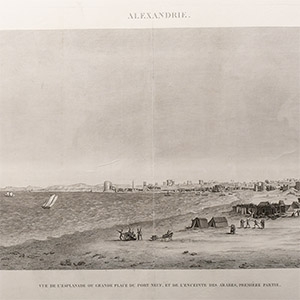
Large Egyptian Expedition Lithograph Print
1817 A.D.Sold for (Inc. bp): £117
Charles-Louis Balzac & Berthault - Alexandrie. Vue de l'esplanade ou grande place du Port Neuf, et de l'enceinte des arabes, première partie - Proof etching on laid paper of plate 97 from Description de l'Égypte: ou, Recueil des Observations et des Recherches qui ont été Faites en Égypte Pendant l'Expédition de l'Armée Française with later backing sheet. 220 grams, 110.5 x 66.5 cm (sheet)
From the collection of a North American priest. Acquired between 1981-1996. Property of a North American collector.
Produced between February 1802 and 1830 on the orders of Napoleon Bonaparte; published between 1809 and 1828. Just 1,000 copies were distributed to various institutions, printed on laid paper with an 'Égypte ancienne et moderne' watermark. -
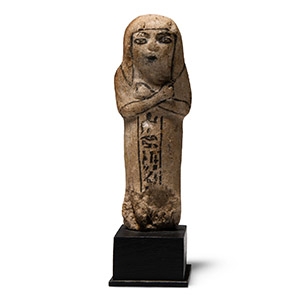
Egyptian Faience Shabti with Hieroglyphic Inscription
Late New Kingdom-Third Intermediate Period, 1186-715 B.C.Estimate: £1,000 - 1,400 (+bp*)
Opening Bid: £500
Pale grey glazed composition shabti with black outlining to the wig, eyes and facial features, arms, seed sack and a vertical panel of hieroglyphic text to the lower body dedicating the shabti to 'The illuminated, the Osiris, The God's Father (a priestly title) Pia[..]'; mounted on a custom-made stand. 249 grams total, 14 cm high including stand
Ex Marc Delorme, Antiquité Archéologie, France. From the private collection of Mr & Mrs Gent of Belgium, acquired June 2009. Accompanied by a handwritten illustrated invoice and two handwritten dealer's tags. -
.jpg)
Egyptian Multi-Stranded Faience Mummy Bead Necklace
Late Period, 664-525 B.C.Sold for (Inc. bp): £156
Composed of polychrome composition beads of mainly annular and tubular types. 29.3 grams, 75 cm long
Acquired before 1979. From the private collection of Mr F. A., South Kensington, London, UK; thence by descent 2014.
