
Loading, please wait...


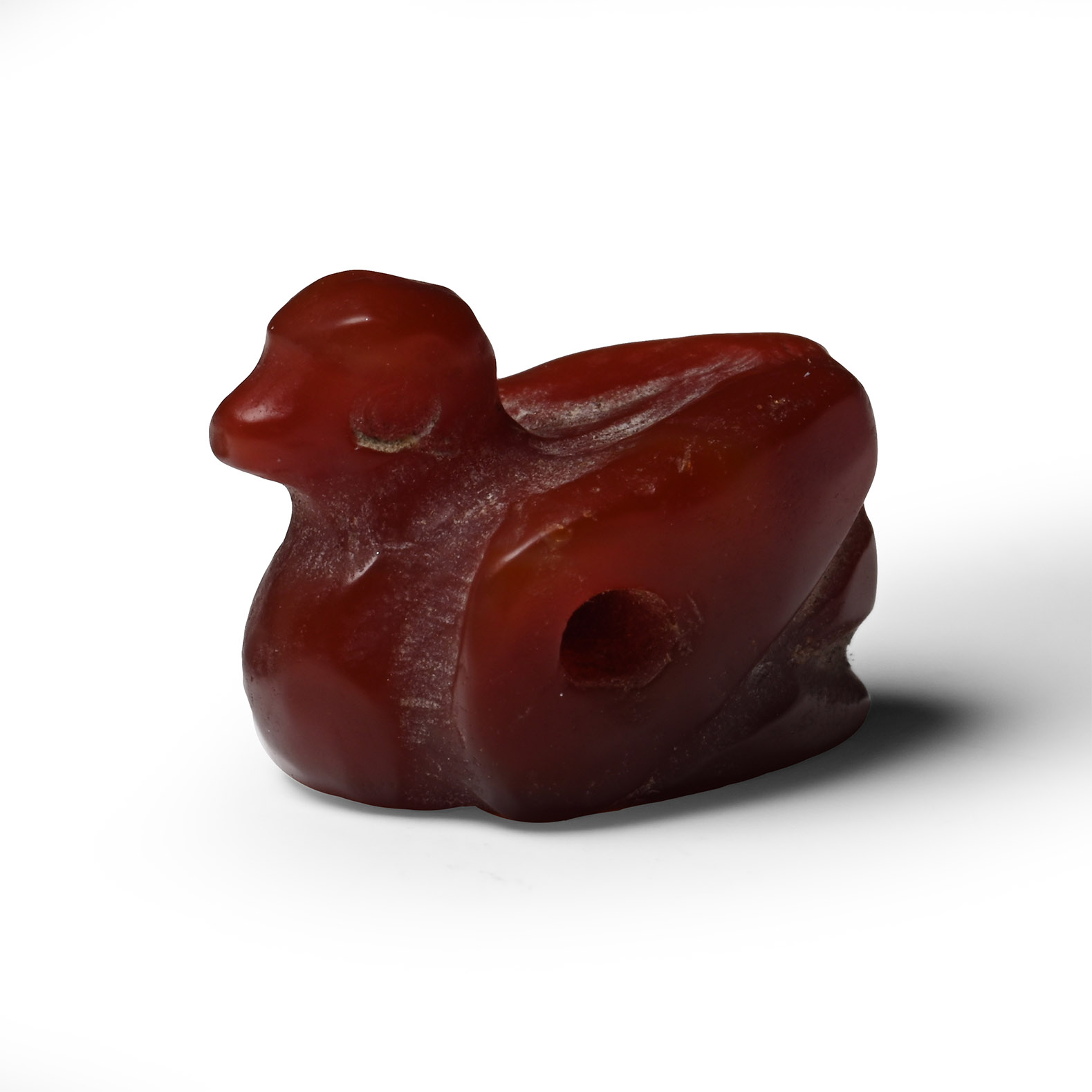
LOT 0500
Egyptian Red Jasper Bird Amulet
LATE PERIOD, 664-332 B.C.
1/2 in. (1.35 grams, 13 mm).
The seated figure of a duck(?), its small carefully rendered head with internally detailed eyes; a transverse suspension hole through its folded wings. [No Reserve]
ProvenanceFrom the collection of a gentleman, acquired on the London art market in the 1990s.
LiteratureCf. Andrews, C., Amulets of Ancient Egypt, London, 1994, p.61, pl.60b, for a duck amulet, considered to represent a food offering or a symbol of resurrection.
CONDITIONTimeLine Auctions follows a vetting process to ensure the authenticity and legality of all items, reinforcing our commitment to integrity and responsible trading. Each antiquity, antique, and coin lot undergoes thorough examination by a vetting committee of at least ten external specialists, professional trade association members, scientists, and archaeologists: Our Vetting Process
AUCTIONS:
TimeLine is a leading auction house specialising in antiquities, ancient art, collectables, natural history, coins, medals, and books. Our auctions offer museums, collectors, historians, and enthusiasts the opportunity to acquire unique and historically significant pieces.
-
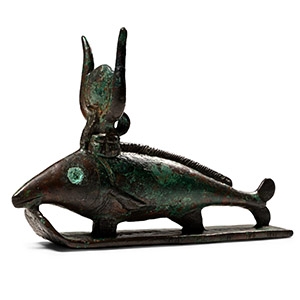
Large Egyptian Bronze Oxyrhynchus Fish of Per-Medjed
Late Period-Ptolemaic Period, 664-30 B.C.Estimate: £6,000 - 8,000 (‡+bp*)
Opening Bid: £3,000
Modelled in the round on a sledge attached by ventral and pectoral fins, forked tail, dorsal ridge, tapering nose; recessed circular eyes with enamel fill; horned sun disc headdress fronted by a uraeus and a suspension loop behind. 585 grams, 17 cm
Acquired from Gallery Reiner, Paris, 1981. Private collection, Europe. Accompanied by a copy of French passport no.150583 dated 29 November 2013. This lot has been checked against the Interpol Database of stolen works of art and is accompanied by a search certificate number no.12375-226676.
The Medjed, a type of elephant-snout fish (Mormyrus kannume), was revered in ancient Egyptian religion, particularly in Per-Medjed, better known by its Greek name, Oxyrhynchus Polis. This version of the name, meaning "city of the sharp-nosed," reflects the fish's distinctive appearance as depicted in Egyptian art. These fish were believed to have consumed the penis of Osiris, the god who was dismembered and scattered by his brother Seth. As sacred creatures, figurines of the Medjed were often adorned with a horned sun-disc headdress worn by the goddesses Hathor and Isis, suggesting a close association with both. Some figurines, like this example, featured suspension loops, allowing them to be worn as pendant amulets. -
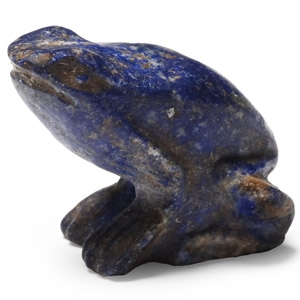
Egyptian Lapis Lazuli Frog Amulet
Late Period, 664-332 B.C.Sold for (Inc. bp): £260
Naturalistically rendered figure of a seated frog with longitudinal suspension hole through feet. 2.6 grams, 19 mm
From the collection of a gentleman, acquired on the London art market in the 1990s. -
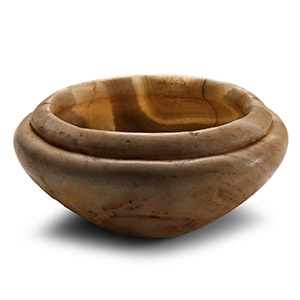
Egyptian Alabaster Bowl
1st Dynasty, circa 3000 B.C.Estimate: £1,500 - 2,000 (‡+bp*)
Opening Bid: £750
Of conical profile with flattened base, carinated shoulder and stepped rounded rim, possibly for accepting a lid. 380 grams, 11.6 cm wide
Property from an American deceased estate, acquired between 19770-1989. with Bonhams, London, 28 October 2009, no.16 (Part). Private European collection. Accompanied by copies of the relevant Bonhams catalogue pages. This lot has been checked against the Interpol Database of stolen works of art and is accompanied by a search certificate number no.12071-215259.
