
Loading, please wait...
LOT 0026
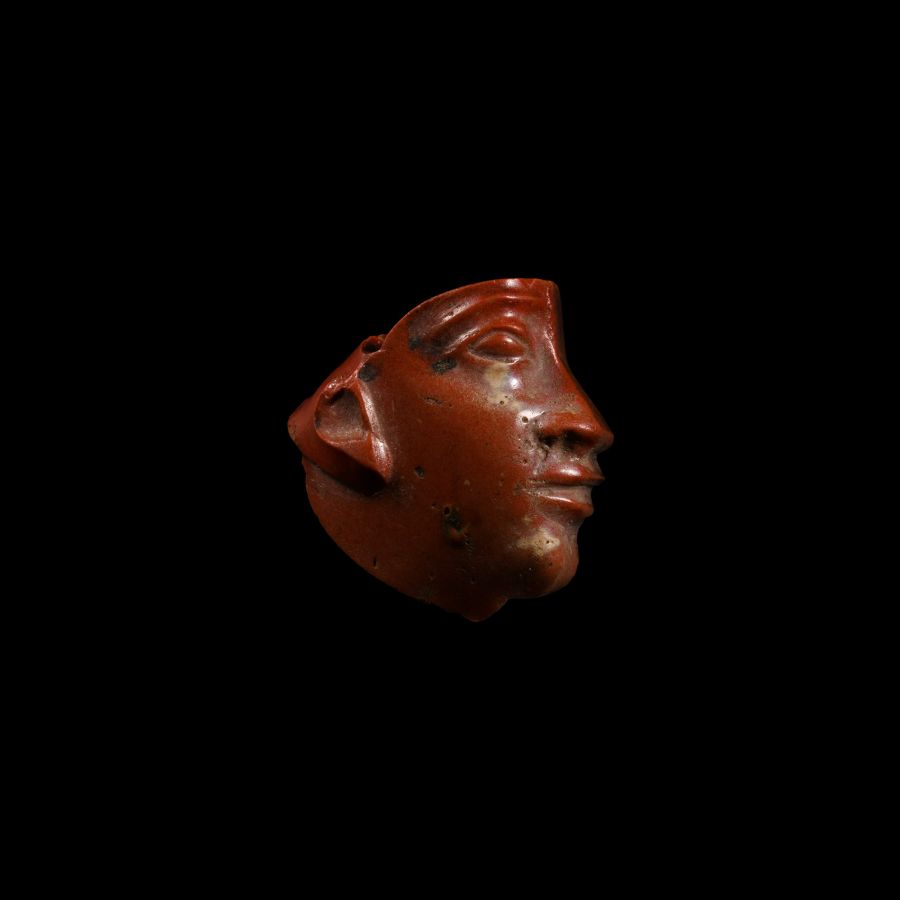
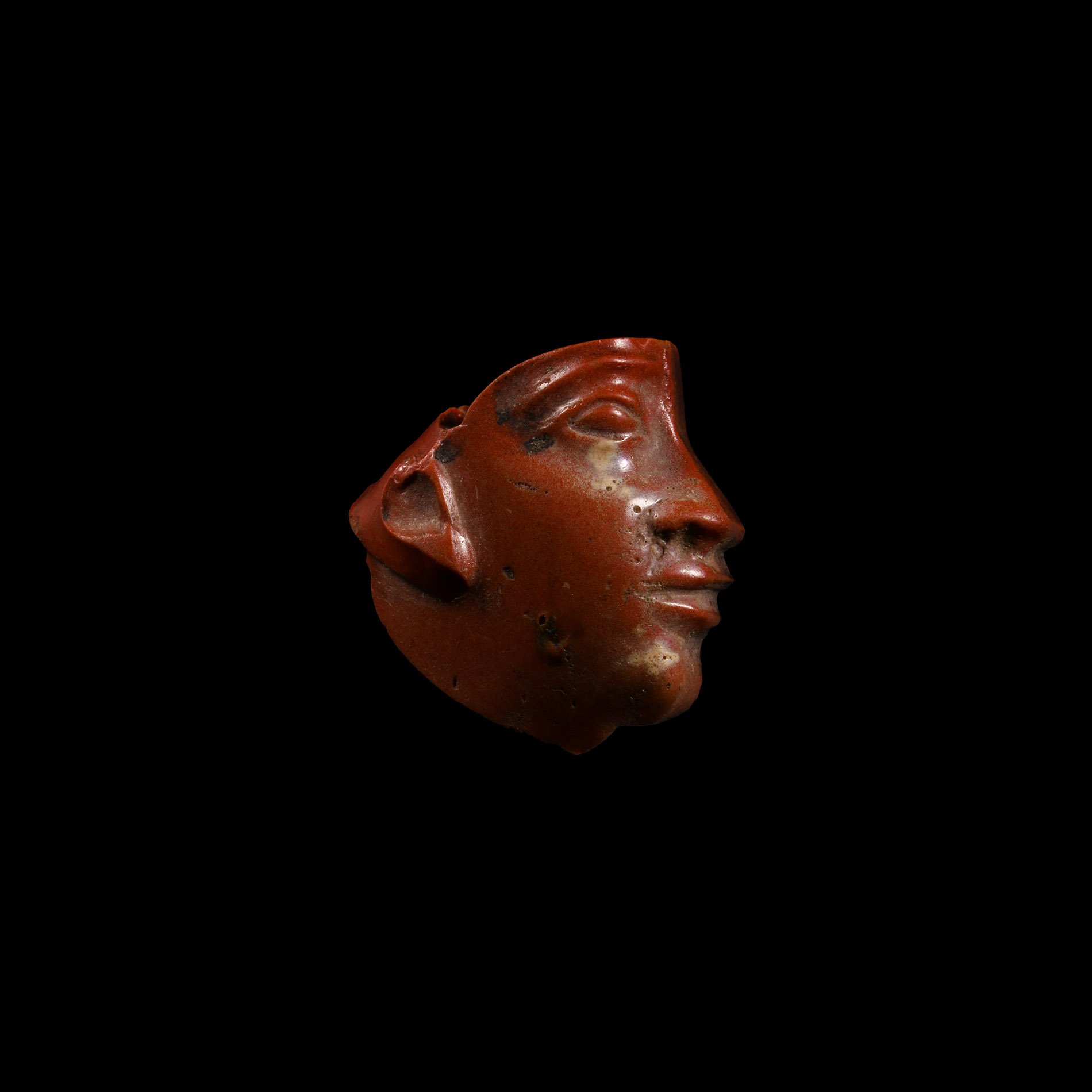
Egyptian Red Glass Face Inlay
PTOLEMAIC PERIOD, CIRCA 332-32 B.C.
1 1/4 in. (16.7 grams, 31 mm wide).
A red glass insert of a profile face with remains of a pharaonic crown to the forehead.
ProvenanceEx Joseph Altounian (1889-1954), Paris and Macon, thence by decent.
with Christie's, London, 3 July 2018, lot 29.
English private collection.
This lot has been checked against the Interpol Database of stolen works of art and is accompanied by search certificate no.11603-199738.
Cf. The Metropolitan Museum, New York, accession number 66.99.186, for a profile glass inlay of this date; cf. Riefstahl, E., Ancient Egyptian Glass and Glazes In The Brooklyn Museum, New York, 1968, p.77 no. 76, pl. XI for a similar face belonging to a royal figure inlay with separately fashioned crown, collar, and torso.
FootnotesJoseph Altounian opened his shop in 1906 in Paris and then relocated to Mâcon in 1924 when he was joined by his wife Henriette Lorbet. They specialised in Egyptian and Greek art, medieval sculpture and decorative arts, selling to major museums both in Europe and in the United States. At his death in 1954 the business was taken over by his daughter, Jacqueline Altounian-Lorbet, and her husband Bernard Rousset, who then specialised in antique furniture.
CONDITIONTimeLine Auctions follows a vetting process to ensure the authenticity and legality of all items, reinforcing our commitment to integrity and responsible trading. Each antiquity, antique, and coin lot undergoes thorough examination by a vetting committee of at least ten external specialists, professional trade association members, scientists, and archaeologists: Our Vetting Process
AUCTIONS:
TimeLine is a leading auction house specialising in antiquities, ancient art, collectables, natural history, coins, medals, and books. Our auctions offer museums, collectors, historians, and enthusiasts the opportunity to acquire unique and historically significant pieces.
-
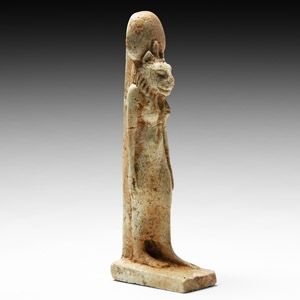
Egyptian Faience Figure of Sekhmet
Late New Kingdom, 1350-1070 B.C.Sold for (Inc. bp): £975
A glazed composition figure of the goddess Sekhmet advancing with feline head and sun-disc headdress; dorsal pillar and rectangular base; repaired. 19.8 grams, 86 mm high
Acquired early 1990s. Ex private American collection; thence by descent. Private Swiss collection since 1998. -
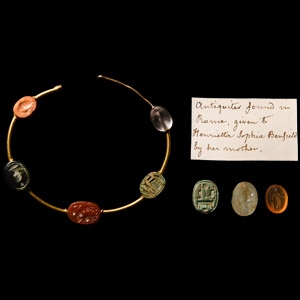
Egyptian and Later Scarab and Intaglio Collection
Late Period, 664-332 B.C.Sold for (Inc. bp): £1,950
A mixed group of scarabs and intaglios comprising: carnelian plaque with helmetted warrior holding shield with right hand and winged Nike on his left; green glazed composition scarab with enigmatic hieroglyphs on base; onyx scarab with an armed running warrior on base, cut in Rome; a later gold bracelet with an Etruscan scarab; one wedjat eye scaraboid; an Etruscan scarab with a centaur; one stone scarab with seated Ra-Horakhty above nb reading 'lord Ra Horakhty'; one pink stone scarab with bird. 4.13 grams total, 12-15 mm
Supplied with small a handwritten note: 'Antiquities found in Rome, given to Henrietta Sophia Benfield by her mother'. Henrietta Sophia Benfield (1796-1857) was the daughter of Paul Benfield and his wife, Mary Frances, daughter of Henry Swinburne (1743-1803). Property of the Berkeley collection. With Sotheby's, London, 11 December 2019, lot 182. English private collection. -
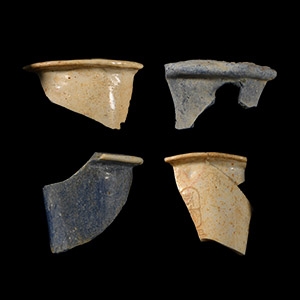
Egyptian Glass Offering Cup Fragment Group with Cartouche
New Kingdom, 18th Dynasty, 1386-1349 B.C.Sold for (Inc. bp): £78
A group of fragments of blue and white glass offering cups; one with a partial cartouche of Amenhotep III. 14 grams total, 30-34 mm
From a UK private collection, 1975-1978.
