
Loading, please wait...
LOT 0024
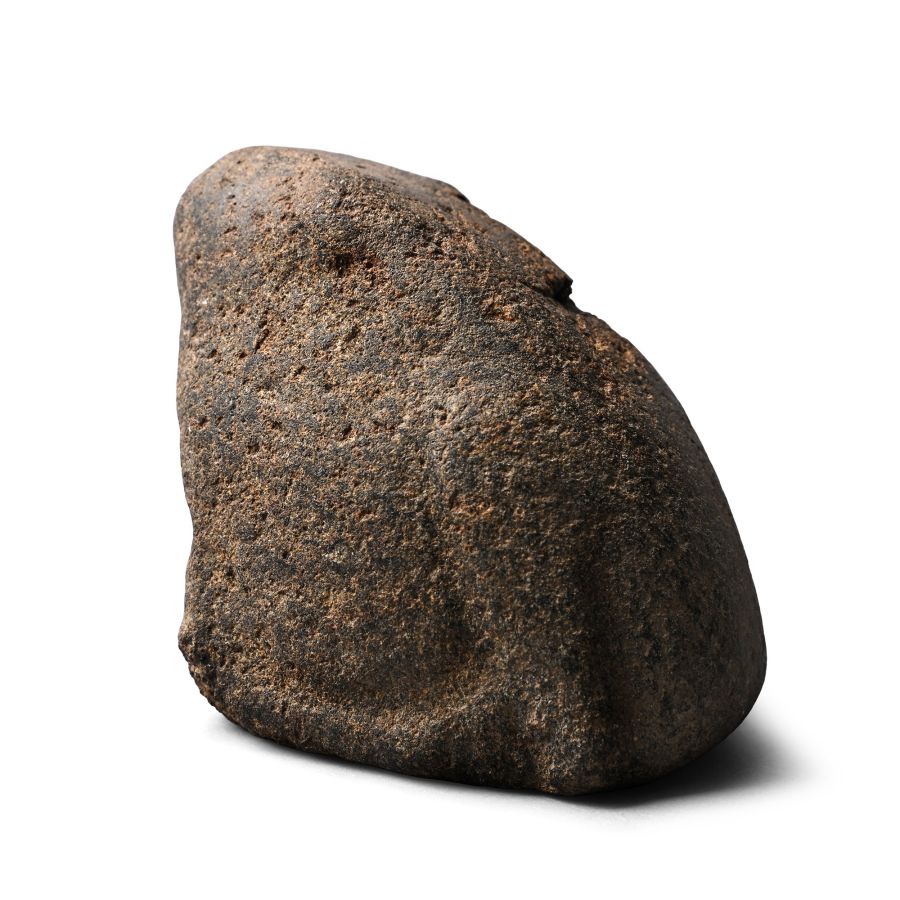
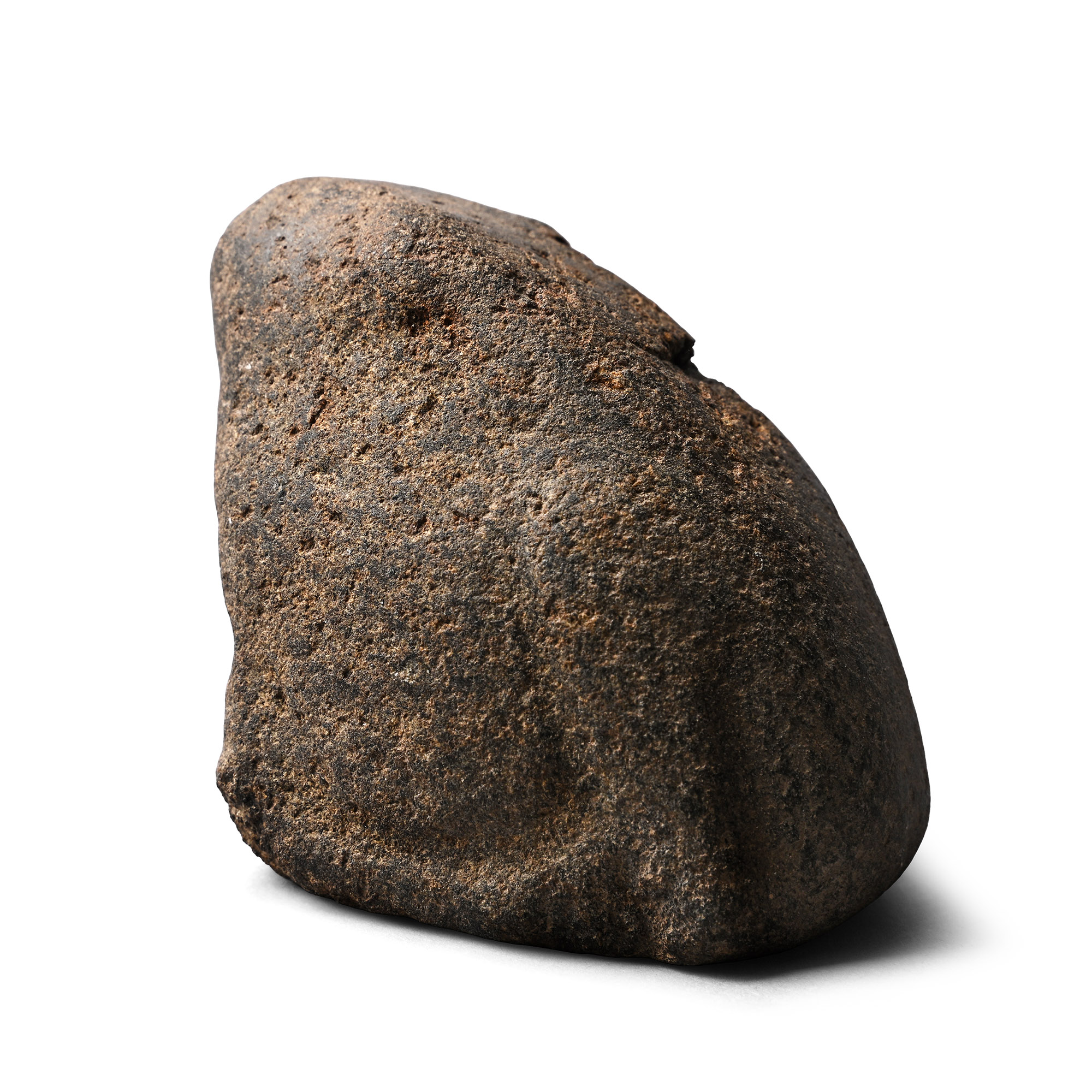
Egyptian Predynastic Stone Frog
4TH MILLENNIUM B.C.
3 1/8 in. (537 grams, 81 mm).
Pyramidal in form with shallow-carved hip and facial detailing.
Provenancewith Artemis Gallery, Munich, Germany, 2001.
Private collection, Europe.
This lot has been checked against the Interpol Database of stolen works of art and is accompanied by a search certificate number no.12580-232124.
Cf. Teeter, E. (ed.), Before the Pyramids, The origins of Egyptian Civilization, Chicago, 2011, fig.65, p.211, for a similar stone frog.
FootnotesThe frog had a great role in ancient Egyptian mythology and was connected with the mythology of creation. A number of gods and goddesses were connected with the frog such as Heqet, Ptah, and Heh. The connection with the god Ptah as a god of creation was probably due to the idea that Ptah was the only god who created the world in ancient Egypt through his heart and his tongue. Every work of the god came about through what his heart devised and his tongue commanded. Frogs were often associated with Hekat, deity of birth and fecundity. Amulets of frogs were frequent votive gifts at such Predynastic and Archaic sites at Abydos, Naqada, and Saqqara.
CONDITIONTimeLine Auctions follows a vetting process to ensure the authenticity and legality of all items, reinforcing our commitment to integrity and responsible trading. Each antiquity, antique, and coin lot undergoes thorough examination by a vetting committee of at least ten external specialists, professional trade association members, scientists, and archaeologists: Our Vetting Process
AUCTIONS:
TimeLine is a leading auction house specialising in antiquities, ancient art, collectables, natural history, coins, medals, and books. Our auctions offer museums, collectors, historians, and enthusiasts the opportunity to acquire unique and historically significant pieces.
-
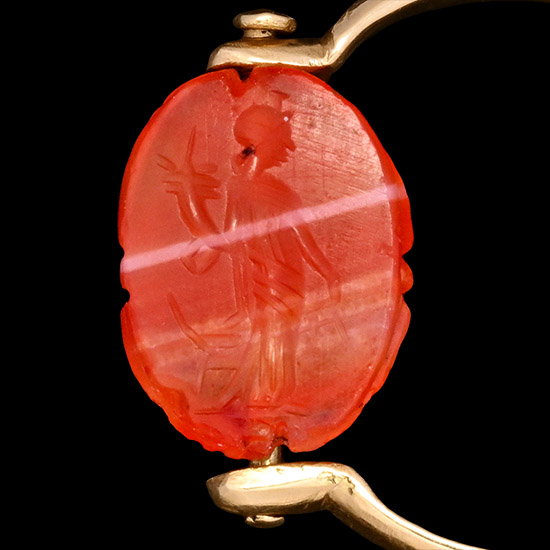
Romano-Egyptian Agate Scarab Engraved with the Goddess Fortuna Mounted in a Gold Ring
1st century B.C.-1st century A.D.Sold for (Inc. bp): £1,170
Scarab with incuse image to the underside of Fortuna with cornucopia and ship's rudder; in later gold swivel ring. 4.34 grams, 22.63 mm overall, 19.34 mm internal diameter (approximate size British N, USA 6 1/2, Europe 13.72, Japan 13)
Private collection, Europe. Acquired on the English art market. -
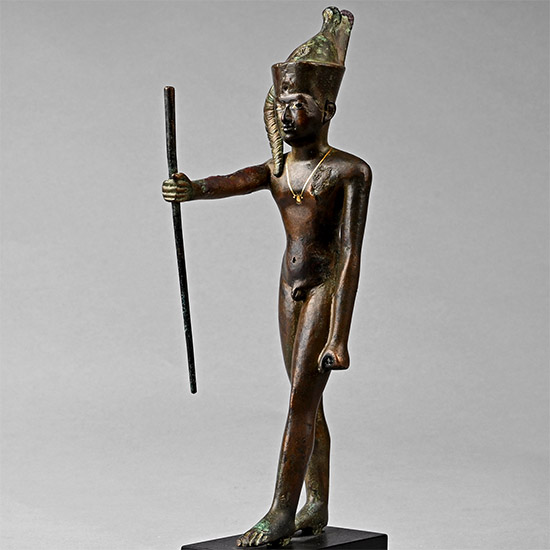
Large Egyptian Bronze Statue of the God Ihy with Gold Necklace and Silver Inlaid Eyes
Late Period, 664-332 B.C.Sold for (Inc. bp): £20,800
Depicted nude in an advancing pose; silver inlaid eyes, braided sidelock of youth; left hand by his side, drilled to accept a separate element, the other outstretched at a right angle to his body, holding a tapering cylindrical staff, not belonging; he may originally have held a sistrum, an ancient Egyptian percussion instrument, or a menat, both closely associated with the goddess Hathor; here, Ihy wears the Pschent crown with remains of uraeus, and an inlaid gold necklace suspended with an ib pendant around his neck; finely detailed facial features, with engraved Nekhbet vulture with outspread wings at the back of the crown; integral lugs on soles of feet; mounted on a custom-made stand. 899 grams total, 25 cm including stand
From the Singer family collection, Germany, acquired circa 1962. with A.A.L., Geneva, 1980. with Christie's, London, 25 April 2015, no.163 [£50,000-£70,000]. Private collection, London, UK. Accompanied by copies of the relevant Christie's catalogue pages. This lot has been checked against the Interpol Database of stolen works of art and is accompanied by search certificate number no.13309-258229.
Ihy was an Egyptian god associated with music, joy, and ritual celebrations, particularly as the divine child of Hathor and of Horus or Ra. He is typically depicted as a youthful figure, often naked or lightly clothed, wearing a sidelock of youth and carrying a sistrum or menat, both percussion instruments closely connected with ritual performances in Hathor's cult, especially at the temples of Dendera and Edfu. His name is generally understood to mean 'the musician' or 'the one who plays music,' although it may also mean 'calf', a reference to his relationship with the cow-goddess Hathor. Bronze statuettes of Ihy, such as this example, were probably produced as votive offerings dedicated in temples, especially those devoted to Hathor. Worshippers may have commissioned such figures in the hope of obtaining divine favour, protection, fertility, healing, or participation in the blessings linked with music and festivity. Some examples may also have served as cult images used in temple ceremonies or as protective objects placed in domestic or funerary settings. -
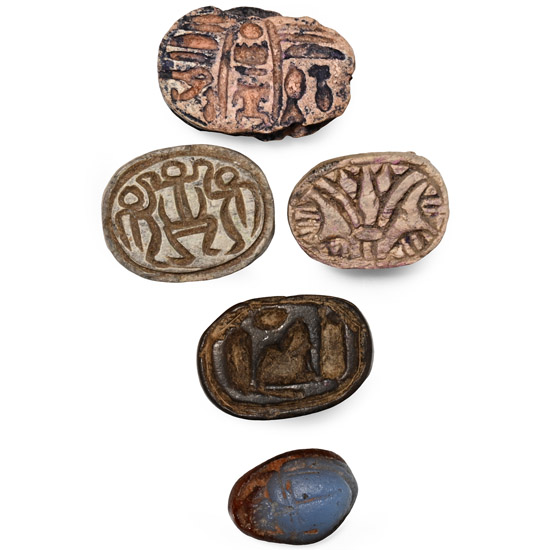
Egyptian Stone and Faience Scarab Group
2nd-1st millennium B.C.Sold for (Inc. bp): £338
Comprising: a blue glazed scarab with the cartouche of Thutmosis III (Men-kheper-Ra) on the underside flanked by other signs; a scarab with three schematic human figures; a scarab with an open lotus flower; another with motifs on the underside; and a blue and black glass scarab with a plain underside. 6.02 grams total, 10-16 mm
From the private collection of a European gentleman (1942-2024), formed since the 1970s.
