
Loading, please wait...
LOT 0460
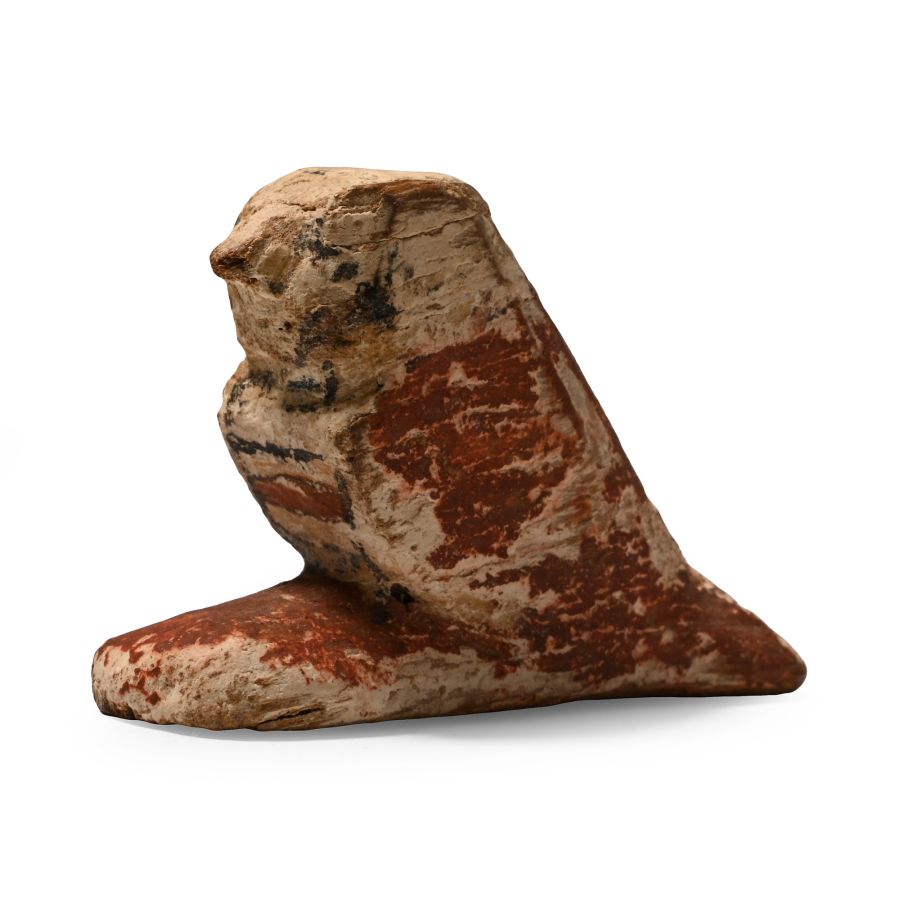
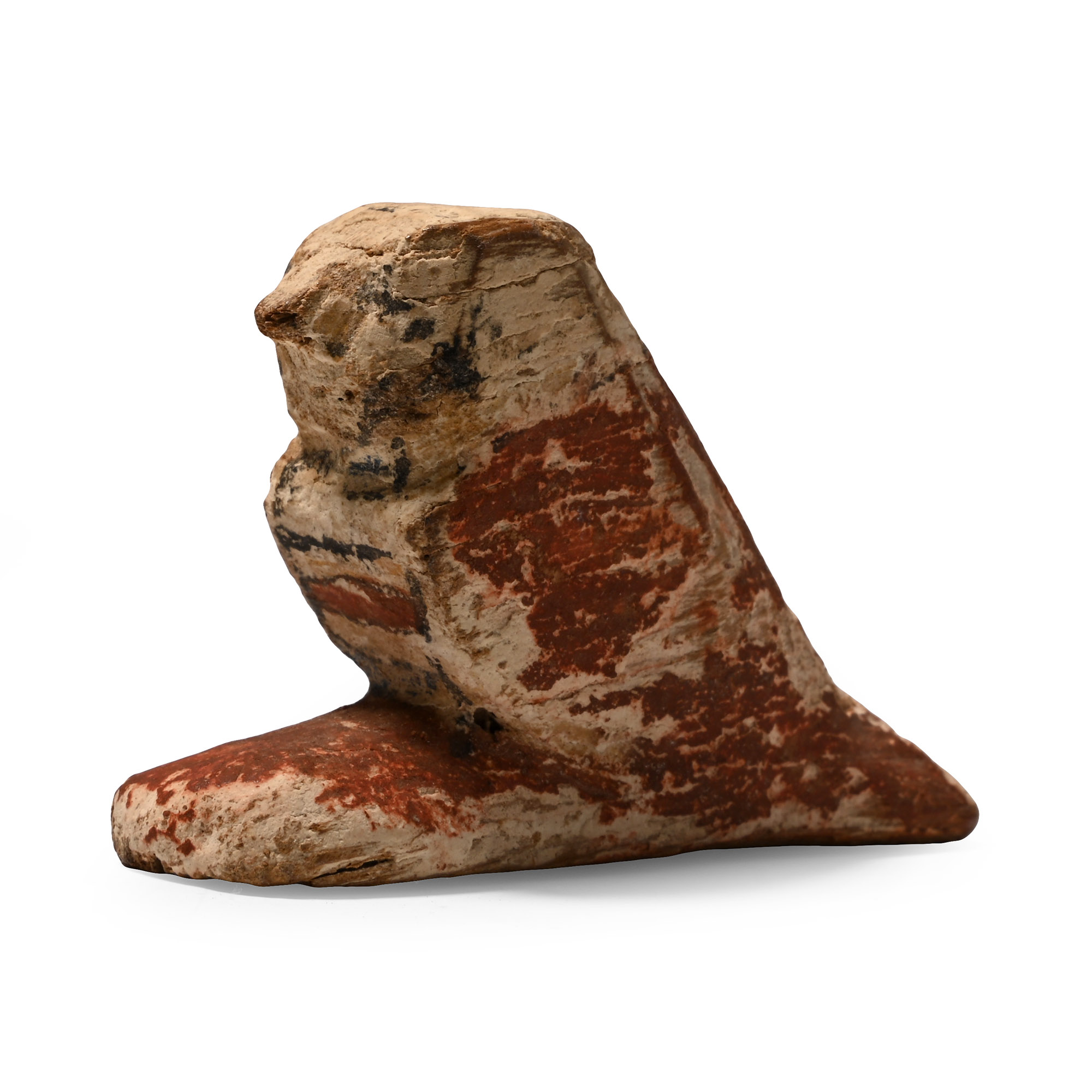
Egyptian Polychrome Wooden Sokar Falcon
LATE PERIOD, 664-332 B.C.
2 3/4 in. (16 grams, 71 mm).
Statuette depicting the couchant falcon god Sokar with wings folded along the sides of the body; chest, wings, and legs with painted details; inked legend on the underside reading 'Ex George Wathen / 1893 / 12'. [No Reserve]
ProvenanceEx George Henry Wathen collection from 1843, who wrote and illustrated the important work 'The Arts, Antiquity and Chronology of Ancient Egypt'.
From the collection of David Donlan (1947–2025), a dedicated and lifelong collector with a passion for the ancient world and the natural sciences, forming his collection from 1960s onwards, using many reputable dealers across the United Kingdom, including the well-regarded Coincraft and The Parthenon Gallery.
Cf. Aston, D., “Canopic Chests from the Twenty–First to the Ptolemaic Period,” Ägypten und Levante 10, 2000, pp.159-178, for numerous examples of falcon-topped canopic boxes.
FootnotesWooden images of the raptor-form god Sokar typically decorated the tops of rectangular wooden coffins and canopic chests, which held jars containing the deceased’s mummified organs. Sokar was a protective god of the Memphite necropolis and was often merged with the funerary god Osiris and Ptah, the creator deity of Memphis.
George Henry Wathen, FGS (21 November 1816 – 10 November 1879) was a geologist, author, magazine publisher, and South African politician of the Victorian era known primarily for his books on the antiquities of Egypt and the gold fields of Victoria, Australia.
TimeLine Auctions follows a vetting process to ensure the authenticity and legality of all items, reinforcing our commitment to integrity and responsible trading. Each antiquity, antique, and coin lot undergoes thorough examination by a vetting committee of at least ten external specialists, professional trade association members, scientists, and archaeologists: Our Vetting Process
AUCTIONS:
TimeLine is a leading auction house specialising in antiquities, ancient art, collectables, natural history, coins, medals, and books. Our auctions offer museums, collectors, historians, and enthusiasts the opportunity to acquire unique and historically significant pieces.
-
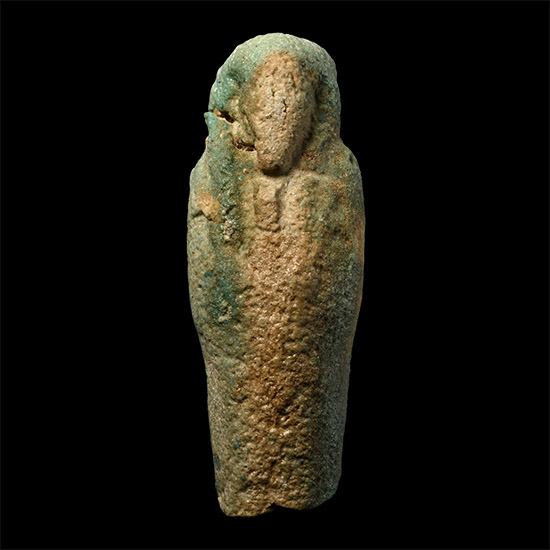
Egyptian Faience Shabti
Late Period, 664-332 B.C.Sold for (Inc. bp): £59
Plano-convex in section with moulded piriform face and wig, tools in the crossed hands, accompanied by an old handwritten note 'faience. Ceramic composed of crushed quartz or quartz sand with small amounts of lime and plant ash or naron. Coated with a bright blue or green glaze or soda[...]' and to verso 'Late period 700-400 BC Ex Margaret Seton-Jones from Flinders Petrie'. 10.5 grams, 49 mm
Ex Margaret Seton-Jones from Flinders Petrie. From the private collection of a Canadian gentleman living in Essex, UK, formed since the 1920s-circa 1990. Property of an Essex lady until the late 1990s; thence by descent. From the private collection of an Essex gentleman since the late 1990s. Accompanied by a handwritten slip with description and provenance. -
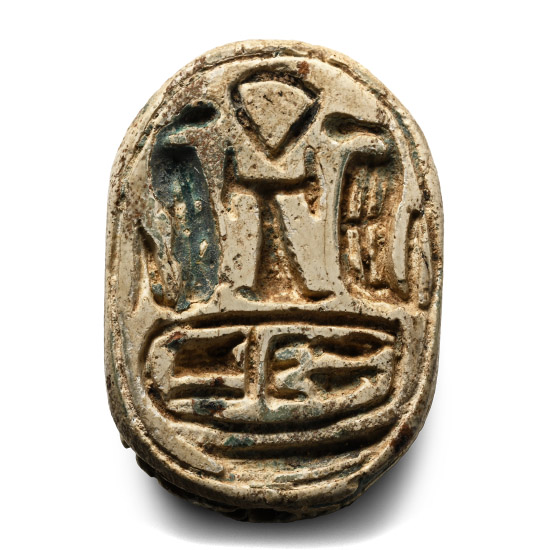
Egyptian Steatite Scarab with Cartouche
Late Period, 664-332 B.C.Sold for (Inc. bp): £117
With detailing to the carapace, mouth and legs, underside with cartouche, ankh and other symbols. 2.98 grams, 18 mm
From the private collection of a European gentleman (1942-2024), formed since the 1970s. -
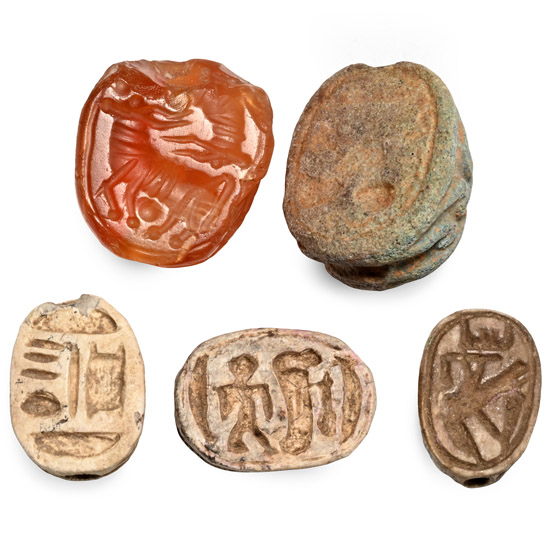
Egyptian Stone Scarab Group
Late Period-Ptolemaic Period, 664-30 B.C. and laterSold for (Inc. bp): £287
Comprising five scarabs with anatomical detailing: one carnelian with two antelopes tête-bêche; one with worn hieroglyphs on the underside; one with two neb signs flanking others; one with two neb signs flanking a standing human figure, uraeus and nefer; and one with the Horus falcon above the sign for gold (nbw). 7.5 grams total, 12-16 mm
From the private collection of a European gentleman (1942-2024), formed since the 1970s.
The falcon on the sign of gold, meaning 'Golden Horus (or falcon)', is found in the titles of Egyptian kings and was therefore considered a potent symbolic motif on scarabs.
