
Loading, please wait...


LOT 0451
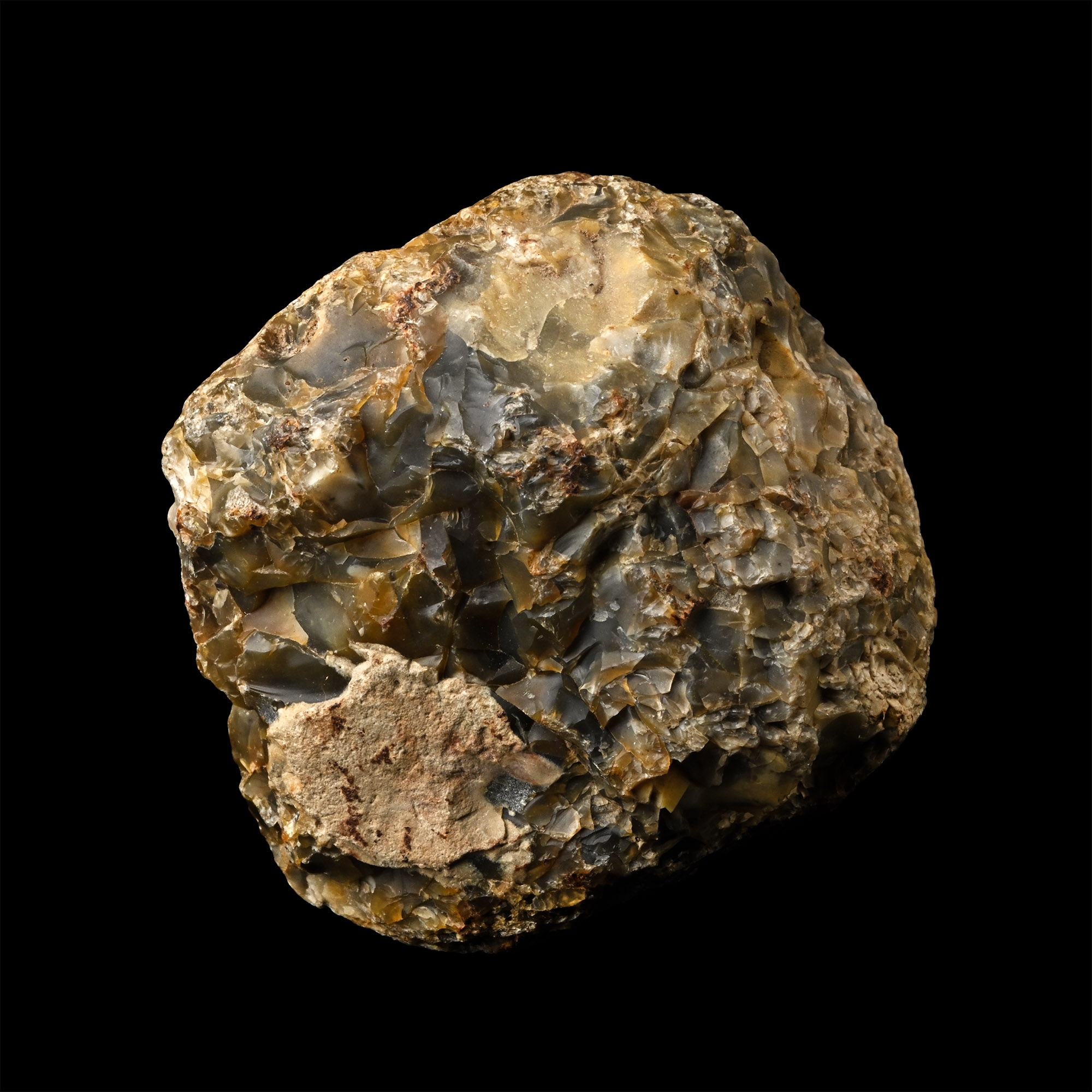
Egyptian Pecked Flint Hammerstone
PREDYNASTIC-EARLY DYNASTIC PERIOD, CIRCA 5,000-3,000 B.C.
1 7/8 in. (140 grams, 48 mm).
Fashioned from a dense flint nodule, retaining part of its original rough cortex. [No Reserve]
ProvenanceFrom the collection of A.D. Passmore (1879-1958), his collection of flints from the area of Stonehenge was donated to the Ashmolean Museum in the 1950s.
From the private collection of Peter Clayton, FCILIP, Dip, Arch, FSA, FRNS, Hemel Hempstead, Hertfordshire, UK; formed since the late 1950s.
Accompanied by a copy of an old handwritten information card by Peter Clayton.
TimeLine Auctions follows a vetting process to ensure the authenticity and legality of all items, reinforcing our commitment to integrity and responsible trading. Each antiquity, antique, and coin lot undergoes thorough examination by a vetting committee of at least ten external specialists, professional trade association members, scientists, and archaeologists: Our Vetting Process
AUCTIONS:
TimeLine is a leading auction house specialising in antiquities, ancient art, collectables, natural history, coins, medals, and books. Our auctions offer museums, collectors, historians, and enthusiasts the opportunity to acquire unique and historically significant pieces.
LOT 0451
Egyptian Pecked Flint Hammerstone
Estimate £30 - 40€35 - 46 (for guidance only)$41 - 54 (for guidance only)
-
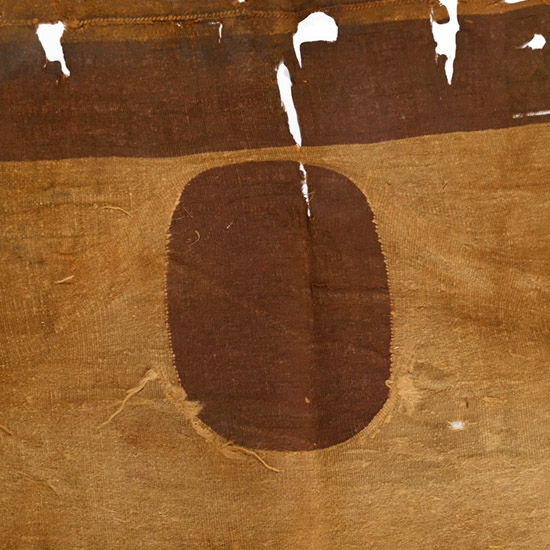
Large Egyptian Coptic Textile Shoulder Fragment of a Man's Military Tunic with Clavus and Orbiculus
Circa 5th-6th century A.D.Estimate: £200 - 300 (+bp*)
Bids: 1 | Current Bid: £5
Large section of a shoulder from a man's tunic in wool on linen, decorated with a long purple clavus featuring geometric squares and a purple orbiculus on the shoulder; tapestry, weave braids with right-angled borders. 233 grams total including paper folder, 82 cm
Acquired 1970s-1996. Property of a North American collector. London collection, 2016.
The tunic was decorated in purple with opus phrygium embroidery. This corresponds to the iconography of military tunics for 5th-7th century Roman soldiers. The archaeological evidence from the desert cemeteries of Egypt offers striking confirmation of pictorial sources on late Roman clothing around the empire. -
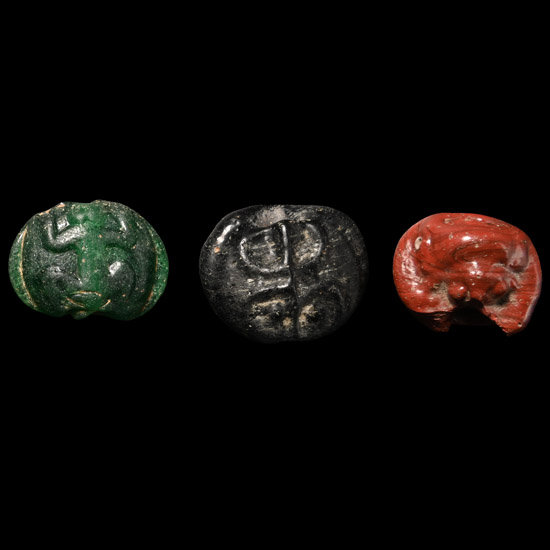
Phoenician Glass Amuletic Bead Group
Mid 1st millennium B.C.Estimate: £60 - 80 (+bp*)
Bids: 1 | Current Bid: £5
Including a grotesque mask, a squatting figure and a scorpion. 5.32 grams total, 14-16 mm
From the private collection of a European gentleman (1942-2024), formed since the 1970s. -
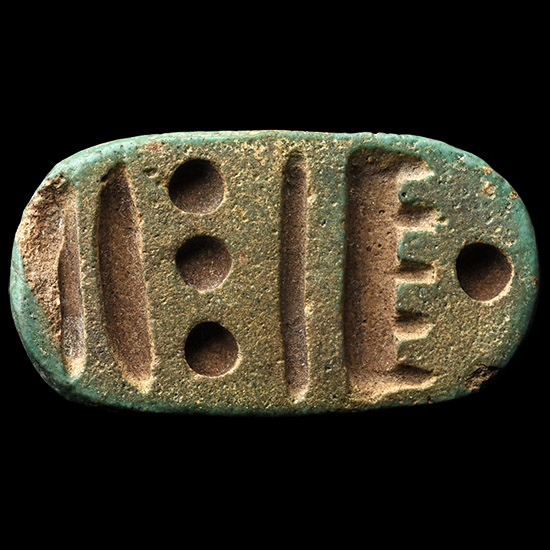
Large Egyptian Amuletic Cartouche-shaped Stamp Naming Amun-Re
Third Intermediate Period-Late Period, circa 1069-332 B.C.Estimate: £300 - 400 (+bp*)
Opening Bid: £150
Large oval stamp with plano-convex profile, plumed motif to the top, pierced for suspension; underside with hieroglyphic legend, possibly a garbled version of (A)mun-Re, lord of the thrones (of the two lands). 13.2 grams, 49 mm
Excavated from Egypt in 1914. From the private collection of Mr David Sams and his wife Elizabeth Kate Sams, gentry and amateur archaeologists who travelled to Egypt in 1914 with their daughter Ethel. Mr Sams and his wife led digging expeditions from which these items come from the family estate of Mr and Mrs Sams, by direct descent to their granddaughter.
