
Loading, please wait...
LOT 0034
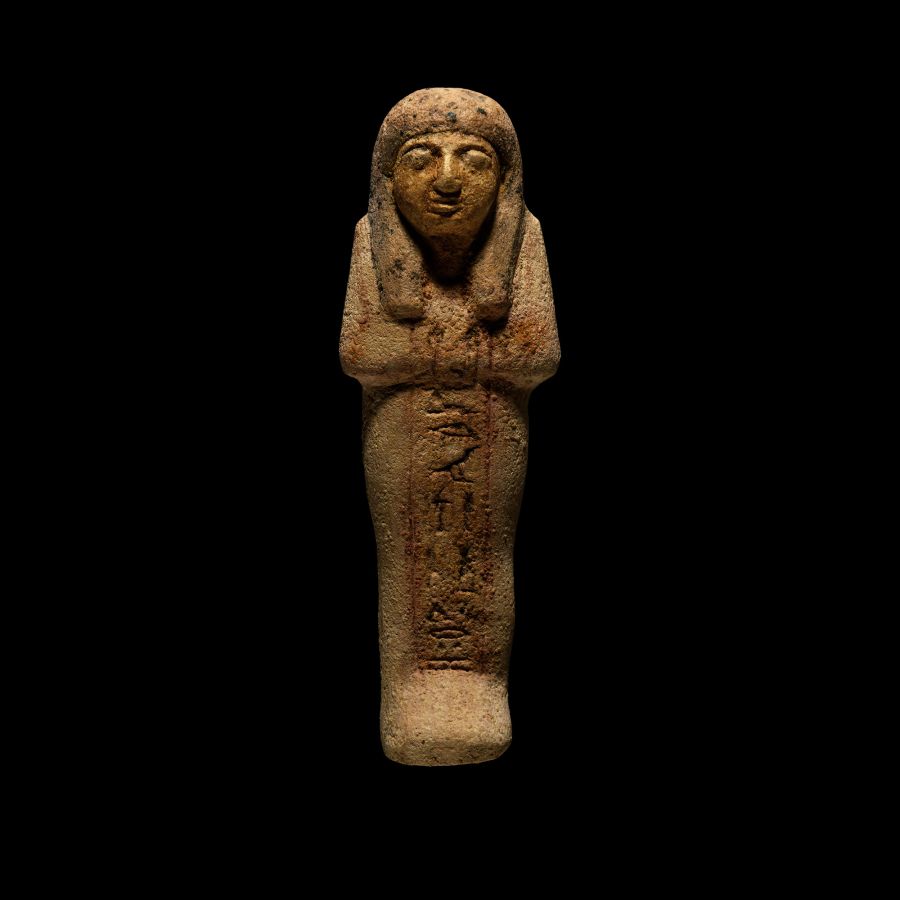
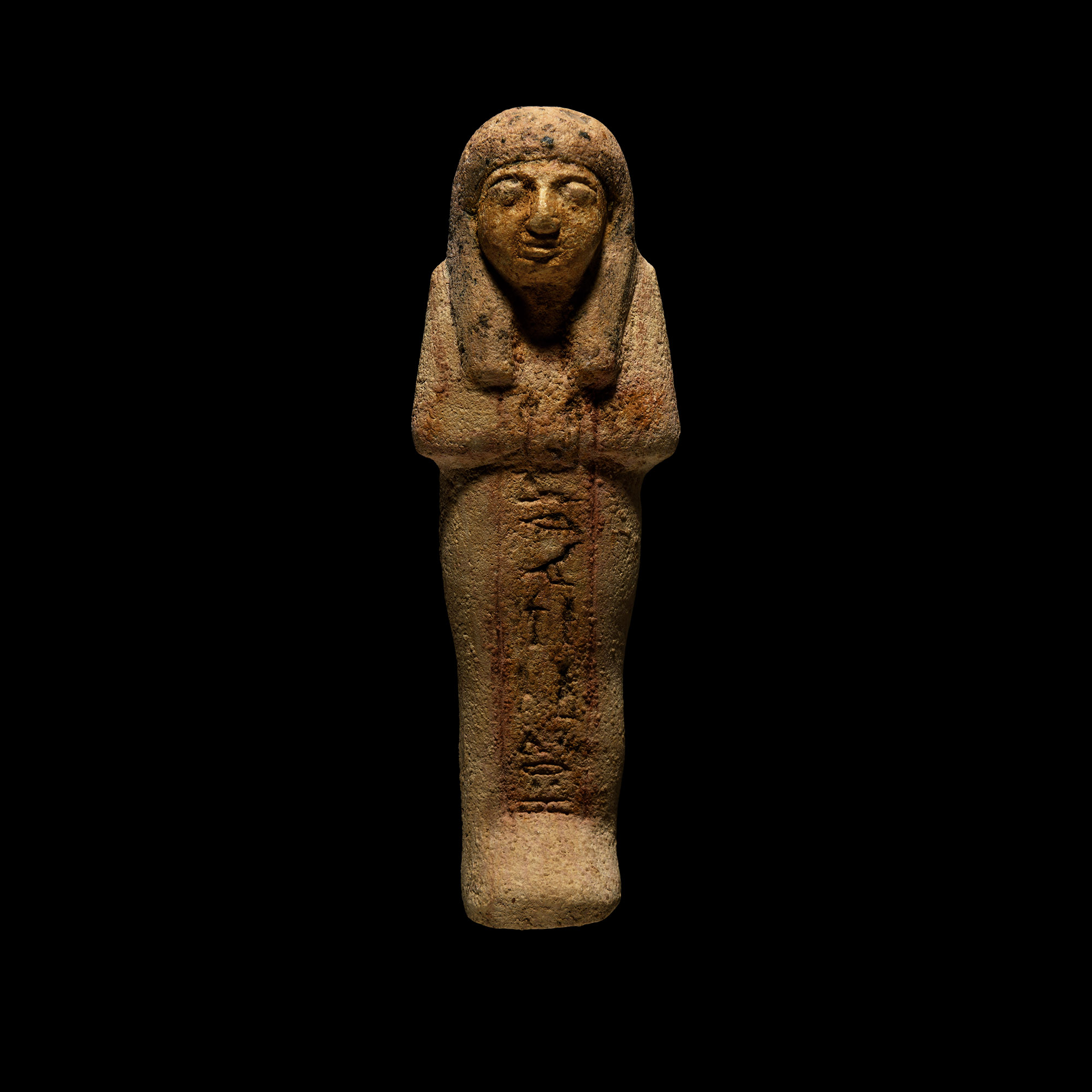
Egyptian Painted Limestone Shabti for Abet-iyiry
LATE NEW KINGDOM, CIRCA 1100 B.C.
5 1/4 in. (162 grams, 13.3 cm).
With remains of pigment to the tripartite wig, face and eyes; vertical band of hieroglyphic inscription in black on the front giving dedication: 'sḥḏ wsir Ꜣbt-iyiry(?) mꜢʾ ḫrw' ‘The illuminated, the Osiris, Abet-iyiry(?), true of voice’; with remains of red borders and red detailing to the back.
ProvenanceAcquired 1970s-1996.
Property of a North American collector.
London collection, 2016.
Cf. similar in the collection of the British Museum under accession no.EA48977.
CONDITIONTimeLine Auctions follows a vetting process to ensure the authenticity and legality of all items, reinforcing our commitment to integrity and responsible trading. Each antiquity, antique, and coin lot undergoes thorough examination by a vetting committee of at least ten external specialists, professional trade association members, scientists, and archaeologists: Our Vetting Process
AUCTIONS:
TimeLine is a leading auction house specialising in antiquities, ancient art, collectables, natural history, coins, medals, and books. Our auctions offer museums, collectors, historians, and enthusiasts the opportunity to acquire unique and historically significant pieces.
LOT 0034
Egyptian Painted Limestone Shabti for Abet-iyiry
Estimate £1,000 - 1,400€1,160 - 1,620 (for guidance only)$1,350 - 1,890 (for guidance only)
-
.jpg)
Egyptian Painted Wooden Mask
Late Period, 664-332 B.C.Estimate: £1,500 - 2,000 (‡+bp*)
Opening Bid: £750
With remains of polychrome painted detailing, depicting a large part of a face with eye detailing and remains of segmented headwear; old collection number 'E.352' and a later suspension loop to the reverse. 283 grams, 23.5 cm high
Ex Roger Liechti collection, Geneva, Switzerland. This lot has been checked against the Interpol Database of stolen works of art and is accompanied by search certificate no.11606-198998. -
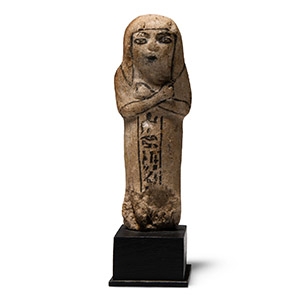
Egyptian Faience Shabti with Hieroglyphic Inscription
Late New Kingdom-Third Intermediate Period, 1186-715 B.C.Estimate: £1,000 - 1,400 (+bp*)
Opening Bid: £500
Pale grey glazed composition shabti with black outlining to the wig, eyes and facial features, arms, seed sack and a vertical panel of hieroglyphic text to the lower body dedicating the shabti to 'The illuminated, the Osiris, The God's Father (a priestly title) Pia[..]'; mounted on a custom-made stand. 249 grams total, 14 cm high including stand
Ex Marc Delorme, Antiquité Archéologie, France. From the private collection of Mr & Mrs Gent of Belgium, acquired June 2009. Accompanied by a handwritten illustrated invoice and two handwritten dealer's tags. -
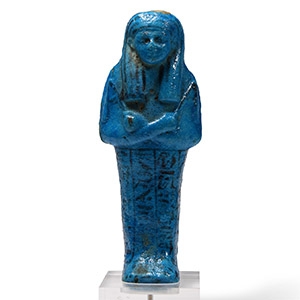
Egyptian Blue Faience Shabti for Nesitanebisheru
Third Intermediate Period, 21st Dynasty, circa 980-935 B.C.Estimate: £25,000 - 35,000 (‡+bp*)
Opening Bid: £12,500
A vibrant blue-glazed mummiform shabti of princess Nesitanebisheru, daughter of Pinudjem II, on a custom-made display stand; modelled with arms crossed over the chest, holding a hoe in each hand, wearing a tripartite wig; netted seed bag painted on the back; the bottom half of the figure bearing eight columns of hieroglyphic text in black giving a version of the shabti spell reading: (1) The illuminated one, the Osiris Nesitanebisheru, she says: (2) ‘O this shabti, if one counts, if one reckons to do (3) for the Osiris Nesitanebisheru, to cultivate the fields, (4) to irrigate the riparian lands, to transport by boat the sand of (5) the east (to) the west and vice-versa – now indeed obstacles are implanted (6) therewith – as a man at his duties (to do for ?) (7) the Osiris Nesitanebisheru, to do all the works that are to be done (8) in God’s land at any time to serve, ‘here I am,’ (you shall say). 314 grams total, 16.5 cm high including stand
The object comes from the well known Deir el-Bahari cache (near Thebes) first discovered in 1870. Ex Zurich Antiquities Fair. Ex R. Liechti, Geneva, acquired from the above. Accompanied by an academic report by Egyptologist Paul Whelan. This lot has been checked against the Interpol Database of stolen works of art and is accompanied by search certificate no.11598-198961.
Nesitanebisheru’s burial was discovered in the famous ‘Royal Cache I’ at Deir el-Bahari (DB 320), with many dozens of coffins and vast quantities of funerary equipment belonging to pharaohs, including Thutmose III and Ramesses II, queens, and other royals, as well as elite members of society that had been reburied by Amun priests to hide them from tomb robbers. Nesitanebisheru’s coffin and burial equipment, including her shabtis, were found at the very end of the c. 70m long tomb in a chamber which served as a family vault for her father, the High Priest of Amun, Pinudjem II, and his principal wife Neskhons. While her worker shabtis are all mostly similar in style with 6-8 text columns, the composition of their inscriptions are not consistent with different openings and variations to the content (often including several peculiarities). Curiously, her titles do not appear in her shabti inscription, unlike those for her mother.
