
Loading, please wait...
_900x900.jpg "Egyptian Orange Carnelian Poppy Head Amulet")
_200x200.jpg "Egyptian Orange Carnelian Poppy Head Amulet")
.jpg "Egyptian Orange Carnelian Poppy Head Amulet")
LOT 0410
Egyptian Orange Carnelian Poppy Head Amulet
NEW KINGDOM, 18TH DYNASTY, 1550-1292 B.C.
3/8 in. (0.3 grams, 12 mm).
Polished and with integral suspension loop. [No Reserve]
ProvenanceEx UK gallery, early 2000s.
This lot is accompanied by an illustrated lot declaration signed by the Head of the Antiquities Department, Dr Raffaele D’Amato.
Cf. Hermann, C., Ägyptische Amulette aus Palästina/Israel: Band III, Fribourg/Göttingen, 2006, pl.CI, no.460, for a similar example.
FootnotesAmulets in the form of poppies were used to heal and alleviate pain and to ward off death. These types of amulets were also linked to Osiris, the Egyptian deity of agriculture, death, and the afterlife.
CONDITIONTimeLine Auctions follows a vetting process to ensure the authenticity and legality of all items, reinforcing our commitment to integrity and responsible trading. Each antiquity, antique, and coin lot undergoes thorough examination by a vetting committee of at least ten external specialists, professional trade association members, scientists, and archaeologists: Our Vetting Process
AUCTIONS:
TimeLine is a leading auction house specialising in antiquities, ancient art, collectables, natural history, coins, medals, and books. Our auctions offer museums, collectors, historians, and enthusiasts the opportunity to acquire unique and historically significant pieces.
-
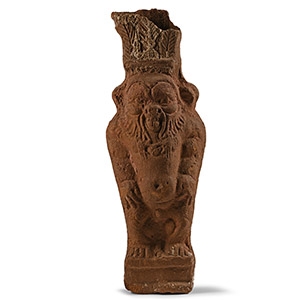
Egyptian Ceramic Statuette of the God Bes Wearing a Feather Crown
Roman Period, 2nd-3rd century A.D.Sold for (Inc. bp): £910
Standing on a pillar and wearing a feather crown and a panther skin cloak, his hands resting on his knees, large protruding ears and grimacing expression. 362 grams, 24 cm
The Erotica Collection Christian von Faber-Castell, Küsnacgt ZH, Switzerland, since the late 1970s. This lot is accompanied by an illustrated lot declaration signed by the Head of the Antiquities Department, Dr Raffaele D’Amato.
Christian von Faber-Castell (born 1950) is a renowned German entrepreneur and art collector, best known as a member of the prominent Faber-Castell family, famed for their iconic writing instruments. A passionate advocate for art and culture, Christian von Faber-Castell curated an extensive and diverse private collection of erotica spanning centuries and cultures. His collection reflects a deep appreciation for the interplay of beauty, sensuality, and artistic expression, bringing together rare and unique works that explore themes of intimacy and human connection. Pieces from this collection have been featured in notable exhibitions and are celebrated for their artistic and historical significance. This offering represents a rare opportunity to acquire works from one of the most fascinating and eclectic private collections of its kind. Bes became one of ancient Egypt's most popular apotropaic deities from the New Kingdom onwards. Despite his somewhat fearful appearance, Bes was the patron and protector of pregnant women and children and was also believed to protect from snakes. -
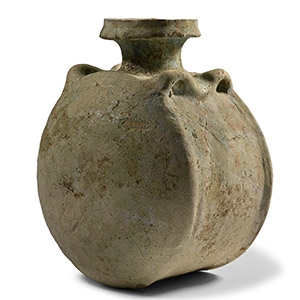
Egyptian Faience Pilgrim's Flask
Late-Ptolemaic Period, 664-30 B.C.Sold for (Inc. bp): £182
With domed faces and grooved edge, a pair of loop handles to each shoulder, slender neck and wide mouth. 825 grams, 17.2 cm
Ex London art market 1990s. From a London, UK, collection. This lot is accompanied by an illustrated lot declaration signed by the Head of the Antiquities Department, Dr Raffaele D’Amato. -
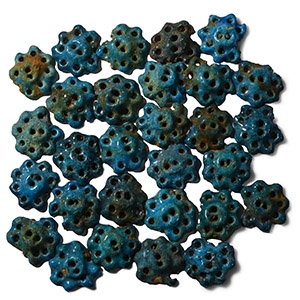
Egyptian Blue Faience Clothing Mounts
Roman Period, 30 B.C.-323 A.D.Estimate: £300 - 400 (+bp*)
Opening Bid: £135
Group of rosette mounts, each plano-convex in profile with two attachment holes to the centre and pierced loops to the rim. 124 grams total, 25-30 mm
UK private collection, formed in the 1980s. This lot is accompanied by an illustrated lot declaration signed by the Head of the Antiquities Department, Dr Raffaele D’Amato.
