
Loading, please wait...
_900x900.jpg "Egyptian Orange Carnelian Poppy Head Amulet")
_200x200.jpg "Egyptian Orange Carnelian Poppy Head Amulet")
.jpg "Egyptian Orange Carnelian Poppy Head Amulet")
LOT 0454
Egyptian Orange Carnelian Poppy Head Amulet
NEW KINGDOM, 18TH DYNASTY, 1550-1292 B.C.
1/2 in. (0.20 grams, 11 mm).
Polished and with integral pierced suspension loop; element from a broad collar. [No Reserve]
ProvenanceEx UK gallery, early 2000s.
This lot is accompanied by an illustrated lot declaration signed by the Head of the Antiquities Department, Dr Raffaele D’Amato.
Cf. The Metropolitan Museum, New York, accession number 40.9.26, for similar; Andrews, C., Amulets of Ancient Egypt, London, 1994, pl.65 (n); Vilímková, M., Egyptian Jewellery, London-New York-Sydney-Toronto, 1969, no. 68, for an elaborate necklace composed of gold and carnelian poppy-head beads.
FootnotesAmulets in the form of poppies were used to heal and alleviate pain and to ward off death. These types of amulets were also linked to Osiris, the Egyptian deity of agriculture, death, and the afterlife.
CONDITIONTimeLine Auctions follows a vetting process to ensure the authenticity and legality of all items, reinforcing our commitment to integrity and responsible trading. Each antiquity, antique, and coin lot undergoes thorough examination by a vetting committee of at least ten external specialists, professional trade association members, scientists, and archaeologists: Our Vetting Process
AUCTIONS:
TimeLine is a leading auction house specialising in antiquities, ancient art, collectables, natural history, coins, medals, and books. Our auctions offer museums, collectors, historians, and enthusiasts the opportunity to acquire unique and historically significant pieces.
-
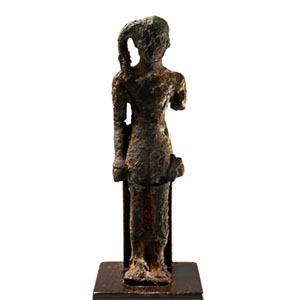
Egyptian Bronze Figurine of Harpocrates
Late Period, 664-332 B.C.Estimate: £200 - 300 (‡+bp*)
Opening Bid: £90
Modelled in the round depicted in a seated pose with bold sidelock reaching to the shoulder; kilt to the thighs, D-shaped base beneath the feet, socket to the middle of the back; provided with a custom-made display stand. 146 grams, 12.2 cm (202 grams total, 13.7 cm including stand)
with Max Hagemann, prior 1964. This lot is accompanied by an illustrated lot declaration signed by the Head of the Antiquities Department, Dr Raffaele D’Amato.
Harpocrates is the Greek rendering of the Egyptian Hor-pa-khered, which translates as 'Horus the Child', referring to Horus as the divine infant of Isis and Osiris. -
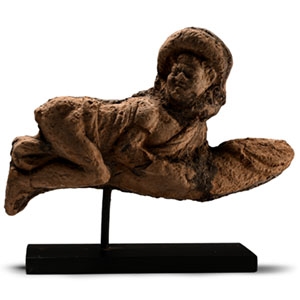
Romano-Egyptian Terracotta Figurine of a Slave with Enormous Phallus
3rd century B.C.-3rd century A.D.Sold for (Inc. bp): £260
Modelled in the round hollow-formed figure of a crouching male gripping his exaggerated phallus and looking over his right shoulder; mounted on a custom-made stand. 284 grams total, 11.6 cm wide including stand
The Erotica Collection Christian von Faber-Castell, Küsnacgt ZH, Switzerland, since the late 1970s. This lot is accompanied by an illustrated lot declaration signed by the Head of the Antiquities Department, Dr Raffaele D’Amato.
Christian von Faber-Castell (born 1950) is a renowned German entrepreneur and art collector, best known as a member of the prominent Faber-Castell family, famed for their iconic writing instruments. A passionate advocate for art and culture, Christian von Faber-Castell curated an extensive and diverse private collection of erotica, spanning centuries and cultures. His collection reflects a deep appreciation for the interplay of beauty, sensuality, and artistic expression, bringing together rare and unique works that explore themes of intimacy and human connection. Pieces from this collection have been featured in notable exhibitions and are celebrated for their artistic and historical significance. This offering represents a rare opportunity to acquire works from one of the most fascinating and eclectic private collections of its kind. -
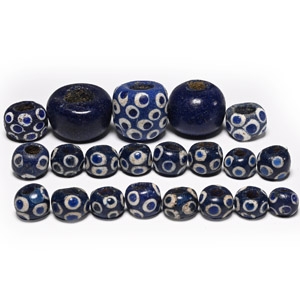
Phoenician Blue Glass Bead Group
6th-3rd century B.C. or laterSold for (Inc. bp): £624
Including drum-shaped types with marvered eye-motifs. 65 grams total, 10-25 mm
UK gallery, early 2000s. This lot is accompanied by an illustrated lot declaration signed by the Head of the Antiquities Department, Dr Raffaele D’Amato.
The category belongs to the cylindrical turquoise eye beads with dark blue and white decorations. Pre-Roman glass beads of this type, generally dated to the Iron Age (end of the ninth century B.C. to 218 B.C.), have been found in significant amounts in the Iberian Peninsula and the Balearic Islands, especially in Phoenician and Punic burial contexts.
