
Loading, please wait...
LOT 0452
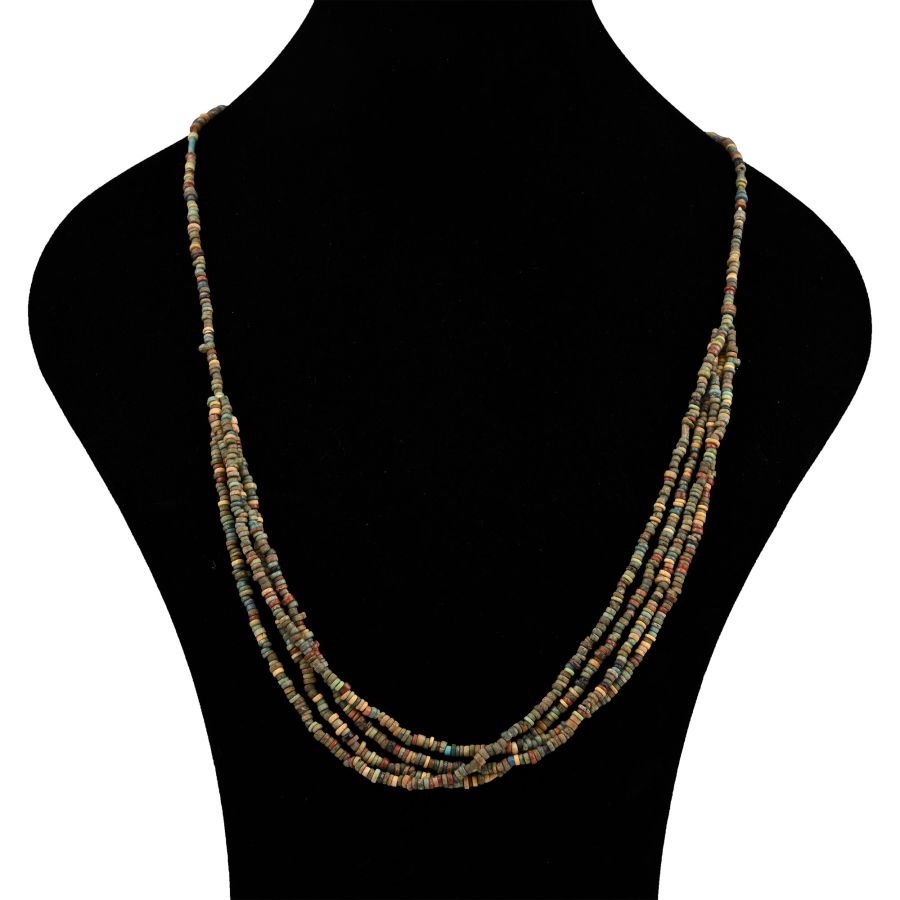
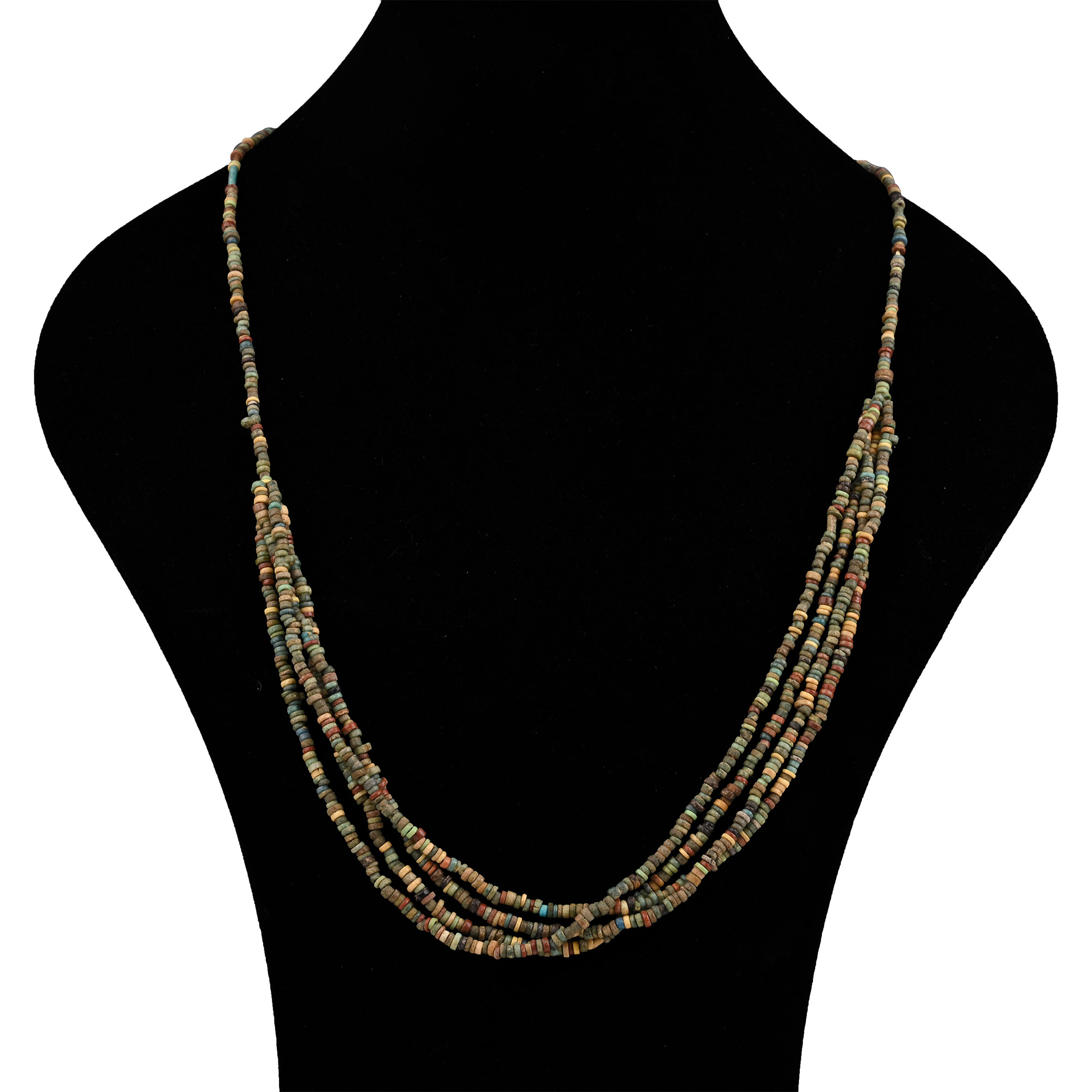
Egyptian Multi-Stranded Mummy Bead Necklace
LATE PERIOD, 664-332 B.C.
25 1/4 in. (22.7 grams, 64 cm).
Four-strand designer necklace composed of polychrome beads of mainly disc and cylindrical types. [No Reserve]
ProvenanceAcquired before 1979.
From the private collection of Mr F.A., South Kensington, London, UK; thence by descent 2014.
Cf. similar specimens in faience at the Worcester Art Museum, inventory no.1925.539.
FootnotesFor thousands of years, artisans in Egypt created vibrant ceramics to echo the beauty of rare jewels. These ornaments were created with almost every material, colour, and texture imaginable, and they come from across Egypt and beyond: vibrant blue lapis lazuli from Afghanistan, glossy black obsidian from Turkey, and aqua-green turquoise from the Sinai. They were worn in life and, after death, they served as precious ornamentation for mummies.
CONDITIONTimeLine Auctions follows a vetting process to ensure the authenticity and legality of all items, reinforcing our commitment to integrity and responsible trading. Each antiquity, antique, and coin lot undergoes thorough examination by a vetting committee of at least ten external specialists, professional trade association members, scientists, and archaeologists: Our Vetting Process
AUCTIONS:
TimeLine is a leading auction house specialising in antiquities, ancient art, collectables, natural history, coins, medals, and books. Our auctions offer museums, collectors, historians, and enthusiasts the opportunity to acquire unique and historically significant pieces.
-
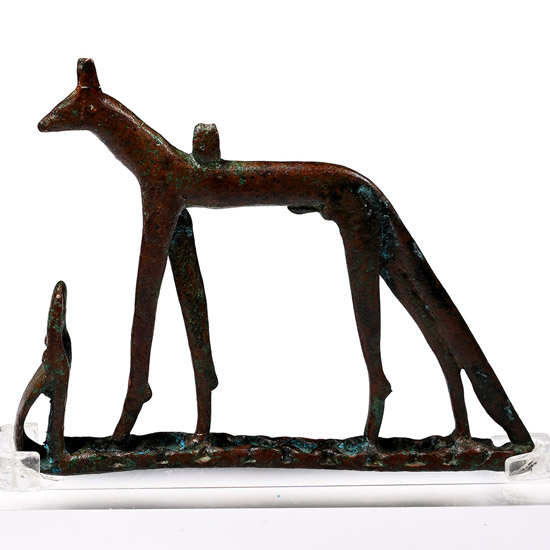
Large Egyptian Bronze Wepwawet Amulet
Third Intermediate-Late Period, 1069-332 B.C.Sold for (Inc. bp): £5,200
Showing the jackal deity Wepwawet standing with ears pricked on a sledge, the slender body modelled with long legs and a tail, suspension loop on the back; two rearing cobras before the jackal; mounted on a custom-made display stand. 54 grams, 91 mm (162 grams total, 11.7 cm including stand )
Ex Dr R. and Mrs L.B., Zumikon, Switzerland. with Galerie Rhéa, Zurich, Switzerland. This lot has been checked against the Interpol Database of stolen works of art and is accompanied by a search certificate number no.12627-236406.
This object may have been the decorative element of a ceremonial standard, examples of which have survived (cf. Petrie, W.M.F., Tanis: Part II / Nebesheh (Am) and Defenneh (Tahpanhes), London, 1886, pl. VII, no. 3). Wepwawet, meaning "Opener of the Ways," was an ancient Egyptian god associated primarily with warfare, protection, and funerary practices. Depicted as a jackal or a man with a jackal's head—often mistaken for Anubis—Wepwawet was believed to guide souls through the afterlife and open paths both in battle and in the spiritual realm. He originated in Asyut (ancient Lycopolis) in Upper Egypt and was one of the oldest deities in the Egyptian pantheon, with worship dating back to at least the First Dynasty (c. 3100–2900 BCE). Over time, Wepwawet became closely linked to Anubis, and the two were sometimes conflated, though Wepwawet retained his distinct identity as a god who preceded and cleared the way. In military contexts, Wepwawet was invoked to "open the way" for pharaohs and armies, ensuring victory and safe passage. In funerary texts, he was described as clearing the path to the afterlife, acting as a scout or guide for the deceased. -
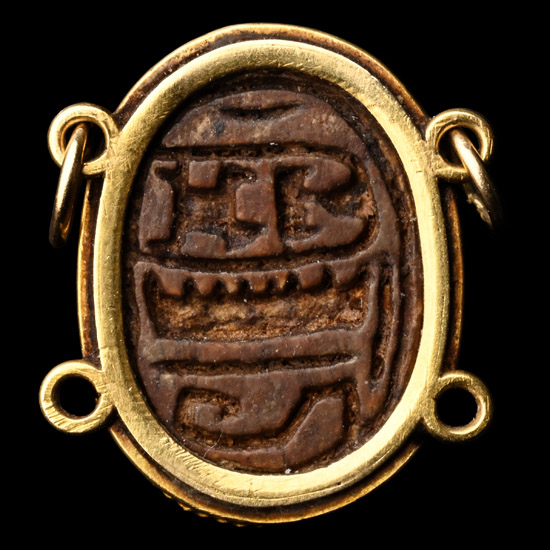
Egyptian Steatite Scarab in Antique Pendant Mount
Late Period, 664-332 B.C. and laterSold for (Inc. bp): £195
The scarab with anatomical detailing on the body, underside with a cartouche for Tuthmoses III and other hieroglyphs; set in a gold filigree mount with four lateral loops. 3.68 grams, 18.3 mm
From the private collection of a European gentleman (1942-2024), formed since the 1970s. -
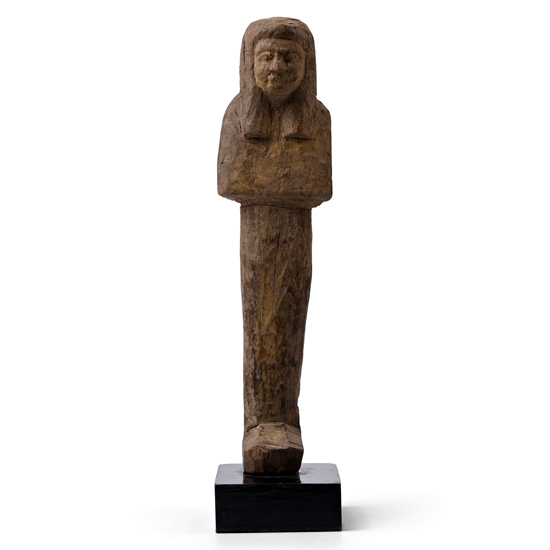
Egyptian Wooden Shabti Figure
New Kingdom, 19th Dynasty, circa 1292-1185 B.C.Estimate: £800 - 1,000 (+bp*)
Opening Bid: £444
Typical mummiform figure, carved in the round with folded arms, wearing a tripartite wig; remains of gesso on the surface; mounted on a wooden base. 138 grams total, 21.9 cm including stand
Ex Budo Bleb (1940-2022) collection, Berlin, formed 1960s onwards.
