
Loading, please wait...
_900x900.jpg "Egyptian Multi-Stranded Mummy Bead Necklace")
_200x200.jpg "Egyptian Multi-Stranded Mummy Bead Necklace")
.jpg "Egyptian Multi-Stranded Mummy Bead Necklace")
LOT 0465
Egyptian Multi-Stranded Mummy Bead Necklace
LATE PERIOD, 664-525 B.C.
29 1/8 in. (26 grams, 74 cm long).
A restrung faience mummy bead necklace comprising multiple strands of polychrome beads including annular and tubular types. [No Reserve]
ProvenanceAcquired before 1979.
From the private collection of Mr F. A., South Kensington, London, UK; thence by descent 2014.
TimeLine Auctions follows a vetting process to ensure the authenticity and legality of all items, reinforcing our commitment to integrity and responsible trading. Each antiquity, antique, and coin lot undergoes thorough examination by a vetting committee of at least ten external specialists, professional trade association members, scientists, and archaeologists: Our Vetting Process
AUCTIONS:
TimeLine is a leading auction house specialising in antiquities, ancient art, collectables, natural history, coins, medals, and books. Our auctions offer museums, collectors, historians, and enthusiasts the opportunity to acquire unique and historically significant pieces.
-
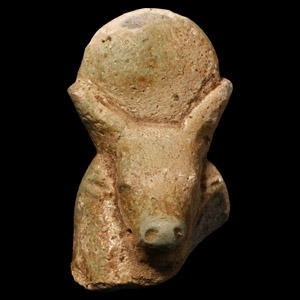
Egyptian Bull-Headed Apis Shabti Head
New Kingdom, Ramesside Period, 1295-1069 B.C.Sold for (Inc. bp): £1,690
A glazed composition shabti fragment representing the head of a bull surmounted by a sun-disc between its horns, wearing a lappet wig and with human arms crossed over the chest; the missing lower portion continued the shape of a mummiform human body; the back of the figure flat and bearing faint traces of inscription, the opening begins with a common shabti introduction which appears to be followed (as would be expected) by the name of syncretic deity Osiris Apis. 34 grams, 60 mm
Acquired early 1990s. Ex private American collection; thence by descent. Private collection since 1998. Accompanied by a scholarly note by Egyptologist Paul Whelan.
The figure comes from the catacombs at Saqqara where the sacred Apis bulls were buried, known today as the Serapeum. The Apis bull was associated principally with the gods Ptah, patron deity of Memphis, and Osiris, and when one died it was afforded the kind of lavish burial befitting a pharaoh. All bull-headed shabtis date to the 19th and 20th Dynasties and were left as offerings beside the huge granite sarcophagi of the deified bulls. These shabtis were among hundreds of objects recovered from the catacombs by Auguste Mariette during his excavations there between 1850-1853. The Musée du Louvre in Paris holds the largest collection of artefacts from the Serapeum outside Egypt, including around 120 Apis shabtis. They reveal that the this fragment with its sun-disc is from a rare variant of this shabti type; just 5 of the Louvre examples have sun-discs (S 1823, N 5234 51-54), the remaining shabtis have a bull’s head with short stubby horns and no sun-disc. -
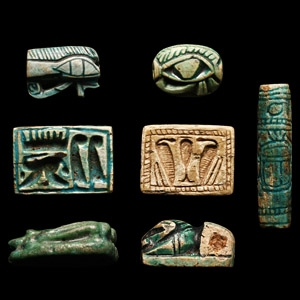
Egyptian Amulet Collection
New Kingdom-Late Period, 1550-332 B.C.Estimate: £2,000 - 3,000 (‡+bp*)
Opening Bid: £1,000
A mixed group of glazed composition amulets and beads comprising: white rectangular bead with Tilapia fish in high-relief and two cobras flanking a hem ideogram; turquoise frog on heater-shaped base with serpent to the underside; green scaraboid with wedjat to the carapace, Hathor sistrum with cow's horns to the underside; green ram-headed scaraboid with hieroglyphs to the underside; green cylinder with scarab motif; green wedjat with a cartouche of Thutmose III to the reverse; green rectangular bead with djed pillar flanked by ostrich feathers and incuse hieroglyphs to the reverse. 14.3 grams total, 14-27 mm
Two amulets with Bonhams, London, Knightsbridge, UK, 3 October 2000, lot 385 [Part]. Private Swiss collection. This lot has been checked against the Interpol Database of stolen works of art and is accompanied by search certificate no.11593-198956. Accompanied by a copy of the relevant Bonhams catalogue pages. -
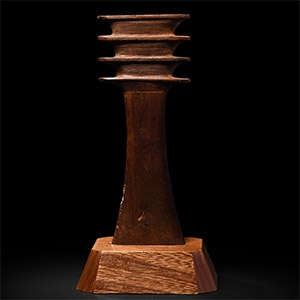
Egyptian Djed Pillar Amulet
7th-1st century B.C.Estimate: £2,500 - 3,500 (‡+bp*)
Opening Bid: £1,250
A large finely-made wooden amuletic djed pillar; old collector's accession number 'E.436' to underside; mounted on a custom-made display stand. 106 grams, 17 cm high
with ink inscribed 'E.436' to base. Acquired in 1970. Ex private European collection. This lot has been checked against the Interpol Database of stolen works of art and is accompanied by search certificate no.11602-199041.
The djed pillar symbolises stability and is usually understood to be the spine of the god Ptah although its origins are more probably in cult practices involving sheaves of reeds which were revered due to the general absence of trees from the Egyptian landscape. The djed later came to be symbolise Seker, the falcon god of Memphis and Ptah, the Memphite god of craftsmen, who carried a sceptre formed as a combination of the djed and the ankh. The cult of Ptah waned and gave way to that of Osiris so that by the New Kingdom (16th century B.C.), the djed had become associated with Osiris, part of whose cult included a ceremony for raising the djed representing Osiris's triumph over Seth.
