
Loading, please wait...
LOT 0430
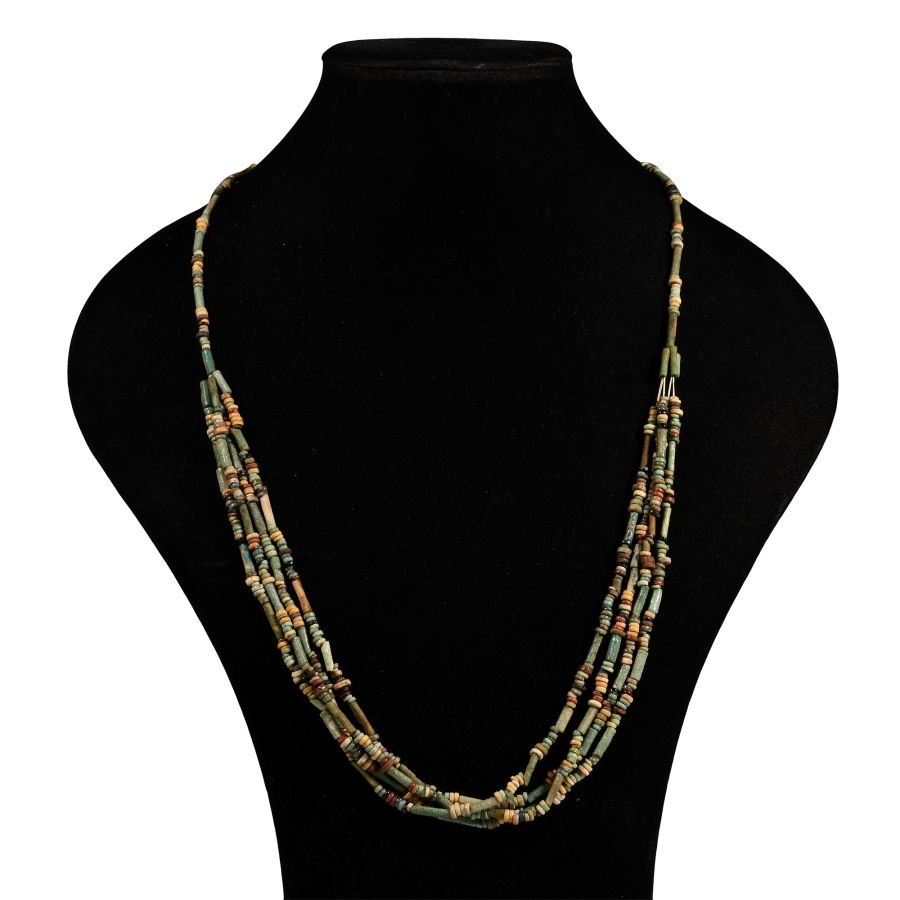
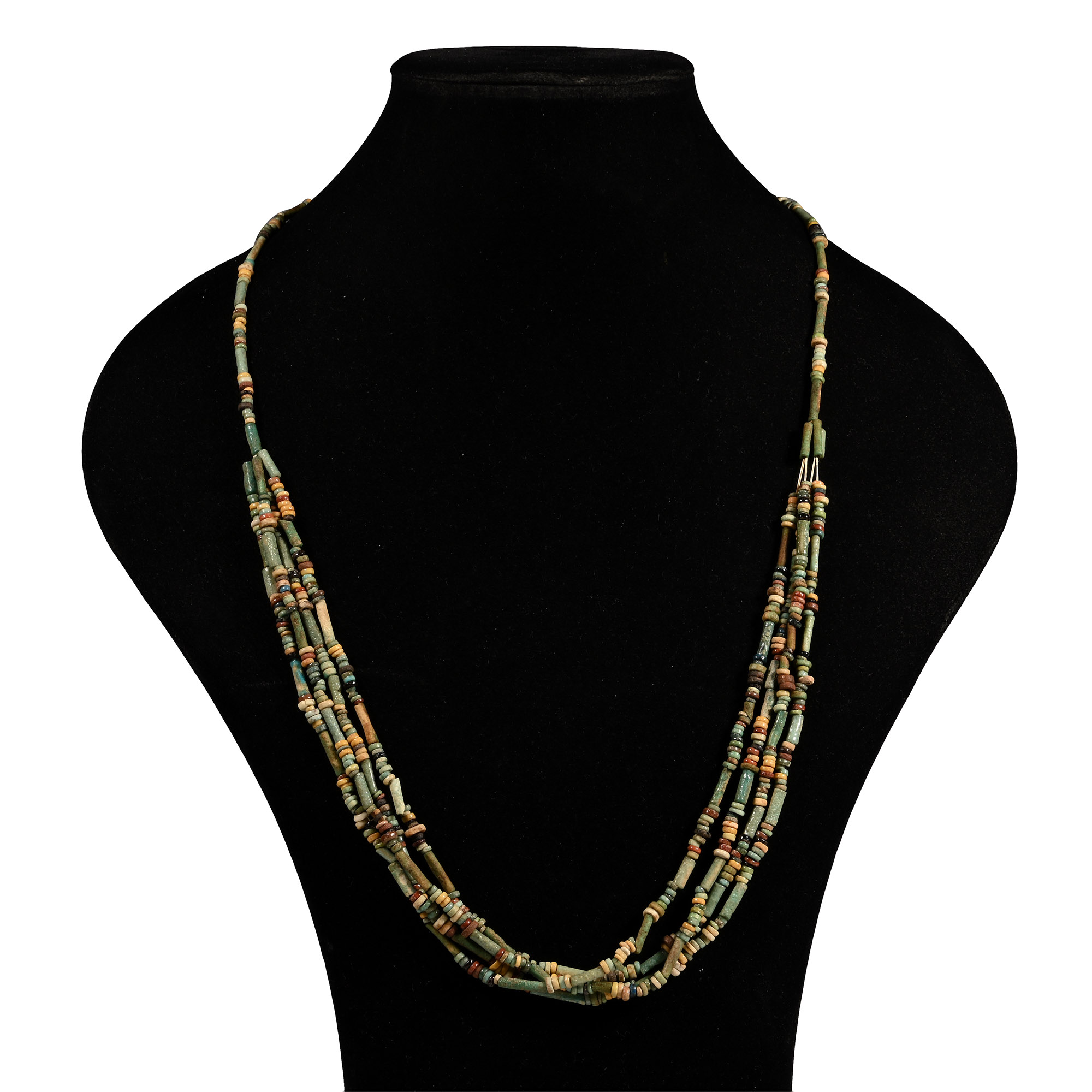
Egyptian Multi-Stranded Mummy Bead Necklace String
LATE PERIOD, 664-525 B.C.
32 1/4 in. (28 grams total, 82 cm long).
A composition necklace composed of multiple strands of polychrome beads of mainly annular and tubular types. [No Reserve]
ProvenanceAcquired before 1979.
From the private collection of Mr F. A., South Kensington, London, UK; thence by descent 2014.
This lot is accompanied by an illustrated lot declaration signed by the Head of the Antiquities Department, Dr Raffaele D’Amato.
Cf. Derriks, C., Delvaux, L., Antiquités égyptiennes au Musée royal de Mariemont, Morlanwelz, 2009, pp.267-268, for similar.
FootnotesRed and yellow faience were among the new colours appeared in the 18th Dynasty, but they were in use until the Late Period. It was ideally formed from a core of sand and quartz and a vitreous alkaline glaze. It was the preferred medium of Egyptian jewellers even before the First Dynasty, because of its malleability and its ability to imitate other more expensive materials thanks to the colour of the glaze.
CONDITIONTimeLine Auctions follows a vetting process to ensure the authenticity and legality of all items, reinforcing our commitment to integrity and responsible trading. Each antiquity, antique, and coin lot undergoes thorough examination by a vetting committee of at least ten external specialists, professional trade association members, scientists, and archaeologists: Our Vetting Process
AUCTIONS:
TimeLine is a leading auction house specialising in antiquities, ancient art, collectables, natural history, coins, medals, and books. Our auctions offer museums, collectors, historians, and enthusiasts the opportunity to acquire unique and historically significant pieces.
-
Egyptian Faience Mummy Bead Necklace
Late Period, 664-332 B.C.Sold for (Inc. bp): £78
Mainly annular beads in various shades. 14.6 grams, 90 cm
From an old English deceased estate. Acquired on the Yorkshire art market in the early 1990s. Property of a London, UK, collector. This lot is accompanied by an illustrated lot declaration signed by the Head of the Antiquities Department, Dr Raffaele D’Amato. -
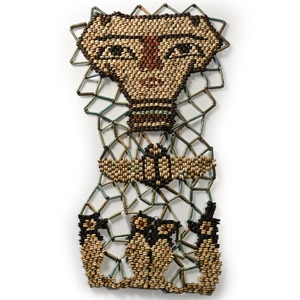
Egyptian Faience Mummy Beadwork Mask
Ptolemaic Period, 332-30 B.C.Sold for (Inc. bp): £676
A netted beadwork panel of annular and tubular glazed composition beads depicting a mummy face mask with a false beard, a scarab with extended wings below, and beneath the 'Four Sons of Horus’, Hapy, Imsety, Qebehsenuef, and Duamutef, joined together with areas of open netting of tubular examples; restrung with some later beads. 145 grams, 32 cm
Mariaud de Serres, Paris, 1990s. This lot is accompanied by an illustrated lot declaration signed by the Head of the Antiquities Department, Dr Raffaele D’Amato.
The Four Sons of Horus were deities responsible for protecting the deceased's internal organs. The human-headed Imsety protected the liver, the baboon-headed Hapy protected the lungs, the jackal-headed Duamutef protected the stomach, and the falcon-headed Qebehsenuef protected the intestines. These internal organs were often placed in canopic jars with the head of the respective Son of Horus. -
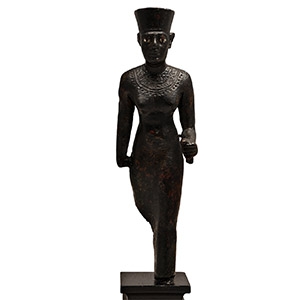
Egyptian Bronze Statue of Neith
Late Period, 664-332 B.C.Sold for (Inc. bp): £11,050
Modelled in the round in a striding pose wearing a tight-fitting robe and sporting the Red (deshret) Crown of Lower Egypt; eyes inlaid with silver, an elaborate ornamental collar to the chest; the right arm hanging at the side, the left arm bent at the elbow with hand clenched to accept a staff, possibly a papyrus sceptre; mounted on a custom-made stand. 162 grams total, 12.7 cm including stand
From a 1940s collection based on the base and remains of label verso. From the Keane private collection, Kent, UK. This lot has been checked against the Interpol Database of stolen works of art and is accompanied by search certificate number no.12479-229477. This lot has been cleared against the Art Loss Register database, and is accompanied by an illustrated lot declaration signed by the Head of the Antiquities Department, Dr Raffaele D’Amato.
Neith is one of the oldest ancient Egyptian deities with roots in the Early Dynastic Period. She is often depicted as a woman wearing the Red Crown of Lower Egypt and carrying a sceptre, symbolising her divine power. As a warrior and mother figure, Neith embodies creation, wisdom, and warfare. Her cult rose in prominence during the Ramesside Period as she became linked with the sun god. The primary centre of her worship was the city of Sais in the western Nile Delta, which became a significant religious and political hub during the 26th Dynasty (664–525 B.C.). Kings of this era claimed her as their protector and identified with her in royal titles.
