
Loading, please wait...

LOT 0470
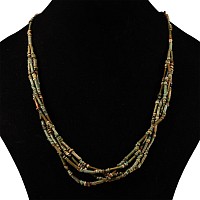
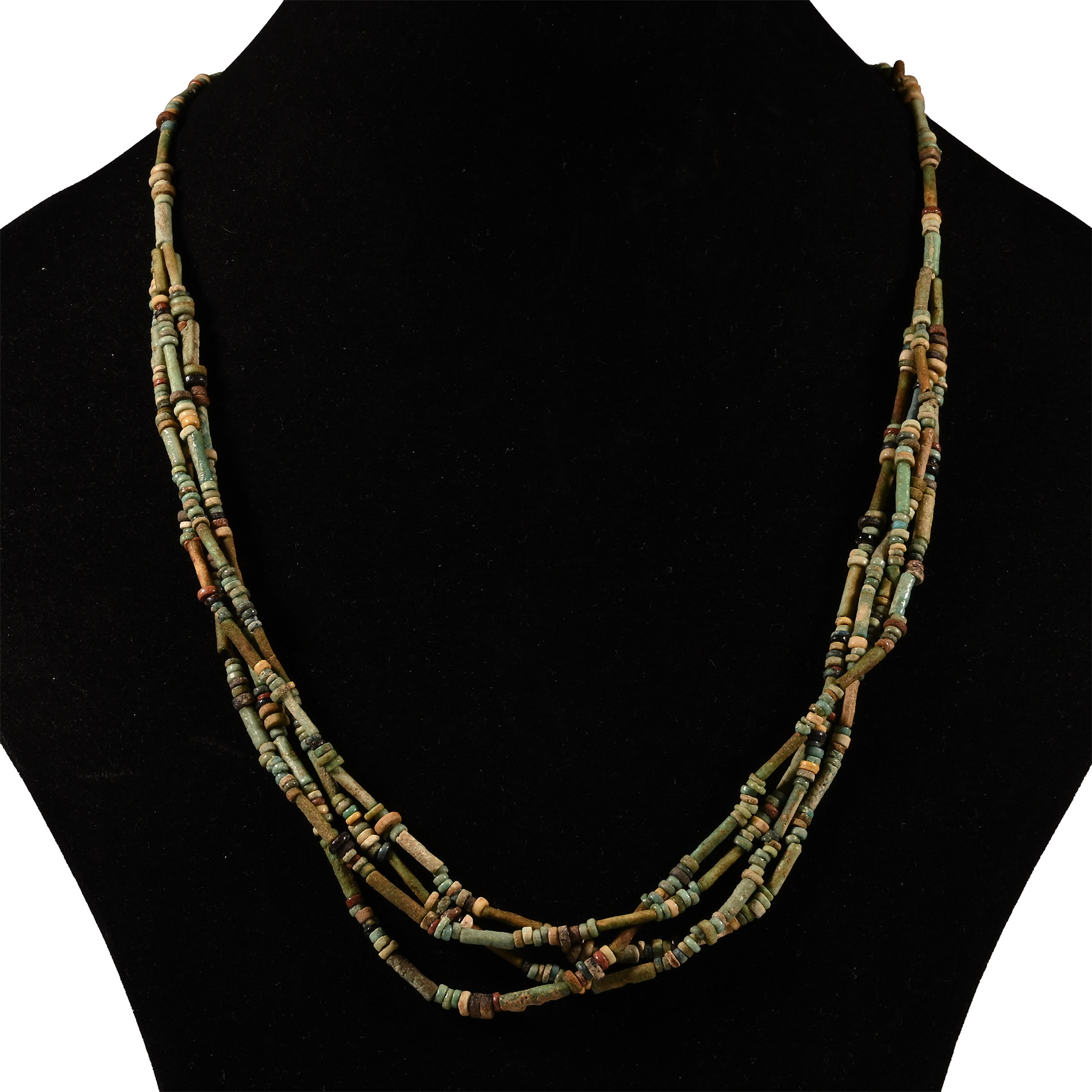
Egyptian Multi-Stranded Faience Mummy Bead Necklace
LATE PERIOD, 664-332 B.C.
28 1/4 in. (21 grams, 72 cm long).
Multi-stranded designer necklace composed of beads of mainly annular and tubular types. [No Reserve]
ProvenanceAcquired before 1979.
From the private collection of Mr F.A., South Kensington, London, UK; thence by descent 2014.
Cf. similar specimens in faience at the Worcester Art Museum, inventory no.1925.539.
FootnotesFor thousands of years, artisans in Egypt created vibrant ceramics to echo the beauty of rare jewels. These ornaments were created with almost every material, colour, and texture imaginable and they come from across Egypt and beyond: vibrant blue lapis lazuli from Afghanistan, glossy black obsidian from Turkey, and aqua-green turquoise from the Sinai. They were worn in life and, after death, they served as precious ornamentation for mummies.
CONDITIONTimeLine Auctions follows a vetting process to ensure the authenticity and legality of all items, reinforcing our commitment to integrity and responsible trading. Each antiquity, antique, and coin lot undergoes thorough examination by a vetting committee of at least ten external specialists, professional trade association members, scientists, and archaeologists: Our Vetting Process
AUCTIONS:
TimeLine is a leading auction house specialising in antiquities, ancient art, collectables, natural history, coins, medals, and books. Our auctions offer museums, collectors, historians, and enthusiasts the opportunity to acquire unique and historically significant pieces.
-
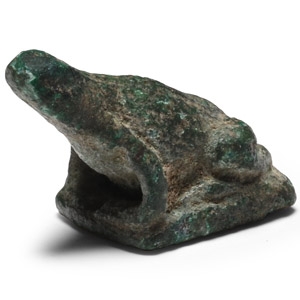
Egyptian Bronze Frog Weight
Roman Period, 30 B.C.-323 A.D. or earlierSold for (Inc. bp): £156
Modelled as a standing frog on a rectangular base. 9.6 grams, 24 mm wide
From the collection of a gentleman, acquired on the London art market in the 1990s. -
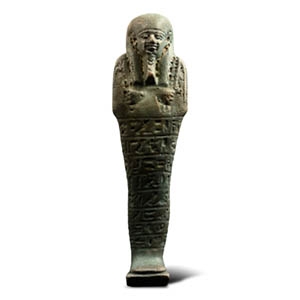
Large Egyptian Blue Glazed Hieroglyphic Shabti
26th Dynasty, 664-525 B.C.Estimate: £1,500 - 2,000 (+bp*)
Opening Bid: £700
Of mummiform type, wearing a tripartite wig and long plaited divine beard, with arms crossed and the left hand holding a pick, the right hand holding a hoe and the cord of a seed bag hanging over his left shoulder, with carefully rendered cosmetic lines around the eyes, narrow eyebrows, and slightly smiling lips giving it a serene expression characteristic of the finest ushabtis of the period; standing on an integral plinth from which a plain back pillar terminating at the base of the wig extends; eight horizontal rows of hieroglyphic inscription, the Sixth Chapter of the Book of the Dead; water worn. 235 grams, 18.6 cm
Acquired on the German art market, 1989-1995. with The Museum Gallery, 19 Bury Place, London, WC1, UK, 1998-2003. Property of a London based academic, 2003-present. -
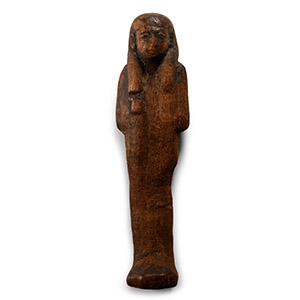
Egyptian Wooden Funerary Shabti Figurine
2nd-1st millennium B.C.Estimate: £1,500 - 2,000 (‡+bp*)
Opening Bid: £750
Carved in the round with D-shaped base, carefully modelled hair and ears with beard absent, the right hand visible, not holding any work tools, the body has the appearance of a mummy entirely draped in a shroud with rather elongated proportions, the broad and rounded face with a slightly ‘smiling’ expression, framed by a tripartite hairstyle without stripes, which continues down the back and two lappets on the chest. 39 grams, 14.5 cm
Ex R. Liechti (1934-2010) Geneva, Switzerland, formed between 1950-1990s. This lot has been checked against the Interpol Database of stolen works of art and is accompanied by a search certificate number no.12079-218221.
