
Loading, please wait...
_900x900.jpg "Egyptian Multi-Stranded Faience Mummy Bead Necklace")
_200x200.jpg "Egyptian Multi-Stranded Faience Mummy Bead Necklace")
.jpg "Egyptian Multi-Stranded Faience Mummy Bead Necklace")
LOT 0483
Egyptian Multi-Stranded Faience Mummy Bead Necklace
LATE PERIOD, 664-525 B.C.
28 3/8 in. (31 grams, 72 cm long).
Composed of polychrome beads of mainly tubular and annular types; modern clasp. [No Reserve]
ProvenanceAcquired before 1979.
From the private collection of Mr F. A., South Kensington, London, UK; thence by descent 2014.
Cf. similar specimens in faience at the Worchester Art Museum, inventory no.1925.539.
CONDITIONTimeLine Auctions follows a vetting process to ensure the authenticity and legality of all items, reinforcing our commitment to integrity and responsible trading. Each antiquity, antique, and coin lot undergoes thorough examination by a vetting committee of at least ten external specialists, professional trade association members, scientists, and archaeologists: Our Vetting Process
AUCTIONS:
TimeLine is a leading auction house specialising in antiquities, ancient art, collectables, natural history, coins, medals, and books. Our auctions offer museums, collectors, historians, and enthusiasts the opportunity to acquire unique and historically significant pieces.
-
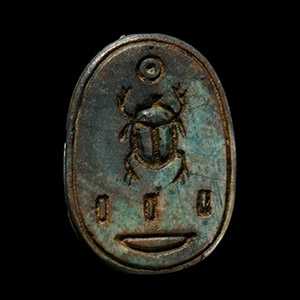
Egyptian Stone Scarab Inscribed for Tutankhamun
New Kingdom, 1334-1325 B.C.Sold for (Inc. bp): £6,500
Naturalistically modelled and coloured blue, hieroglyphs on base; pierced for suspension. 4.55 grams, 20 mm
Ex collection of Emil Saad, Paris-Alexandria. -
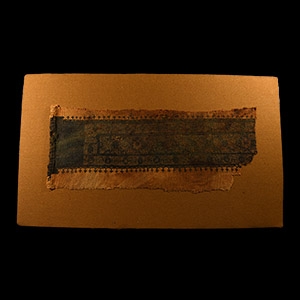
Egyptian Mounted Coptic Textile with Crenellated Blossoms
Circa 5th-7th century A.D.Sold for (Inc. bp): £78
Part of a tunic, the rectangular segment in yellow and green linen and wool, the central part decorated with interlaced geometric motifs, surrounded by an edge of similar motifs and border edged of crenellated blossoms. 264 grams, 64 x 37 cm
Acquired 1970s-1996. Property of a North American collector. London collection, 2016.
Among the many fragments from wool tunics are several long strips that match to form nearly full-length central pectoral clavi. They are patterned with a profusion of small figures or interlaced abstract designs, birds, plants and animals with a contrasting border filled with geometric motifs. -
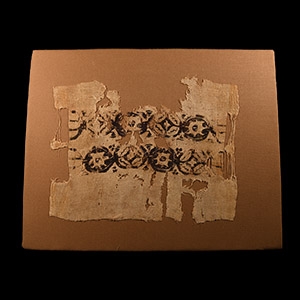
Egyptian Mounted Coptic Textile
Circa 5th-7th century A.D.Sold for (Inc. bp): £33
Comprising a double band of purple wool over linen, the ornament consisting of a series of circles alternating with a star-shaped and rhomboid decoration. 152 grams, 42.5 x 34 cm
Acquired 1970s-1996. Property of a North American collector. London collection, 2016.
The large segments can be classified as clavi, although they are not part of a tunic but more possibly borders of a curtain, or a funerary sheet. Mantles and funerary shrouds were usually decorated by wide bands along the lower border, imitating the ornaments of tunics with clavi and orbiculi.
