
Loading, please wait...
LOT 0684
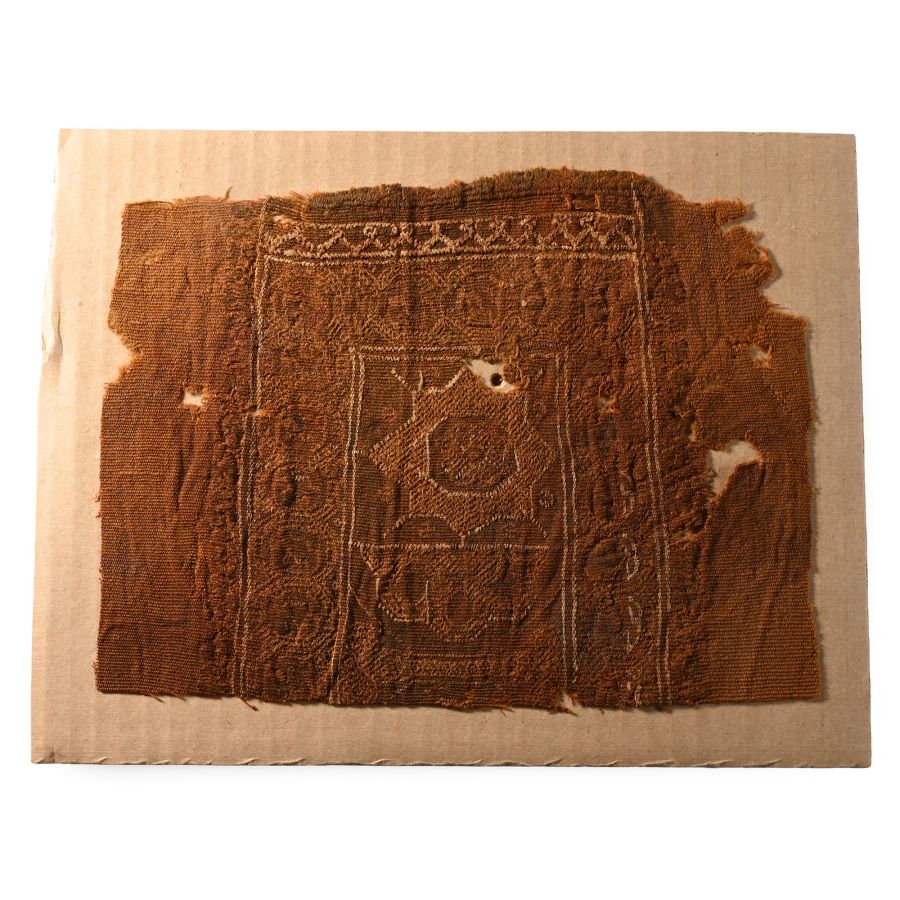
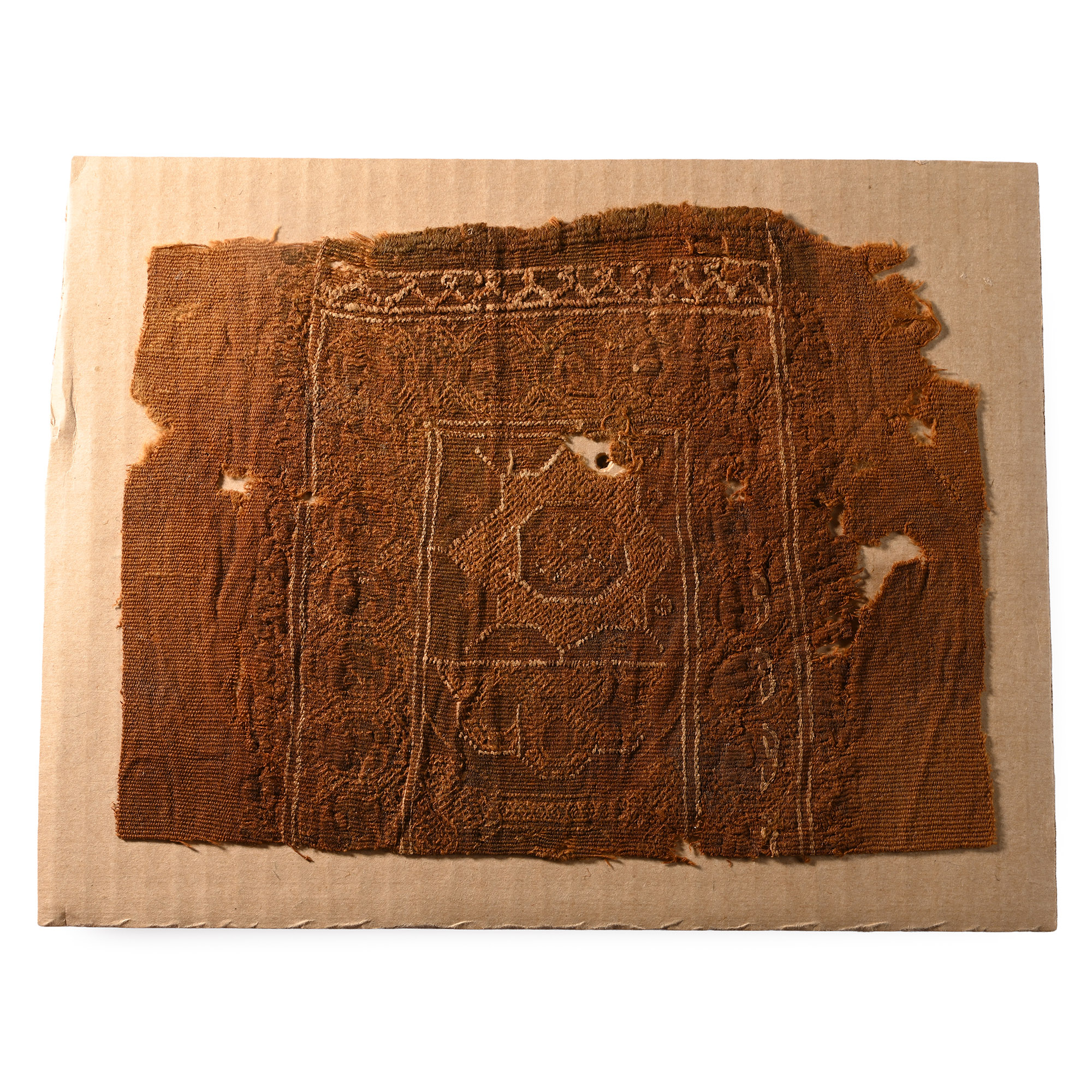
Egyptian Mounted Coptic Textile Fragment of a Central Clavus
CIRCA 6TH-7TH CENTURY A.D.
8 5/8 in. (45 grams total, 22 cm).
Wide tunic fragment in coarse linen and purple-violet wool with animal figures enclosed within an orbiculi, the central part of the fragment featuring a geometric decoration of stars and lozenges; mounted on cardboard backing. [No Reserve]
ProvenanceAcquired 1970s-1996.
Property of a North American collector.
London collection, 2016.
Cf. Institut du monde arabe, L'art copte en Égypte: 2000 ans de Christianisme : exposition présentée à l'Institut du monde arabe, Paris, du 15 mai au 3 septembre 2000, Paris, 2000, p.137, no.124, for a fragment of tunic decorated in a similar way.
FootnotesAmong the many fragments from wool tunics, there are several long strips that match to form nearly full-length central pectoral clavi. They are patterned with a profusion of small figures or interlaced abstract designs, birds, plants and animals, with a contrasting border filled with geometric motifs.
CONDITIONTimeLine Auctions follows a vetting process to ensure the authenticity and legality of all items, reinforcing our commitment to integrity and responsible trading. Each antiquity, antique, and coin lot undergoes thorough examination by a vetting committee of at least ten external specialists, professional trade association members, scientists, and archaeologists: Our Vetting Process
AUCTIONS:
TimeLine is a leading auction house specialising in antiquities, ancient art, collectables, natural history, coins, medals, and books. Our auctions offer museums, collectors, historians, and enthusiasts the opportunity to acquire unique and historically significant pieces.
LOT 0684
Egyptian Mounted Coptic Textile Fragment of a Central Clavus
Estimate £40 - 60€46 - 70 (for guidance only)$54 - 81 (for guidance only)
Opening Bid
£5 (EUR 6; USD 7) +BP*
-
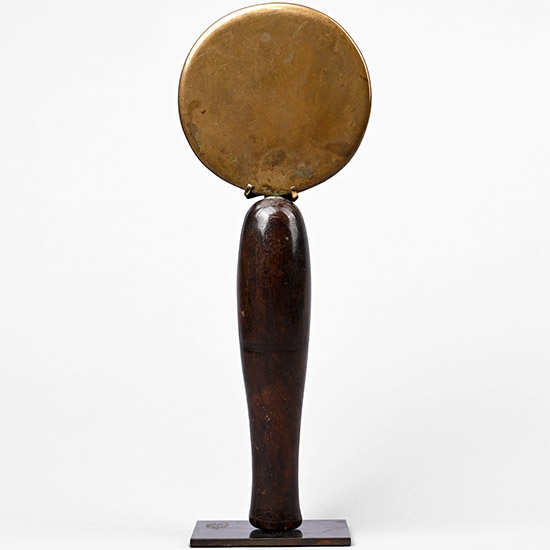
Egyptian Bronze Mirror with Wooden Handle
New Kingdom, 18th-20th Dynasty, 1550-1070 B.C.Estimate: £4,000 - 6,000 (+bp*)
Opening Bid: £2,000
The rounded cylindrical handle narrowing towards the base and decorated with three horizontal bands; the circular, heavy bronze mirror highly polished and relatively small; accompanied by a custom-made display stand. 766 grams total, 29 cm high including stand
with Rupert Wace, Ancient Art, 2003. Private collection, UK. This lot has been checked against the Interpol Database of stolen works of art and is accompanied by search certificate no.13517-263432.
The club-type handle resembles the hieroglyph hem, which can mean 'servant'. Therefore, the handle is thought to represent the mirror disc's servant. This type appears in pictorial scenes; for example, a similar smaller disc mirror with a hem handle is depicted in the Theban tomb (TT 60) of Senet (Davies, N.de G., The Tomb of Antefoker, Vizier of Sesostris I, and of His Wife, Senet, London 1930, pl. 30), and another with a larger disc and a shorter hem handle is depicted on the inside of the coffin of Sebeka (Steindorff, G., Grabfunde des mittleren Reichs in den königlichen Museen zu Berlin. Part 2: Der Sarg des Sebk.-o.- ein Grabfund aus Gebelen, Berlin, 1896, 2, pl. 2). -
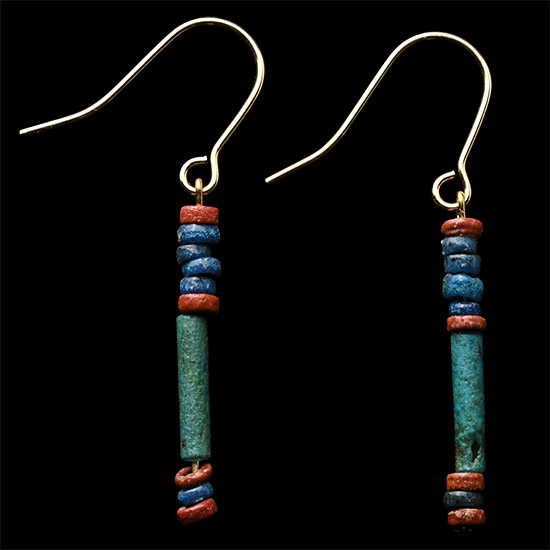
Egyptian Faience Earrings on Modern Mounts
Late-Ptolemaic Period, circa 664-30 B.C.Estimate: £50 - 70 (+bp*)
Opening Bid: £5
Each composed of two groups of faience disc beads separated by a longer tubular bead with a modern gold wire fitting. 0.85 grams total, 43 mm each
Ex Ancient Art shop, Windsor, UK, 1990s. -
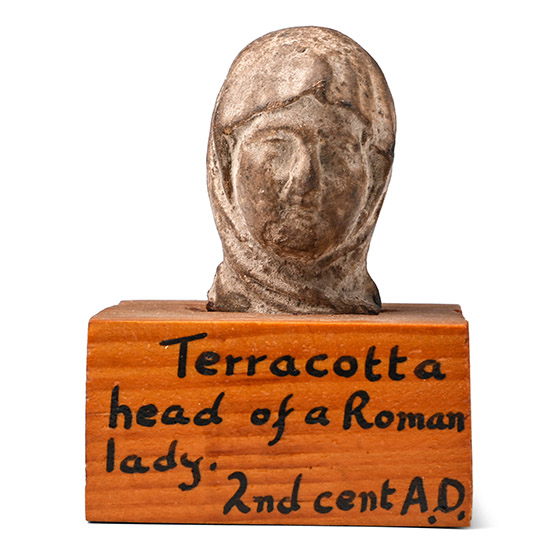
Egyptian Terracotta Head of a Roman Lady
Hellenistic Period, circa 3rd-2nd century B.C.Estimate: £100 - 140 (+bp*)
Opening Bid: £5
Depicting the cloth-wrapped head of a lady, mounted on a wooden stand. 40.9 grams total, 51 mm including stand
Acquired from High Street, Herne Bay, circa June 1957, for £1.00. Certificate of antiquity no.668 of Blanchard's Egyptian Museum, Cairo. From the private collection of Peter Clayton, FCILIP, Dip, Arch, FSA, FRNS, Hemel Hempstead, Hertfordshire, UK; formed since the late 1950s. Accompanied by an old handwritten information card by Peter Clayton, collection no.11.
This head comes from a draped female figure, known as the Tanagra-type, often wearing elegant himations (cloaks) and wide-brimmed hats (tholia), or holding accessories such as fans, wreaths, and mirrors.
