
Loading, please wait...
_900x900.jpg "Egyptian Mixed Scarab Collection")
_200x200.jpg "Egyptian Mixed Scarab Collection")
.jpg "Egyptian Mixed Scarab Collection")
LOT 0421
Egyptian Mixed Scarab Collection
2ND-1ST MILLENNIUM B.C. AND LATER
1/2 - 1 3/8 in. (36.9 grams total, 14-35 mm).
Stone plaque with raised relief depictions of the Apis bull and a falcon deity beneath; a mixed group of scarabs and scaraboids, most bearing text or motifs on the underside, including: a rope border enclosing the head of a lion wearing a sun disc and uraeus; a plain copper-alloy scaraboid; a line border enclosing the throne name of Amenhotep III (neb-maat-Re); an indeterminate standing figure; a central hes- vase flanked by rearing cobras; a group of hieroglyphs, perhaps a slightly incorrect spelling of the throne name of Amenhotep II (akheperu-Re); and a group of four hieroglyphs. [8]
ProvenanceFrom the collection of a gentleman, acquired on the London art market in the 1990s.
LiteratureCf. Petrie, W.M.F., Scarabs and Cylinders with Names, London, 1917, pl. XXXIV, for numerous examples of scarabs bearing Amenhotep III's throne name.
CONDITIONTimeLine Auctions follows a vetting process to ensure the authenticity and legality of all items, reinforcing our commitment to integrity and responsible trading. Each antiquity, antique, and coin lot undergoes thorough examination by a vetting committee of at least ten external specialists, professional trade association members, scientists, and archaeologists: Our Vetting Process
AUCTIONS:
TimeLine is a leading auction house specialising in antiquities, ancient art, collectables, natural history, coins, medals, and books. Our auctions offer museums, collectors, historians, and enthusiasts the opportunity to acquire unique and historically significant pieces.
-
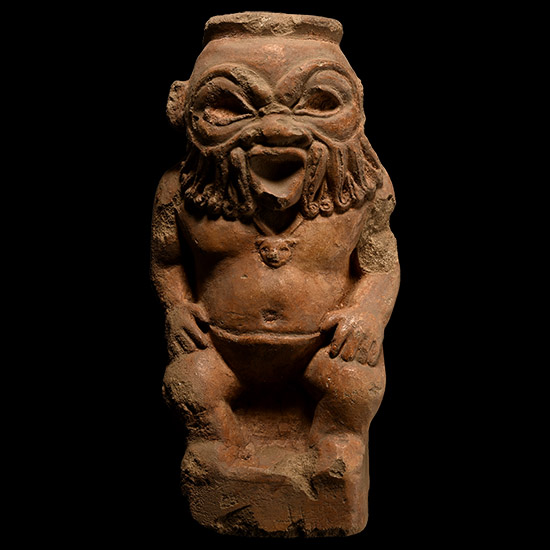
Egypto-Roman Seated Limestone Statuette of Bes
Ptolemaic-Roman Period, circa 332 B.C.-300 A.D.Estimate: £2,000 - 3,000 (+bp*)
Current Winning Bid: £1,000
Modelled in the round in a crouching pose on a rectangular base; the beard modelled in hanks with curled ends, the eyes recessed to accept inserts, mouth gaping; animal head amulet on the chest suspended on a cord; socket to reverse; chipped. 942 grams, 18.5 cm
Bonhams, London, 4 July 1995, no.36. Private collection, New York, USA. This lot has been checked against the Interpol Database of stolen works of art and is accompanied by search certificate number no.13294-255443.
From the New Kingdom onwards, Bes became one of ancient Egypt's most popular apotropaic deities. Despite his somewhat fearsome appearance, Bes served as the patron and protector of pregnant women and children and was also believed to shield them from snakes. -
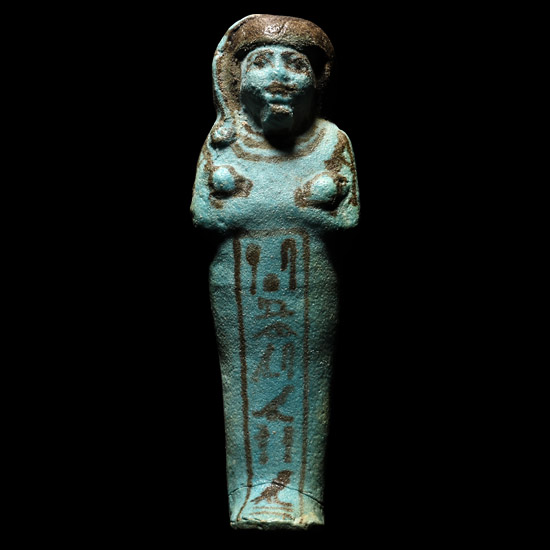
Egyptian Blue Glazed Shabti for Hor
New Kingdom, 19th Dynasty, 13th century B.C.Sold for (Inc. bp): £1,300
Modelled with a rounded wig and sidelock; painted black detailing to the eyes, lips, collar and agricultural tools held in the crossed hands; painted vertical panel to lower body with hieroglyphic legend “The illuminated one, the Osiris, the sem priest, the great director of craftsmen, Hor, justified” (sḥḏ wsı͗r sm wr ḫrp(w) ḥmw(w)t ḥr mꜣꜥ-ḫrw); repaired. 146 grams, 13.8 cm
Acquired on the UK art market, 1990s. Private collection, New York, USA. This lot has been checked against the Interpol Database of stolen works of art and is accompanied by search certificate no.13430-225467.
Although the inscription names the owner as Hor, it seems likely that this shabti was made for a high official named Hori. Several sem priests named Hori are known. It seems plausible that this shabti belonged to the Hori who was the son of Prince Khaemwaset, son of Ramesses II, since a similar example was found alongside those of the prince in a chamber in the Serapeum (Mariette, A., Le Sérapéum du Memphis, Paris, 1857, pl. 10). -
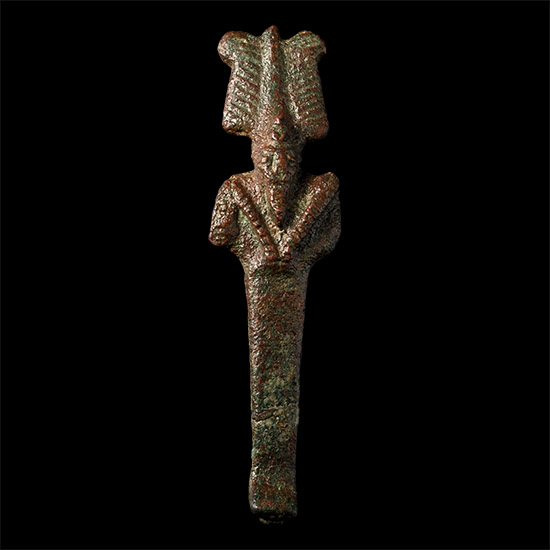
Egyptian Bronze Osiris Figure
Late-Ptolemaic Period, circa 664-30 B.C.Sold for (Inc. bp): £156
Standing pose wearing the atef crown with flanking ostrich plumes and frontal uraeus; holding the crook (heka) and flail (nekhakha) regalia in his crossed hands; peg to underside of feet; repaired. 16.17 grams, 68 mm
From the private collection of a Canadian gentleman living in Essex, UK, formed since the 1920s-circa 1990. Property of an Essex lady until the late 1990s; thence by descent. From the private collection of an Essex gentleman since the late 1990s.
