
Loading, please wait...
LOT 0510
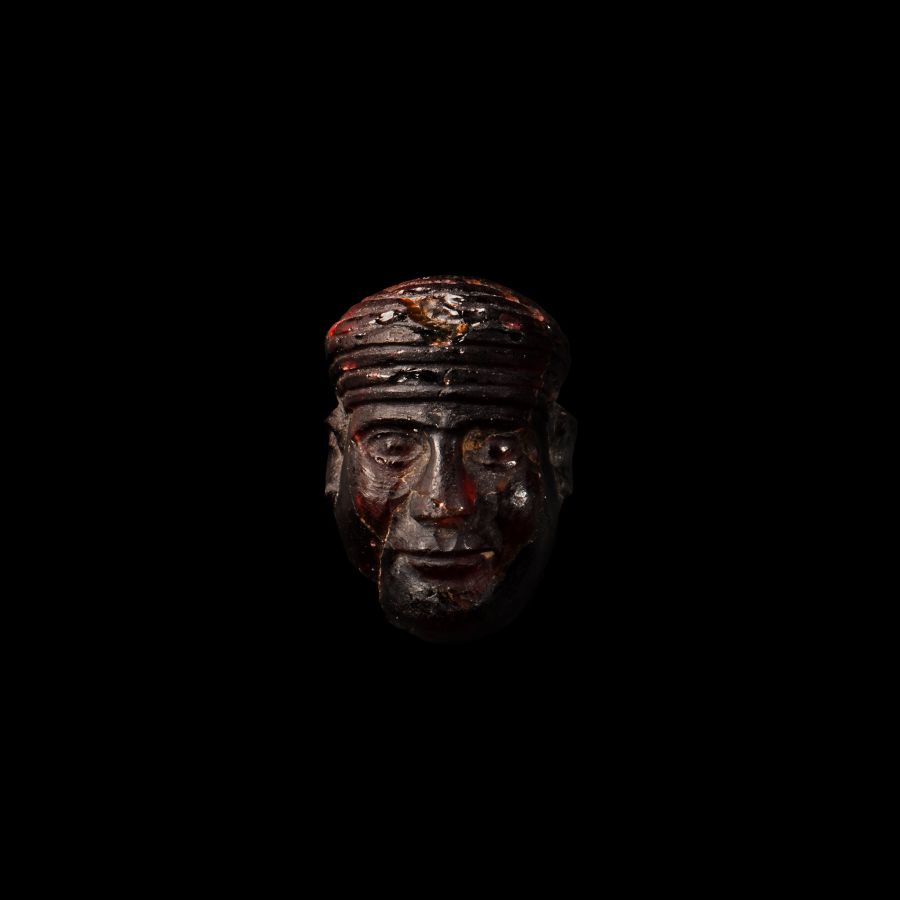
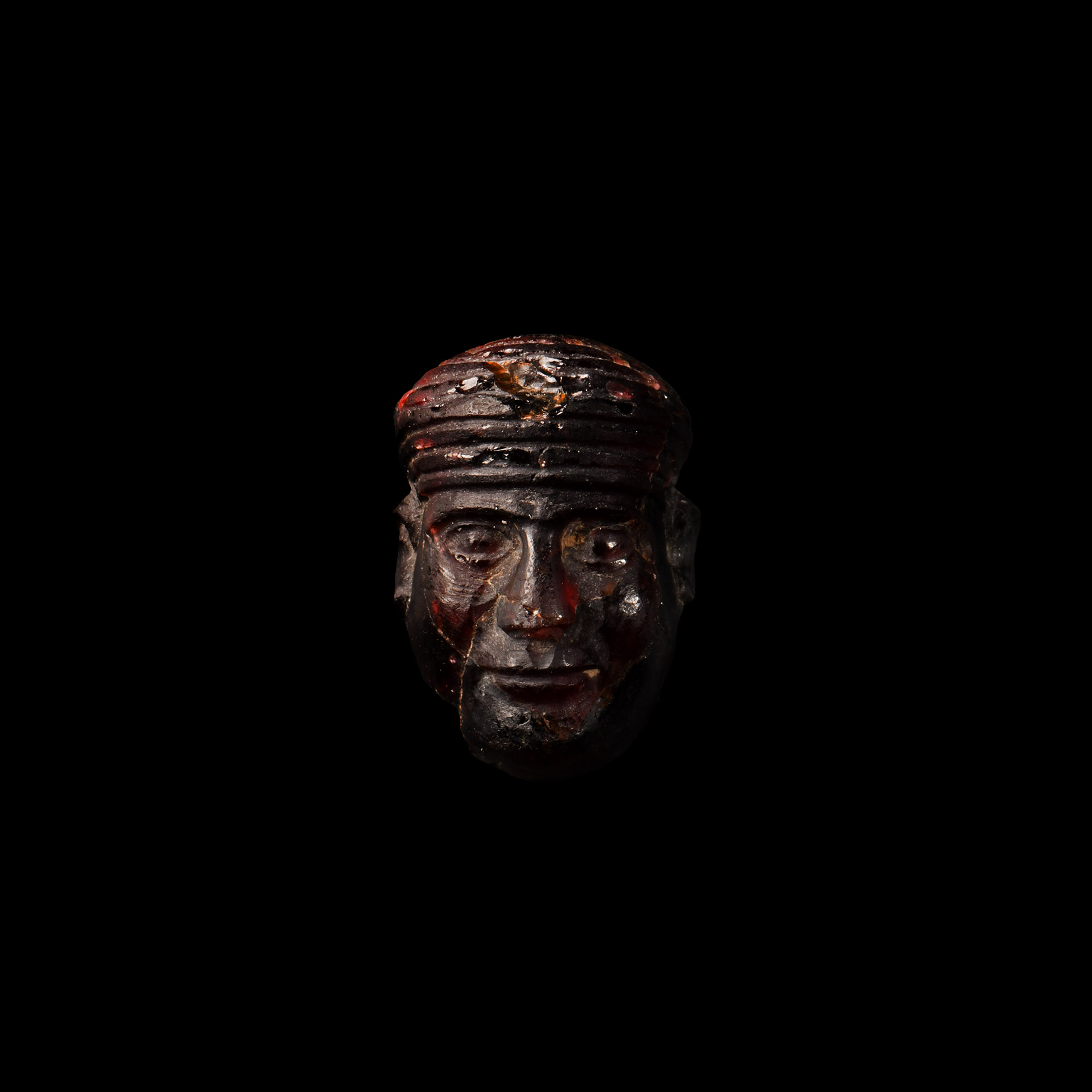
Egyptian Male Head Inlay
LATE NEW KINGDOM, 1550-1070 B.C.
1 in. (12.5 grams, 24 mm high).
A glass or garnet model of a clean-shaven male head with a headdress formed as rope bands; amuletic insert for a piece of jewellery.
Provenancewith HVMC, Hotel des Ventes de Monte-Carlo, 19 January 2022, lot 63.
English private collection.
Cf. Andrews, C., Amulets of Ancient Egypt, London, 1994, p.69, for discussion
CONDITIONTimeLine Auctions follows a vetting process to ensure the authenticity and legality of all items, reinforcing our commitment to integrity and responsible trading. Each antiquity, antique, and coin lot undergoes thorough examination by a vetting committee of at least ten external specialists, professional trade association members, scientists, and archaeologists: Our Vetting Process
AUCTIONS:
TimeLine is a leading auction house specialising in antiquities, ancient art, collectables, natural history, coins, medals, and books. Our auctions offer museums, collectors, historians, and enthusiasts the opportunity to acquire unique and historically significant pieces.
LOT 0510
Egyptian Male Head Inlay
Estimate £800 - 1,000€930 - 1,160 (for guidance only)$1,080 - 1,350 (for guidance only)
-
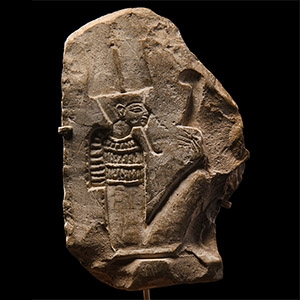
Egyptian Limestone Fragment with Seated God
Ramesside Period, 19th Dynasty, 1295-1186 B.C.Sold for (Inc. bp): £1,235
A carved limestone relief fragment depicting a squatting god Amun-Re, facing right wearing a headdress topped by two ostrich-feather plumes, a segmented mantle to the shoulders, knees drawn up supporting another ostrich plume; inked accession numbers to the reverse: '974.15', '69.10019'; accompanied by a custom-made display stand. 53 grams, 74 mm (84 grams total, 10.5 cm high including stand)
From a deceased American estate, acquired between 1970-1989. with Bonham's, London, Knightsbridge, 28 October 2009, lot 23 [Part]. Accompanied by a copy of the relevant Bonhams catalogue pages. -
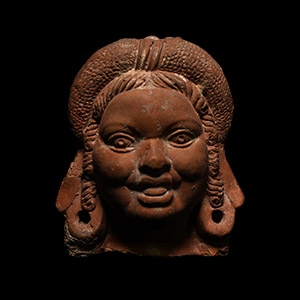
Graeco-Egyptian Head of Baubo Lamp
2nd century B.C.-2nd century A.D.Sold for (Inc. bp): £1,300
A terracotta oil lamp formed as the head of Baubo, with a smiling, plump face, wavy locks and taenia, two circular apertures at either side of her neck, expression formed with semi-naturalistic features and large extended earlobes accommodating circular apertures; circular hole to reverse and oval hole to top of head; trace remains of white gesso; vintage collection label to reverse. 245 grams, 10.4 cm
with ink inscribed label '1.2.27 CAS (22)'. From the deceased estate of N.A.C. Embiriscos, UK, 1950-1969. with Christie's London, 25 April 2001, lot 249. Accompanied by a copy of the relevant Christie's catalogue pages. -
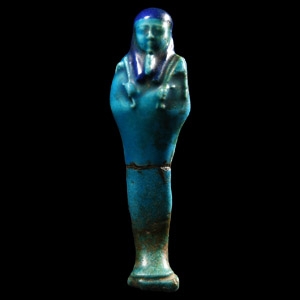
Egyptian Blue Faience Shabti
Early Ptolemaic Period, circa 3rd century B.C.Estimate: £1,000 - 1,400 (‡+bp*)
Opening Bid: £500
A mummiform shabti with a thick and lustrous turquoise glaze, sporting a tripartite wig highlighted in darker blue glaze, and a long beard; holding a pick, hoe and a cord for a seed bag hanging over the left shoulder; raised dorsal pillar and an integral plinth; repaired. 44 grams, 11.5 cm high
Ex collection of Jacques René Fiechter, Switzerland (1920-1950). with Auction Martin, Egyptian Collection André Bircher, 1949. Accompanied by an academic report by Egyptologist Paul Whelan.
The lack of inscription hinders positive identification, but the shabti’s proportions, elegant modelling, and lustrous glaze closely match others considered to have come from an area of the extensive necropolis at Abydos, labelled “Cemetery G” by its excavator Flinders Petrie, where hundreds of blue lustrous-glazed shabtis of varying qualities were recovered. This figure is closest in style to those belonging to Petosiris, son of Djed-hor. Both were buried with similarly blue lustrous-glazed shabtis that were mostly plain although a few were inscribed with an inscription.
