
Loading, please wait...

LOT 0009
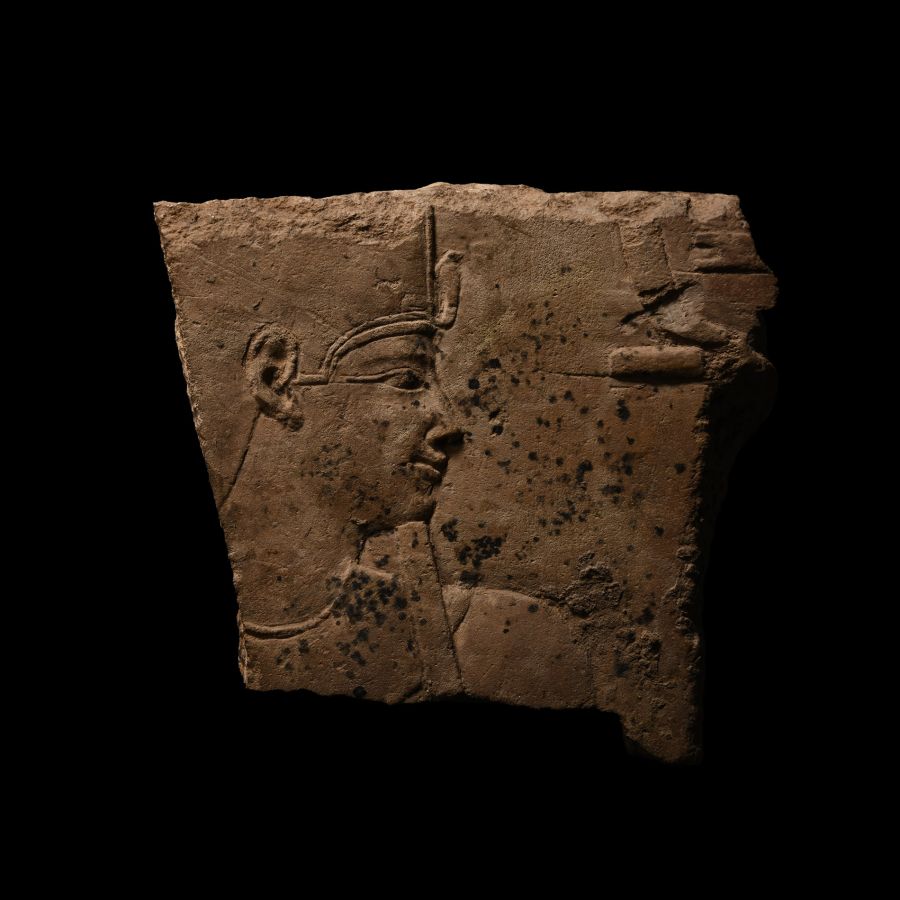
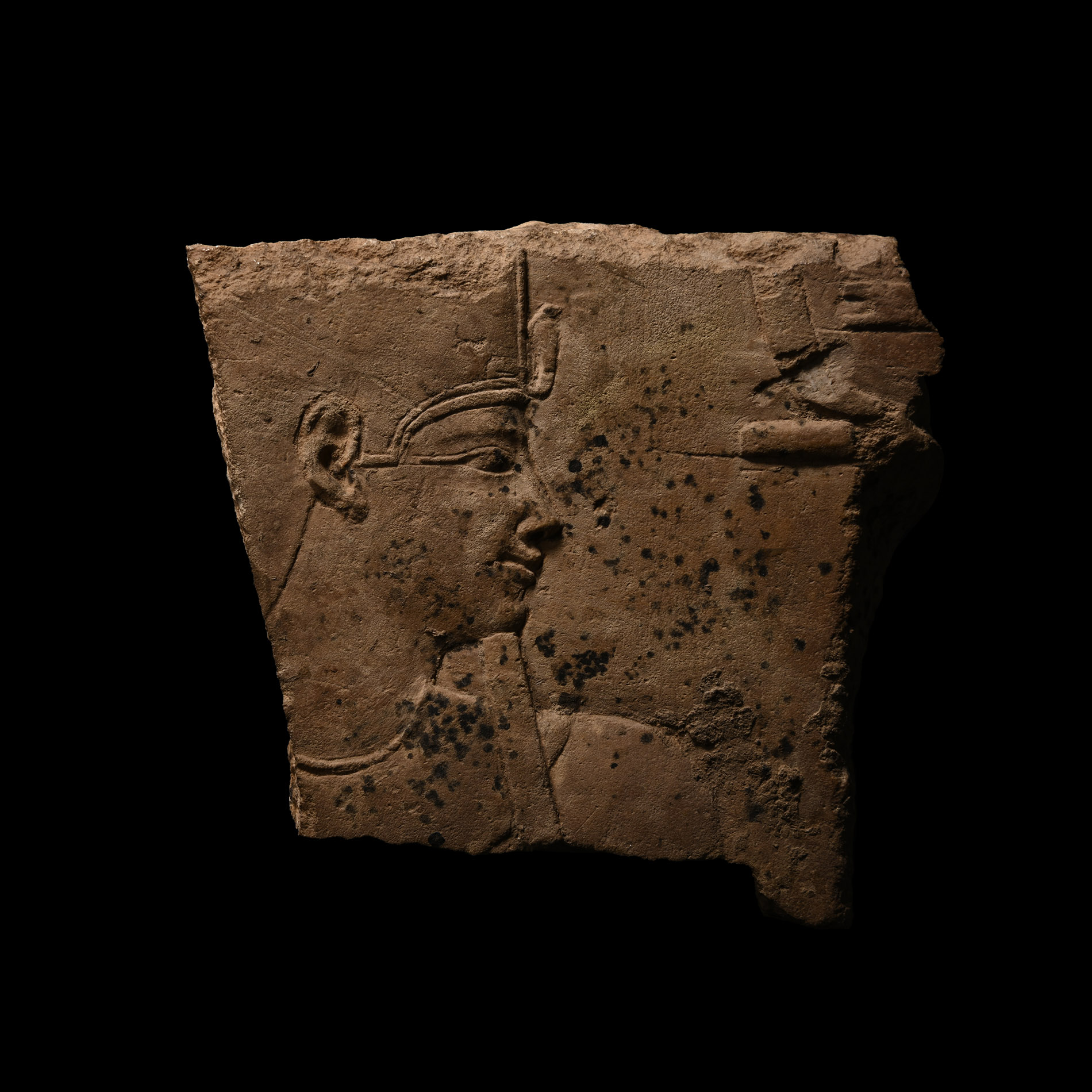
Egyptian Limestone Relief of a Ptolemaic King
PTOLEMAIC PERIOD, 332-30 B.C.
4 1/4 in. (405 grams, 11 cm).
Trapezoidal fragment bearing a low-relief depiction of a Ptolemaic king shown in profile, with characteristic plump cheeks, slightly upturned mouth, and internally detailed ear, wearing a long false beard, the Red or Dual Crown of Egypt with uraeus to the front, and a broad collar; the lower part of a cartouche to the right.
ProvenanceLéon Rodrigues-Ely (1924–1973), Marseille, France.
with Christie's, Paris, 6 May 2015, no.93.
Private collection, Europe.
Accompanied by a copy of an Art Loss Register certificate no.S00104585.
This lot has been checked against the Interpol Database of stolen works of art and is accompanied by a search certificate number no.12369-226941.
Cf. Chassinat, É., Le Temple d’Edfou,Vol.12, Cairo, 1934, pl.331, for a similar low relief representation of King Ptolemy IV in the Temple of Horus, Edfu.
FootnotesLéon Rodrigues-Ely (1924–1973) was a prominent French collector based in Marseille, known for his keen interest in fine art and antiquities. Throughout his life, Rodrigues-Ely assembled an eclectic and esteemed collection, particularly focusing on European and Mediterranean artifacts. His passion for collecting was fuelled by a deep appreciation for history and culture, and he was well-regarded among art dealers and scholars alike. Many of the pieces in his collection were acquired from significant galleries and private collections across Europe, reflecting his dedication to preserving cultural heritage. Rodrigues-Ely’s collection continued to be highly sought after following his death, with several pieces passing through prestigious auction houses, cementing his legacy in the art world.
CONDITIONTimeLine Auctions follows a vetting process to ensure the authenticity and legality of all items, reinforcing our commitment to integrity and responsible trading. Each antiquity, antique, and coin lot undergoes thorough examination by a vetting committee of at least ten external specialists, professional trade association members, scientists, and archaeologists: Our Vetting Process
AUCTIONS:
TimeLine is a leading auction house specialising in antiquities, ancient art, collectables, natural history, coins, medals, and books. Our auctions offer museums, collectors, historians, and enthusiasts the opportunity to acquire unique and historically significant pieces.
-
.jpg)
Egyptian Bronze Sistrum with Bes and Hathor
Roman Period, 30 B.C.-323 A.D.Sold for (Inc. bp): £14,950
The large liturgical rattle with a columnar handle composed of a bifacial figure of Bes standing on a lotus capital, flanked by seated sphinxes, his feathered crown supporting the bust of goddess Hathor wearing a broad collar and a curling wig, two rearing uraei emerging from the sides to support the base of the rattle, both wearing the pschent crown, above the cobras a standing figure of the goddess Hathor in cow form, wearing a tripartite wig and a sun disc between the horns; the rattle with a looped body with flared outer rims and set with three metal rods to accept metal discs, a pair of reclining lions to the base and the top with three felines surrounding a cockerel, and resting one of their front paws on the bird. 1.52 kg, 39.5 cm
German art market. European private collection, 1970s-early 2000s. Acquired from the above; thence by descent. Private collection, London, UK. Accompanied by an academic report by Dr Raffaele D’Amato. This lot has been checked against the Interpol Database of stolen works of art and is accompanied by search certificate number no.12348-225588.
The sistrum (seshesh in ancient Egyptian) was a rattle-like musical instrument, played exclusively by women in religious ceremonies. It was often decorated with the bust of the goddess Hathor to whom the sistrum was sacred. Their use continued into the Roman period in ceremonies associated with the cult of Isis. -
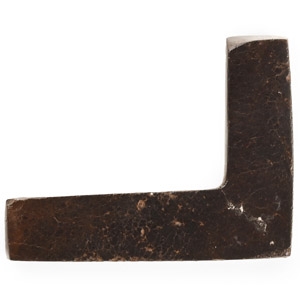
Egyptian Hardstone Architectural Amulet
Late Period, 664-332 B.C.Estimate: £200 - 300 (+bp*)
Opening Bid: £100
Carved haematite representation of a carpenter's or stonemason's set-square. 3.15 grams, 24 mm
with Hotel des Ventes, Drouot, Paris, France. From the collection of Mr H. Naudy, Paris, France. Acquired at between 2004-2010. Property of a French collector.
Amulets of the L-shaped carpenter's or stonemason's set-square, usually depicted as two rectangular strips of unequal lengths meeting at a right angle, were most frequently made of dark hard stones such as haematite, as this example. Set-square amulets were believed to bestow eternal moral uprightness upon their possessor. -
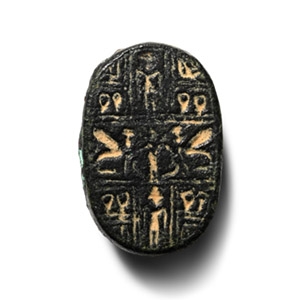
Phoenician Bronze Scarab
Late 1st millennium B.C.Estimate: £350 - 450 (+bp*)
Opening Bid: £180
Scaraboid with incised detailing to the underside, with a central column depicting standing figures top and bottom, each flanked by two ankh symbols, and a central motif of a standing figure grasping a sceptre and winged serpent in each hand. 6.54 grams, 17 mm
From an early 20th century Home Counties, UK, collection.
