
Loading, please wait...
_900x900.jpg "Egyptian Limestone Fragment with Hieroglyphs")
_200x200.jpg "Egyptian Limestone Fragment with Hieroglyphs")
.jpg "Egyptian Limestone Fragment with Hieroglyphs")
LOT 0518
Egyptian Limestone Fragment with Hieroglyphs
OLD KINGDOM, 2700-2200 B.C.
7 1/2 in. (1.5 kg, 19 cm).
A limestone fragment of provincial workmanship, displaying a partial column of titular naming hieroglyphs, possibly royal; repaired. [No Reserve]
ProvenanceLondon collection, acquired on the art market in the 1980s.
From the collection of a West London, UK, gentleman.
TimeLine Auctions follows a vetting process to ensure the authenticity and legality of all items, reinforcing our commitment to integrity and responsible trading. Each antiquity, antique, and coin lot undergoes thorough examination by a vetting committee of at least ten external specialists, professional trade association members, scientists, and archaeologists: Our Vetting Process
AUCTIONS:
TimeLine is a leading auction house specialising in antiquities, ancient art, collectables, natural history, coins, medals, and books. Our auctions offer museums, collectors, historians, and enthusiasts the opportunity to acquire unique and historically significant pieces.
-
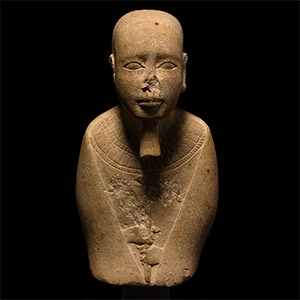
Egyptian Bust of Ptah
Late Period, 26th-30th Dynasty, circa 664-343 B.C.Sold for (Inc. bp): £13,000
A white limestone figure of the god Ptah with false beard, wearing an enveloping cloak and a broad wesekh-collar, holding the shaft of a was sceptre; serene, oval face with almond-shaped eyes and fleshy lips; remnants of dorsal pillar to reverse; mounted on a custom-made display stand. 1.39 kg total, 22.3 cm high including stand
Ex private Belgium collection, 1960s. with Vanderkindere Auctions, Brussels, Belgium, 26 February 2013, lot 261. English private collection. This lot has been checked against the Interpol Database of stolen works of art and is accompanied by search certificate no.11605-199743. Accompanied by a scholarly note by Egyptologist Paul Whelan.
Ptah is attested from the beginning of ancient Egypt’s dynastic history and was a creator god, a god of craftsmen, and the patron deity of the Memphite region. The principal temple of the god was located in the city of Memphis. The fragmentary back pillar on this statuette indicates that it was most probably a temple offering, originally inscribed with an invocation to Ptah together with the donor’s name. Such votive figurines with back pillars naming the god and the dedicator occur in various materials, including faience and stone. -
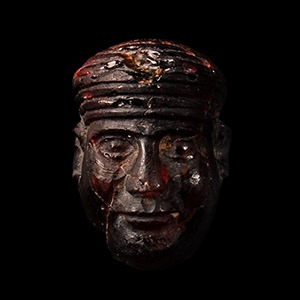
Egyptian Male Head Inlay
Late New Kingdom, 1550-1070 B.C.Estimate: £800 - 1,000 (+bp*)
Opening Bid: £400
A glass or garnet model of a clean-shaven male head with a headdress formed as rope bands; amuletic insert for a piece of jewellery. 12.5 grams, 24 mm high
with HVMC, Hotel des Ventes de Monte-Carlo, 19 January 2022, lot 63. English private collection. -
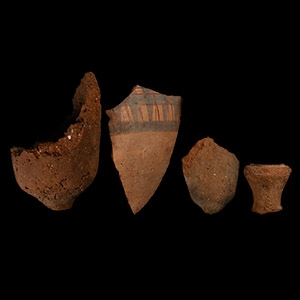
Egyptian Tell el Amarna Artefact Collection
New Kingdom, 18th Dynasty, 1350-1334 A.D.Sold for (Inc. bp): £182
A group of five ceramic fragments from Tell el Amarna, comprising: a bread mould fragment with one rounded face, believed to originate from the Small Aten Temple; a decorated blue ware fragment featuring a polychrome painted geometric design; a fragment believed to have come from the King's House, Tell el Amarna; a probable miniature vessel with foot and chipped rim. 711 grams total, 5.2-14.4 cm
From an old UK collection. From the private collection of Alf Baxendale (1941-2016) part 2, keen Egyptologist, member of the Egyptology Society, trustee of the Amarna Trust; thence by descent. Accompanied by three identification display cards. Accompanied by a copy of his obituary published in Horizon, The Amarna Project and Amarna Trust newsletter, Issue 18, 2017, p.21, by Barry John Kemp, CBE, FBA, Professor Emeritus of Egyptology at the University of Cambridge and directing excavations at Amarna in Egypt.
