
Loading, please wait...


LOT 0007
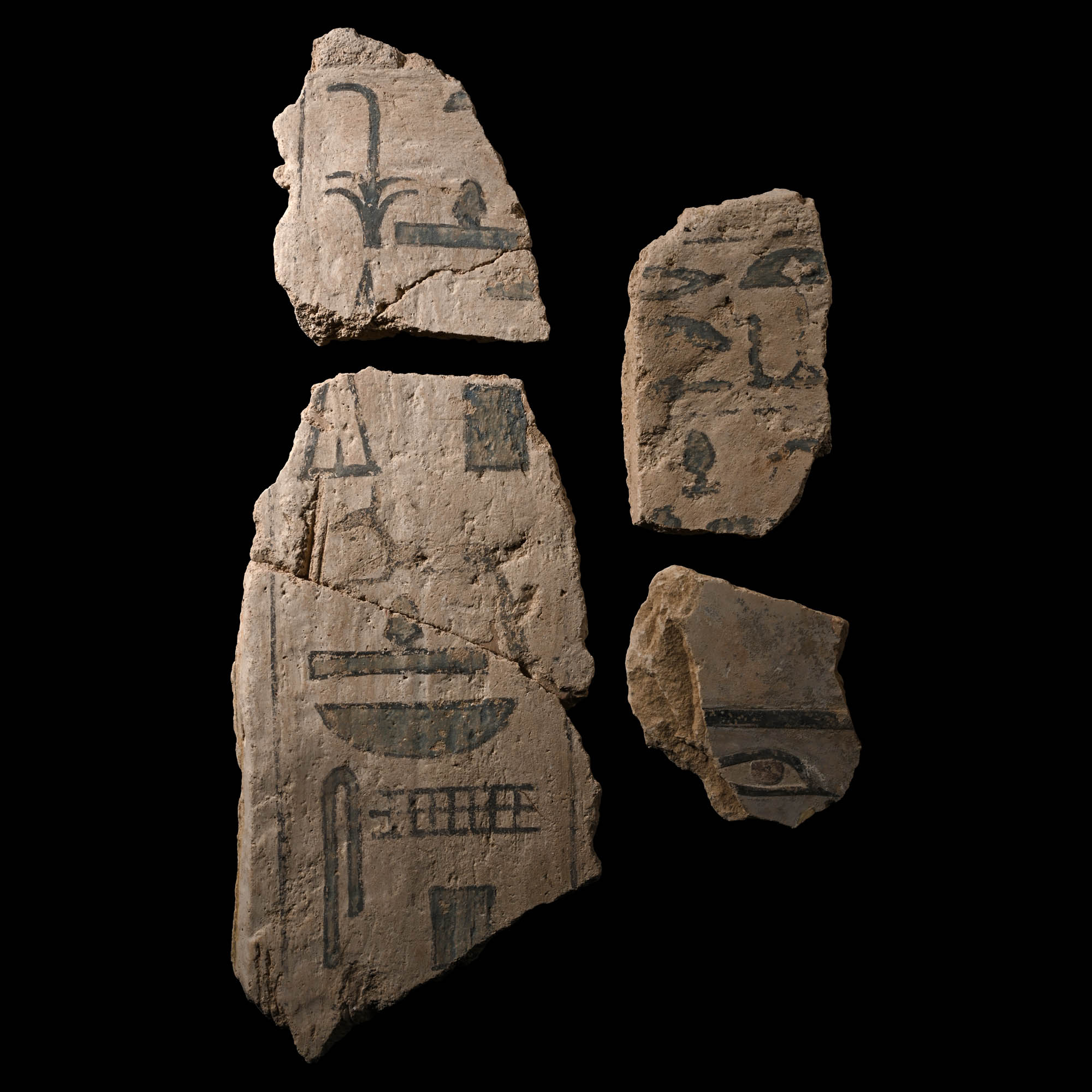
Egyptian Limestone Fragment Group
MIDDLE KINGDOM, 2035-1550 B.C.
4 - 10 7/8 in. (1.03 kg total, 10.1-27.7 cm).
Comprising four fragments of dressed and plastered wall, each with painted hieroglyphs in blue, green and black shades, some with low-relief modelling. [4]
ProvenanceAcquired in the mid 1980s-1990s.
Private collection, Switzerland, thence by descent.
Private collection, since the late 1990s.
Cf. Oppenheim, A., Arnold, Do., Arnold, D., Yamamoto, K. (eds.), Ancient Egypt Transformed: The Middle Kingdom, New York, 2015, p.61, cat.11 detail, for similar styling of the eye and eyebrow.
FootnotesThese fragments seem to be sections of tomb wall reliefs. They include portions of an offering formula, mention of a 'district', a festival, and the symbol of Anubis. The decoration in different parts of some Middle Kingdom tombs had scenes and texts applied in paint or executed with raised relief carving.
CONDITIONTimeLine Auctions follows a vetting process to ensure the authenticity and legality of all items, reinforcing our commitment to integrity and responsible trading. Each antiquity, antique, and coin lot undergoes thorough examination by a vetting committee of at least ten external specialists, professional trade association members, scientists, and archaeologists: Our Vetting Process
AUCTIONS:
TimeLine is a leading auction house specialising in antiquities, ancient art, collectables, natural history, coins, medals, and books. Our auctions offer museums, collectors, historians, and enthusiasts the opportunity to acquire unique and historically significant pieces.
-
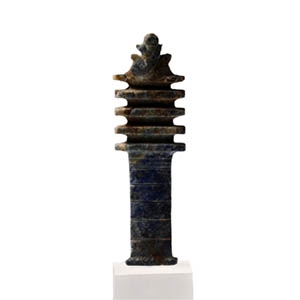
Egyptian Lapis Lazuli Amulet of a Djed Pillar
New Kingdom, 18th Dynasty, circa 1550-1295 B.C.Sold for (Inc. bp): £585
Carved as a square-section column with transverse ribs and a decorative finial, incised transverse lines to the body; mounted on a custom-made display stand. 4.84 grams, 49 mm (8.6 grams total, 64 mm including stand)
Ex R. Liechti (1934-2010) collection, Geneva, Switzerland. Private collection, Europe.
The djed pillar signifies the concepts of 'enduring' and 'stability' and was a common funerary amulet from the Old Kingdom onwards. It was first associated with the gods Ptah and Sokar but later became a symbol of Osiris, representing the god's backbone. In this context, the djed pillar appears in Chapter 155 of the Book of the Dead, concerned with the deceased's resurrection. R. Liechti was a distinguished collector of Egyptian antiquities, known for his discerning eye and passion for ancient artefacts. Active during the mid-20th century, Liechti's collection featured a wide range of objects that showcased the rich cultural heritage of ancient Egypt, from intricately carved statuettes to rare amulets and jewellery. His dedication to preserving and studying these relics earned him a respected reputation among scholars and collectors alike. Many pieces from his collection have since found their way into prominent museum collections and auction houses, further solidifying his legacy in the world of antiquities. -
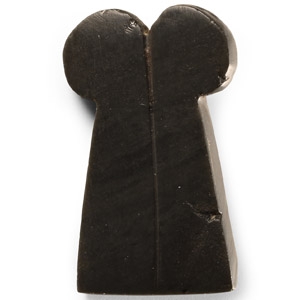
Egyptian Hardstone Double Plume Amulet
Late Period, 664-332 B.C.Estimate: £200 - 300 (+bp*)
Opening Bid: £100
Carved with integral ribbed loop to the reverse; unfinished. 4.4 grams, 31 mm
with Hotel des Ventes, Drouot, Paris, France. From the collection of Mr H. Naudy, Paris, France. Acquired at between 2004-2010. Property of a French collector.
This ancient amulet represents two ostrich feathers or shuty. Interestingly, these feathers were also present on the Atef crown of Osiris, the god of the afterlife and the dead. This suggests the amulet was believed to imbue the wearer with Osiris's divine power and protection. -
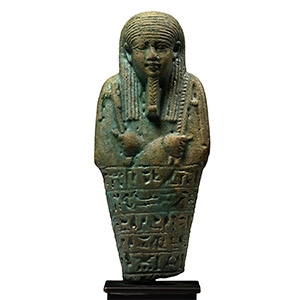
Very Large Egyptian Faience Shabti for Hor-Aset
Late Period, 664-322 B.C.Sold for (Inc. bp): £2,860
The upper part of a large mummiform shabti wearing a striated tripartite wig and long plaited divine beard, holding a pick in the left hand, the right hand holding a hoe and the cord of a seed bag hanging over his left shoulder; the face expertly modelled with carefully rendered cosmetic lines around the eyes, slightly smiling lips giving it a serene expression; plain back pillar terminating at the base of the wig; five horizontal rows of hieroglyphic inscription giving the dedication sḥḏ wsı͗r ḥr (-pn-n-) Ꜣst, ‘The illuminated one, the Osiris Hor (pen-en) Aset’ followed by a version of Chapter 6 from the Book of the Dead; mounted on a custom-made display stand. 509 grams total, 20 cm including stand
Ex Y.F. collection. Acquired in the US, 2011. with Medusa Ancient Art, Quebec. Private collection, Europe. This lot has been checked against the Interpol Database of stolen works of art and is accompanied by a search certificate number no.12374-226922.
