
Loading, please wait...
_900x900.jpg "Egyptian Limestone False Door Relief Panel")
_200x200.jpg "Egyptian Limestone False Door Relief Panel")
.jpg "Egyptian Limestone False Door Relief Panel")
LOT 0006
Egyptian Limestone False Door Relief Panel
MIDDLE KINGDOM, CIRCA 1900-1750 B.C.
11 1/4 in. (4.12 kg, 28.7 cm).
Rectangular panel from a false door stela carved in sunk relief with raised vertical borders framing a scene with a male figure wearing a knee-length kilt, collar and short wig, seated on a stool with lion-claw feet, holding a bolt of cloth in his left hand; before him, a pedestal table with splayed feet, the top laden with vertical loaves; traces of pigment to the collar, kilt and table; rear face dressed but plain.
ProvenanceAcquired in the mid 1980s-1990s.
Private collection, Switzerland, thence by descent.
Private collection, since the late 1990s.
Cf. Hein, I., and Satzinger, H., Stelen des Mittleren Reiches II: einschliesslich der I. und II. zwischenzeit Kunsthistorisches Museum, Wien ägyptisch-orientalische sammlung, Corpus Antiquitatum Aegyptiacarum, Mainz am Rhein, 1993, pp.136-139 for a complete false door stela with a similar scene of the deceased seated before an offering table.
FootnotesThe ancient Egyptians believed the soul of the departed could move in and out of the tomb using a ‘false door.’ This door was identified by a recessed surface with a symbolic entrance at its centre. In the Middle Kingdom, the false door design was combined with other elements or represented by a raised border and cornice above on rectangular stelae.
CONDITIONTimeLine Auctions follows a vetting process to ensure the authenticity and legality of all items, reinforcing our commitment to integrity and responsible trading. Each antiquity, antique, and coin lot undergoes thorough examination by a vetting committee of at least ten external specialists, professional trade association members, scientists, and archaeologists: Our Vetting Process
AUCTIONS:
TimeLine is a leading auction house specialising in antiquities, ancient art, collectables, natural history, coins, medals, and books. Our auctions offer museums, collectors, historians, and enthusiasts the opportunity to acquire unique and historically significant pieces.
-

Egyptian Bone Ram-Headed Boat with Two Deities
Late Period, 664-332 B.C.Sold for (Inc. bp): £624
Carved in the round reed boat with ram-headed prow, altar amidships surmounted by a horned sun disc and flanked by two baboons standing in adoration; repaired. 10.4 grams, 55 mm
From the collection of a gentleman, acquired on the London art market in the 1990s.
This represents a condensed version of a two-dimensional funerary scene of the sun god Re, here represented by the horned disc, in his solar barque, flanked by baboons in an attitude of praise. The boat's ram-headed prow possibly alludes to Re's transformation into a ram during his night-time journey through the Underworld. -
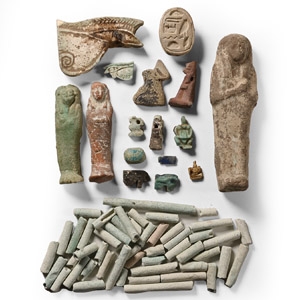
Egyptian Faience Amulet and Bead Group
Mainly Late Period, 664-332 B.C.Sold for (Inc. bp): £390
Comprising tubular beads, wedjat-eye amulets, shabtis, scarabs, and other items. 57 grams total, 8-71 mm
From the private collection of H. Norry, 1980s-1990s. -
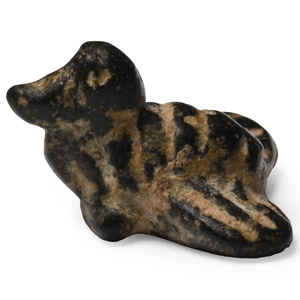
Phoenician Stone Bird-Shaped Weight
Late 1st millennium B.C.Sold for (Inc. bp): £351
Fashioned as a seated bird with partly outspread wings. 4.15 grams, 15 mm
From a London, UK, based collection, 1990s.
