
Loading, please wait...
LOT 0030
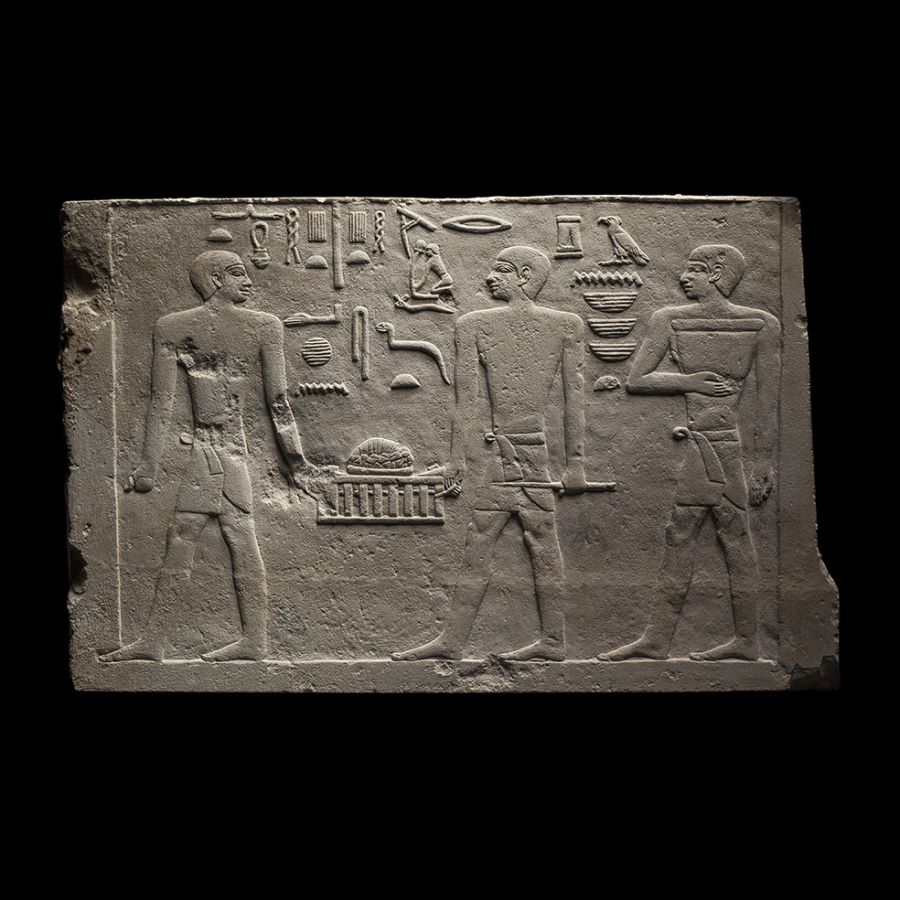
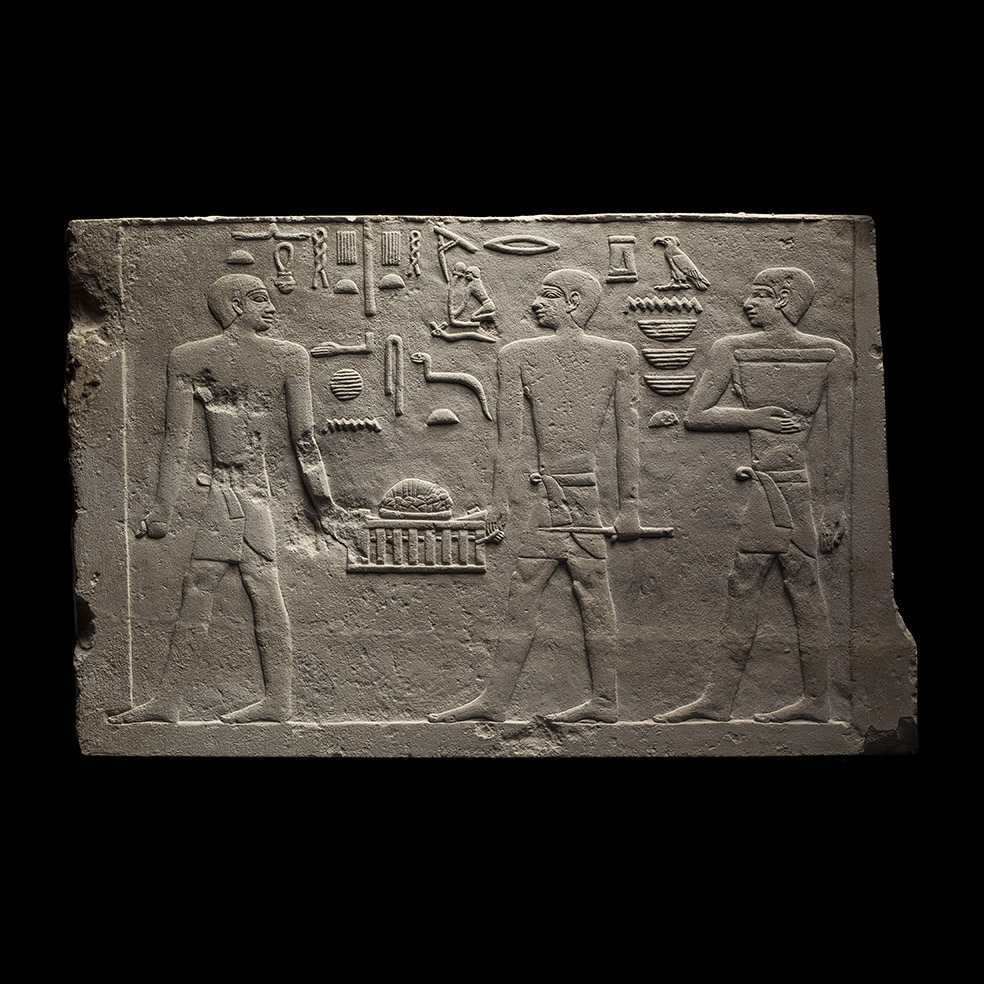
Egyptian Limestone Bas-Relief Panel of Ptah Presiding Over the Smelting of Metals
OLD KINGDOM, 5TH DYNASTY, 2498-2345 B.C.
21 in. (21.35 kg total, 53.5 cm wide including stand).
This expertly carved high-relief scene depicts three male figures with short hairstyles, each wearing a short kilt tied at the waist; the left and central figures carry a small furnace by curved handles, preparing to smelt copper; the central figure also holds a metal poker in his free hand; the figure on the left supports a large container at chest level with one hand; finely rendered hieroglyphic inscriptions in front of each figure record a dialogue among the three metalworkers; the leftmost figure, facing the others, declares “Ptah could not have done better”; the central figure responds with three lines of text “Ptah loves him to pour (into) the brazier of the flame”; the inscription before the rightmost figure reads “copper of the baskets”; together, the second and third texts may be interpreted as “Ptah would love him to pour copper from the baskets into the furnace”; the composition likely formed part of a larger scene illustrating metalworking activities; supplied with a custom-made stand.
Provenancewith Toufic Arakji, Hamburg, by circa 1980.
Private collection, acquired from the above, circa 1980-1994.
with Sotheby’s, New York, Antiquities and Islamic Art, 8 June 1994, no.23.
Private collection, 1994-2010, acquired at the above sale.
with David Aaron, London, UK, 2010-2011.
with Daniel Katz Gallery, London, UK.
UK private collection.
Accompanied by an academic report by Egyptologist Sylvie Caroff.
Accompanied by a copy of an Art Loss Register certificate no.S00142449.
This lot has been cleared against the Art Loss Register database, and is accompanied by an illustrated lot declaration signed by the Head of the Antiquities Department, Dr Raffaele D'Amato.
For a comparable scene, see Hayes, W.C., The Scepter of Egypt, vol. I, p. 98, where a similar composition is described from the tomb of Re-em-kuy.
FootnotesThe mention of Ptah – patron god of craftsmen – links this piece to Memphis, suggesting it came from the tomb of a high-ranking official or priest.
CONDITIONTimeLine Auctions follows a vetting process to ensure the authenticity and legality of all items, reinforcing our commitment to integrity and responsible trading. Each antiquity, antique, and coin lot undergoes thorough examination by a vetting committee of at least ten external specialists, professional trade association members, scientists, and archaeologists: Our Vetting Process
AUCTIONS:
TimeLine is a leading auction house specialising in antiquities, ancient art, collectables, natural history, coins, medals, and books. Our auctions offer museums, collectors, historians, and enthusiasts the opportunity to acquire unique and historically significant pieces.
LOT 0030
Egyptian Limestone Bas-Relief Panel of Ptah Presiding Over the Smelting of Metals
Estimate £80,000 - 100,000€92,800 - 116,000 (for guidance only)$108,000 - 135,000 (for guidance only)
-
.jpg)
Egyptian Body of Anubis Glass Inlay
Late Period-Ptolemaic Period, 664-30 B.C.Sold for (Inc. bp): £208
With gently curved obverse and flat reverse, section of an inlay depicting Anubis, with thick neck and beginning of extended foreleg. 110 grams, 96 mm
Acquired on the French art market, 1980s. with Bonhams, London, 13 April 2011, lot 21. Accompanied by copies of the relevant Bonhams catalogue pages. This lot is accompanied by an illustrated lot declaration signed by the Head of the Antiquities Department, Dr Raffaele D'Amato.
This coloured glass inlay depicts Anubis, the jackal-headed god of mummification and protector of the dead. Likely part of a coffin or shrine, it demonstrates the use of glass to imitate precious materials in elite funerary art. The figure’s profile and predominantly black colour evoke Anubis’s role in preservation and the afterlife. -
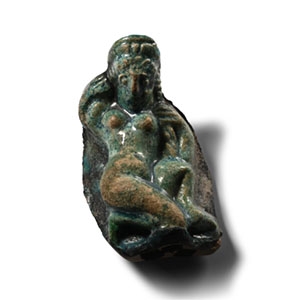
Egyptian Applique with Aphrodite
Ptolemaic Period, 332-30 B.C.Estimate: £600 - 800 (‡+bp*)
Opening Bid: £250
Fragment from a representation of the nude Aphrodite in high-relief, crouching with her left knee raised and her right knee touching the ground, holding her long hair with her hands and wearing a diadem on her head; an appliqué from a vessel with minor filling at the right thigh. 85 grams, 86 mm
Private collection, Somerset, England. with M.B., Los Angeles County, acquired 2014-2015 at a sale in the UK. with Ancient Resource, USA, Auction 70, 06 October 2018, no.7. This lot has been checked against the Interpol Database of stolen works of art and is accompanied by a search certificate number no.12827-240895. This lot is accompanied by an illustrated lot declaration signed by the Head of the Antiquities Department, Dr Raffaele D’Amato. This lot is accompanied by an illustrated lot declaration signed by the Head of the Antiquities Department, Dr Raffaele D'Amato. -
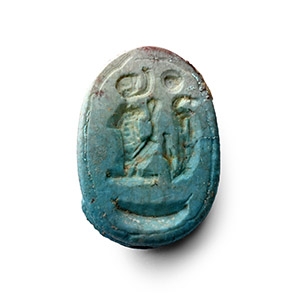
Egyptian Faience Frog Scaraboid with Hieroglyphs
Ptolemaic Period, circa 300 B.C.Sold for (Inc. bp): £195
Ellipsoid in plan with crouching frog to the upper face, incuse legend to the underside. 3.92 grams, 20 mm
Acquired on the European art market in the early 2000s. with Galerie Rhéa, Zurich, Switzerland. This lot is accompanied by an illustrated lot declaration signed by the Head of the Antiquities Department, Dr Raffaele D'Amato.
