
Loading, please wait...

LOT 0034
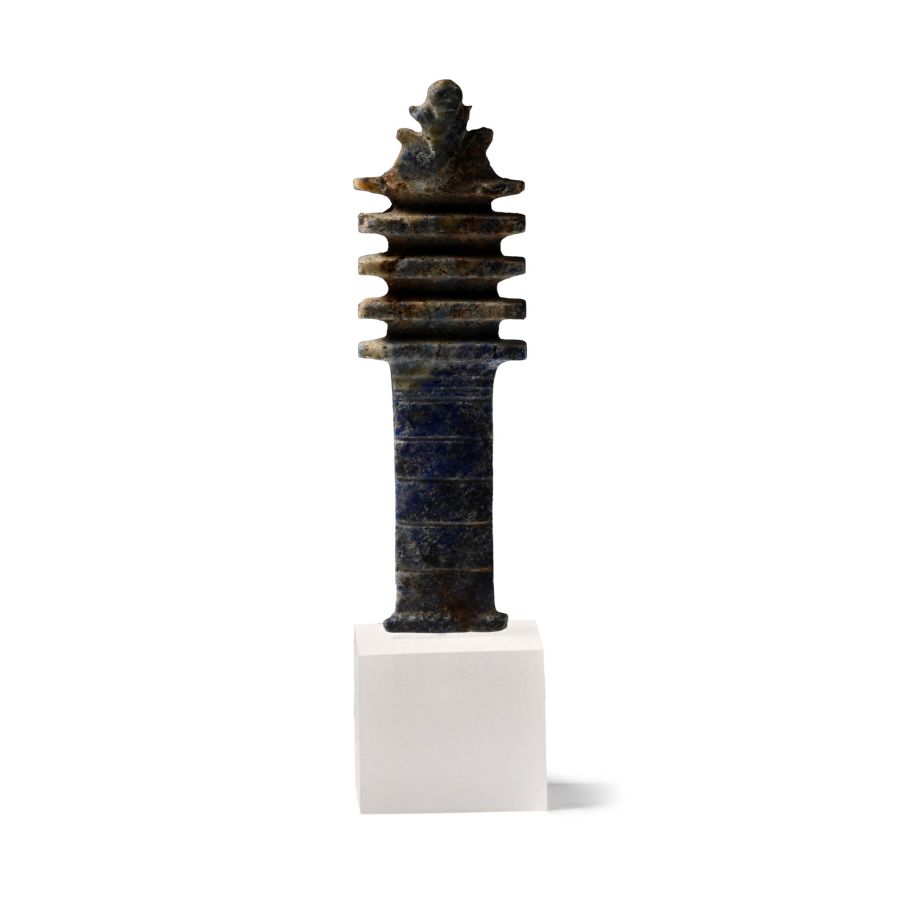
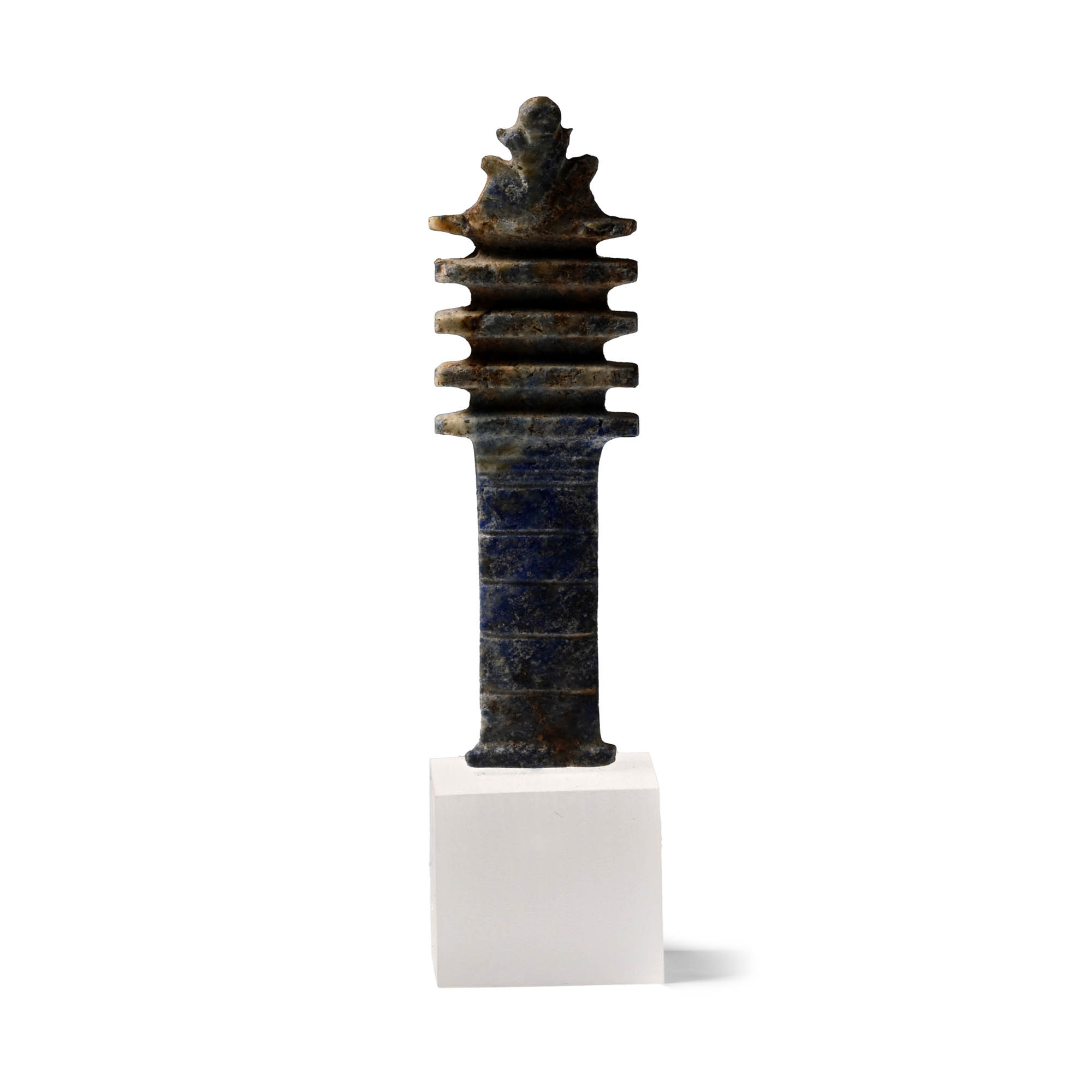
Egyptian Lapis Lazuli Amulet of a Djed Pillar
NEW KINGDOM, 18TH DYNASTY, CIRCA 1550-1295 B.C.
2 in. (2 1/2 in.) (4.84 grams, 49 mm (8.6 grams total, 64 mm including stand)).
Carved as a square-section column with transverse ribs and a decorative finial, incised transverse lines to the body; mounted on a custom-made display stand.
ProvenanceEx R. Liechti (1934-2010) collection, Geneva, Switzerland.
Private collection, Europe.
Cf. National Museums Liverpool, accession no.M11918a, for a later example in lapis lazuli.
FootnotesThe djed pillar signifies the concepts of 'enduring' and 'stability' and was a common funerary amulet from the Old Kingdom onwards. It was first associated with the gods Ptah and Sokar but later became a symbol of Osiris, representing the god's backbone. In this context, the djed pillar appears in Chapter 155 of the Book of the Dead, concerned with the deceased's resurrection.
R. Liechti was a distinguished collector of Egyptian antiquities, known for his discerning eye and passion for ancient artefacts. Active during the mid-20th century, Liechti's collection featured a wide range of objects that showcased the rich cultural heritage of ancient Egypt, from intricately carved statuettes to rare amulets and jewellery. His dedication to preserving and studying these relics earned him a respected reputation among scholars and collectors alike. Many pieces from his collection have since found their way into prominent museum collections and auction houses, further solidifying his legacy in the world of antiquities.
TimeLine Auctions follows a vetting process to ensure the authenticity and legality of all items, reinforcing our commitment to integrity and responsible trading. Each antiquity, antique, and coin lot undergoes thorough examination by a vetting committee of at least ten external specialists, professional trade association members, scientists, and archaeologists: Our Vetting Process
AUCTIONS:
TimeLine is a leading auction house specialising in antiquities, ancient art, collectables, natural history, coins, medals, and books. Our auctions offer museums, collectors, historians, and enthusiasts the opportunity to acquire unique and historically significant pieces.
-
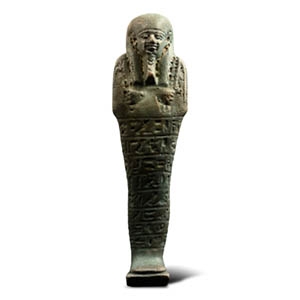
Large Egyptian Blue Glazed Hieroglyphic Shabti
26th Dynasty, 664-525 B.C.Estimate: £1,500 - 2,000 (+bp*)
Opening Bid: £700
Of mummiform type, wearing a tripartite wig and long plaited divine beard, with arms crossed and the left hand holding a pick, the right hand holding a hoe and the cord of a seed bag hanging over his left shoulder, with carefully rendered cosmetic lines around the eyes, narrow eyebrows, and slightly smiling lips giving it a serene expression characteristic of the finest ushabtis of the period; standing on an integral plinth from which a plain back pillar terminating at the base of the wig extends; eight horizontal rows of hieroglyphic inscription, the Sixth Chapter of the Book of the Dead; water worn. 235 grams, 18.6 cm
Acquired on the German art market, 1989-1995. with The Museum Gallery, 19 Bury Place, London, WC1, UK, 1998-2003. Property of a London based academic, 2003-present. -
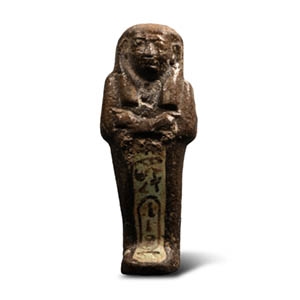
Egyptian Brown Glazed Shabti for Queen Isetnofret
New Kingdom, 12th century B.C.Estimate: £2,000 - 3,000 (+bp*)
Opening Bid: £1,000
Of mummiform type, wearing a tripartite wig, stylised facial features with large ears, hands crossed at the chest; a contrasting green-glazed frontal column of hieroglyphic text with a cartouche which reads wsỉr nswt wrt Ꜣst-nfr.t, ‘The Osiris, the great king's wife Iset-nofret’. 88 grams, 10.8 cm
Acquired on the German art market, 1989-1995. with The Museum Gallery, 19 Bury Place, London, WC1, UK, 1998-2003. Property of a London based academic, 2003-present. This lot has been checked against the Interpol Database of stolen works of art and is accompanied by a search certificate number no.12373-226026.
Several late New Kingdom queens were named Iset-nofret, but this particular example is likely associated with one of the two wives of Ramesses II who had the same name. One of these queens gave birth to Prince Khaemwaset and is mentioned on monuments erected by him. While it is possible that the queen's shabtis were used for funerary purposes, Khaemwaset is known to have placed his own shabtis as votives in non-sepulchral locations in the Memphite necropolises, and it is possible that he also did the same with shabtis naming his mother. For a discussion of the Ramesside queens with this name, see Tyldesley, J., Chronicle of the Queens of Egypt, London, 2006, p.154ff. -
.jpg)
Egyptian Steatite Scarab with Bes
Late Period, 664-332 B.C.Estimate: £150 - 200 (+bp*)
Opening Bid: £75
Plano-convex in section with detailed obverse, the underside with the figure of Bes flanked by adoring baboons and sun discs. 10.7 grams, 31 mm
Ex London, UK collection, 1990s.
Bes became one of ancient Egypt's most popular apotropaic deities from the New Kingdom onwards. Despite his somewhat fearful appearance, Bes was the patron and protector of pregnant women and children and believed to protect the wearer from snakes. The depiction of baboons flanking Bes with their arms raised before the sun disk was a common feature on temple wall reliefs. In ancient Egyptian religious literature, baboons heralded the dawn and, thus, the rebirth of the sun.
