
Loading, please wait...
LOT 0436
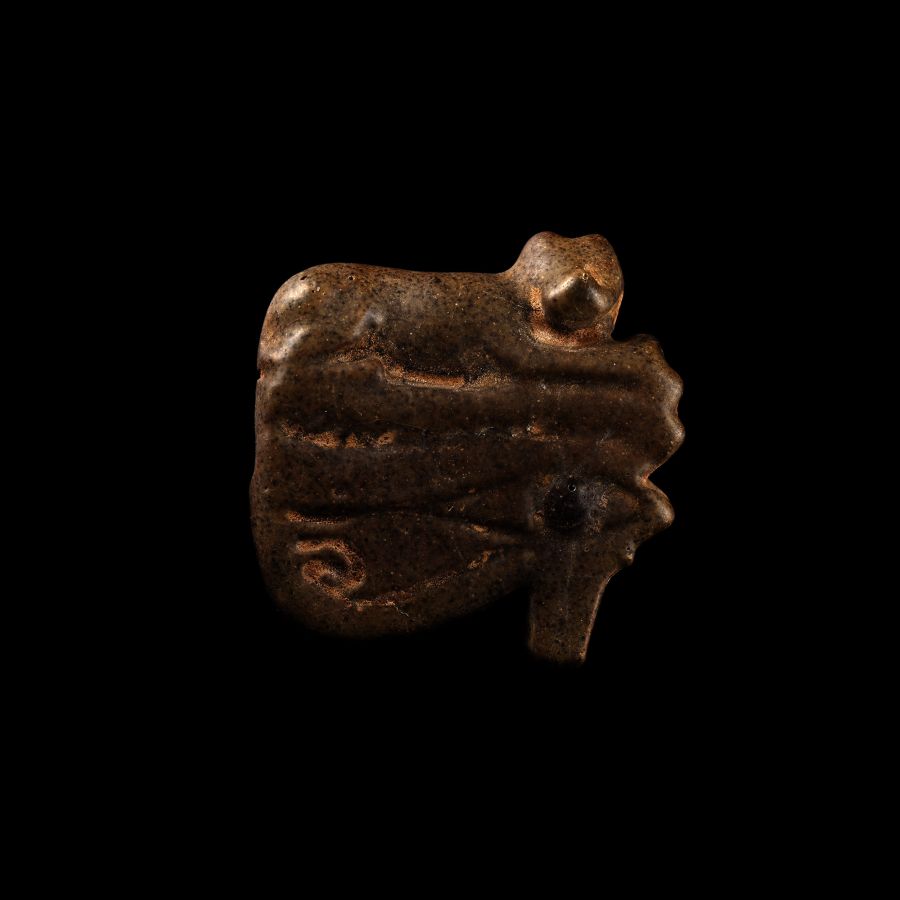
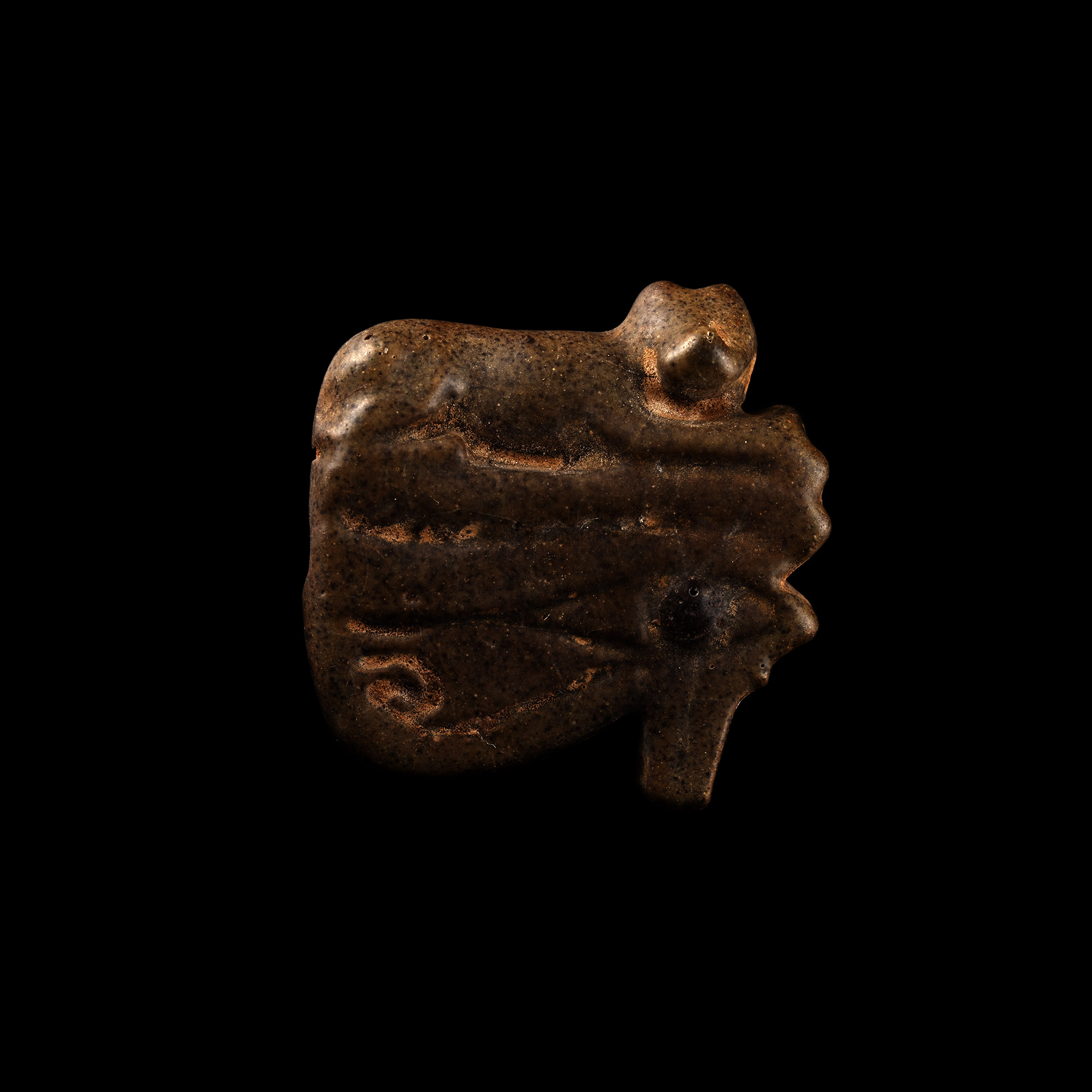
Egyptian Hardstone Eye of Horus with Recumbent Lion
LATE PERIOD, 664-332 B.C.
1 1/8 in. (6.79 grams, 29 mm).
Wedjat-eye amulet with reclining lioness to the top, pierced for suspension.
ProvenanceFrom an early 20th century collection.
Ex London, UK, gallery.
This lot is accompanied by an illustrated lot declaration signed by the Head of the Antiquities Department, Dr Raffaele D'Amato.
Cf. Petrie, W.M.F., Amulets. Illustrated by the Egyptian Collection in University College, London, 1914, pl. XXIV, no. 141k, for a similar example.
FootnotesThe wedjat-eye and lioness are potent, often intertwined symbols in ancient Egyptian mythology. The wedjat, representing Horus’s healed eye, signifies protection and healing, while the lioness—linked to the goddesses Sekhmet, Bastet, and Wadjet—embodies power and fierce defence as the “Eye of Ra”. Together in amulets, as in Egyptian art, they convey healing, protection, and strength. Sometimes the name of a specific goddess was inscribed on the back of the amulet, though here the recumbent lioness serves as the divine symbol.
CONDITIONTimeLine Auctions follows a vetting process to ensure the authenticity and legality of all items, reinforcing our commitment to integrity and responsible trading. Each antiquity, antique, and coin lot undergoes thorough examination by a vetting committee of at least ten external specialists, professional trade association members, scientists, and archaeologists: Our Vetting Process
AUCTIONS:
TimeLine is a leading auction house specialising in antiquities, ancient art, collectables, natural history, coins, medals, and books. Our auctions offer museums, collectors, historians, and enthusiasts the opportunity to acquire unique and historically significant pieces.
LOT 0436
Egyptian Hardstone Eye of Horus with Recumbent Lion
Estimate £300 - 400€350 - 460 (for guidance only)$410 - 540 (for guidance only)
-
.jpg)
Very Large Phoenician Stone Scarab with Hieroglyphics
8th-7th century B.C.Estimate: £8,000 - 10,000 (‡+bp*)
Opening Bid: £4,000
Plano-convex in section with segmented carapace and longitudinal piercing; underside with dense eight-line hieroglyphic text. 209 grams, 68 mm
Private collection, Switzerland, circa 1980. Acquired in 1994. Private collection, Switzerland, thence by descent. Private collection, since the late 1990s. This lot has been checked against the Interpol Database of stolen works of art and is accompanied by a search certificate number no.12850-241676. This lot has been cleared against the Art Loss Register database, and is accompanied by an illustrated lot declaration signed by the Head of the Antiquities Department, Dr Raffaele D'Amato. -
.jpg)
Egyptian Faience Figure of Nefertum
Ptolemaic Period, 332-30 B.C.Estimate: £500 - 700 (‡+bp*)
Opening Bid: £278
In a striding pose with arms at the sides, sporting a black coloured tripartite wig surmounted by the god's distinctive headdress consisting of a lotus flower with two plumes on top; a suspension loop at the back; repaired. 71 grams total, 13 cm including stand
Property from an American deceased estate, acquired between 1970 and 1989. with Bonham's, London, 28 October 2009, no.81 [Part]. This lot is accompanied by an illustrated lot declaration signed by the Head of the Antiquities Department, Dr Raffaele D'Amato.
Nefertum was closely associated with the creator god Ptah and the goddesses Sekhmet and Bastet. He represented the first sunlight and the sweet scent of the Egyptian blue lotus flower (nymphaea caerulea). According to beliefs, the sun rose from the bloom of a blue lotus, embodying notions of rebirth and rejuvenation. Additionally, as the lotus was seen as a symbol of fertility, it is possible that this amulet was also worn for that purpose. -
Egyptian Wooden Shabti
New Kingdom, 19th Dynasty, 1293-1185 B.C.Sold for (Inc. bp): £2,080
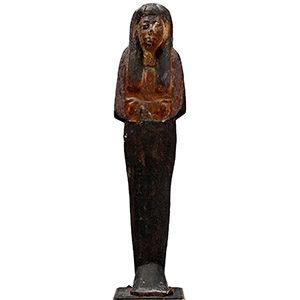
Carved in the round with detailed tripartite wig, hands crossed at the chest; some painted and gilded(?) plaster surface; mounted on a later base. 332 grams, 26.9 cm
From the collection of Mrs Kilvert, who fled from France to England during the French Revolution. Received by gift to the Hodge family from Mrs Kilvert at Bath in 1864-1865; thence by descent to the grandchildren of Mr John Hodge, a private London tutor. From the collection of a New Zealand family; thence by descent. This lot has been checked against the Interpol Database of stolen works of art and is accompanied by a search certificate number no.12846-239090. This lot has been cleared against the Art Loss Register database, and is accompanied by an illustrated lot declaration signed by the Head of the Antiquities Department, Dr Raffaele D'Amato.
A shabti, also known as ushabti or shawabti, is a small funerary figurine found in ancient Egyptian tombs, dating from around 2000 BCE to 30 BCE. Its main purpose was to serve as a servant for the deceased in the afterlife, carrying out manual tasks such as farming or irrigation. Shabtis were often inscribed with a magical formula from the Book of the Dead to ensure they would animate when summoned. The distinctive, lighter-coloured, and previously part-gilded upper body decoration, contrasting with the black used for the rest of the figure, may symbolise the moment of rebirth, when the face of the deceased was bathed in the sun's rays.
