
Loading, please wait...
LOT 0502
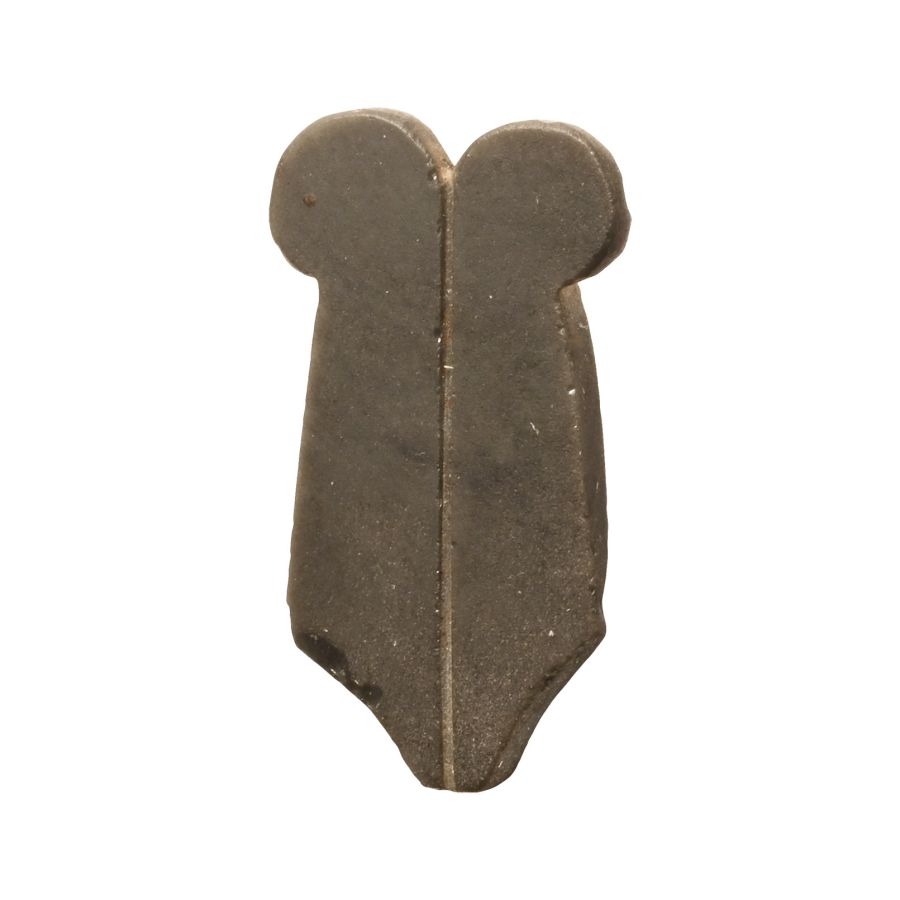
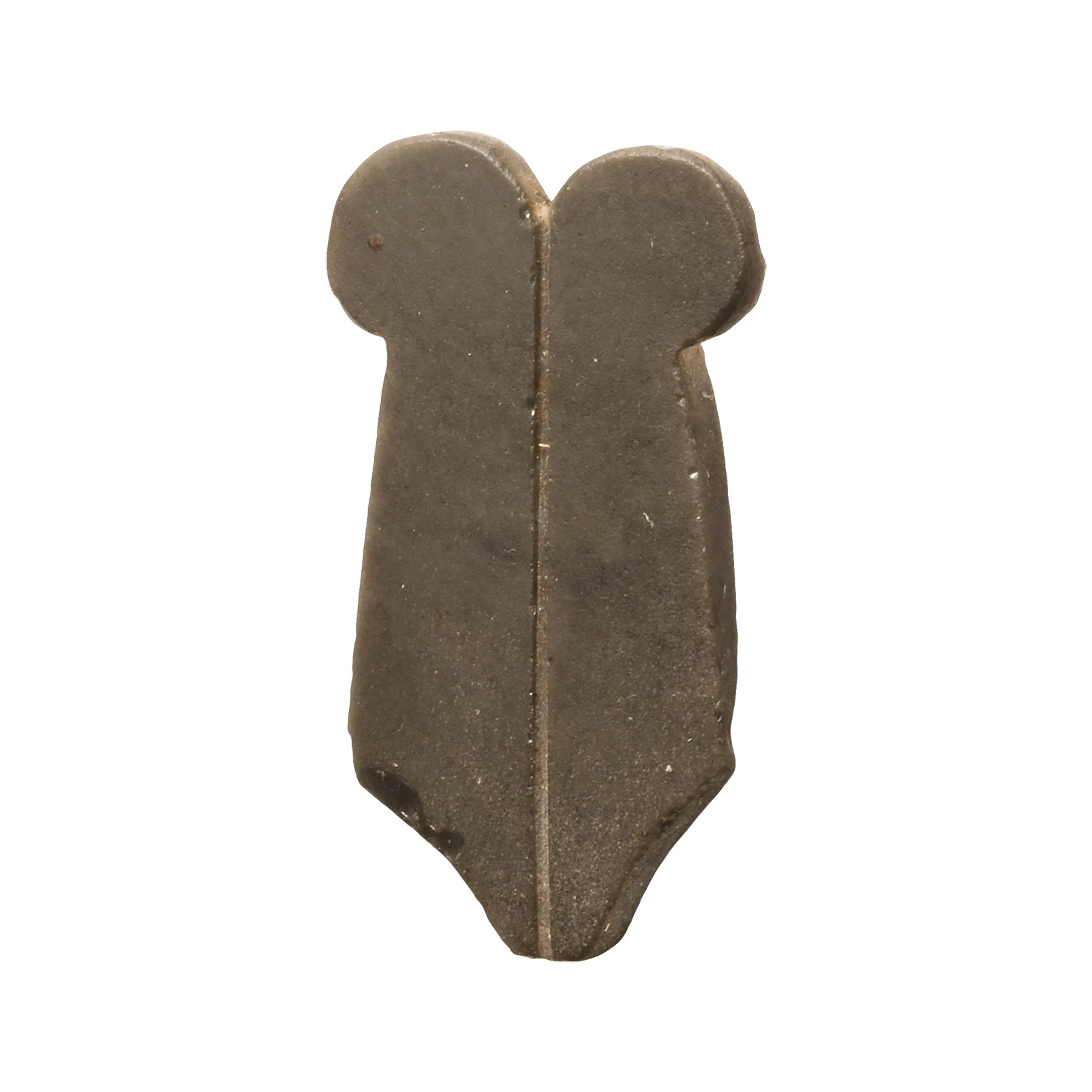
Egyptian Hardstone Double Plume Amulet
LATE PERIOD, 664-332 B.C.
1 1/8 in. (2.58 grams, 27 mm).
Carved with integral loop to the reverse; old inked collector's reference 'ES716'.
Provenancewith Hotel des Ventes, Drouot, Paris, France.
From the collection of Mr H. Naudy, Paris, France.
Acquired at between 2004-2010.
Property of a French collector.
Cf. Andrews, C., Amulets of Ancient Egypt, London, 1994, pl.81(c).
FootnotesThis ancient amulet represents two ostrich feathers or shuty. Interestingly, these feathers were also present on the Atef crown of Osiris, the god of the afterlife and the dead. This suggests the amulet was believed to imbue the wearer with Osiris' divine power and protection.
CONDITIONTimeLine Auctions follows a vetting process to ensure the authenticity and legality of all items, reinforcing our commitment to integrity and responsible trading. Each antiquity, antique, and coin lot undergoes thorough examination by a vetting committee of at least ten external specialists, professional trade association members, scientists, and archaeologists: Our Vetting Process
AUCTIONS:
TimeLine is a leading auction house specialising in antiquities, ancient art, collectables, natural history, coins, medals, and books. Our auctions offer museums, collectors, historians, and enthusiasts the opportunity to acquire unique and historically significant pieces.
LOT 0502
Egyptian Hardstone Double Plume Amulet
Estimate £200 - 300€230 - 350 (for guidance only)$270 - 410 (for guidance only)
-
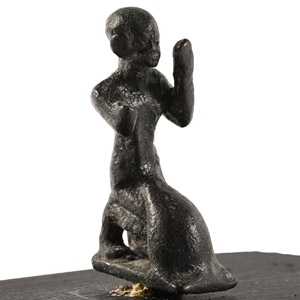
Egyptian Bronze Statue of a Kneeling Priest
Late Period, 664-332 B.C.Estimate: £250 - 350 (+bp*)
Opening Bid: £139
Kneeling on a rectangular platform with a wide apron covering his thighs, clean-shaven head and hands raised in adoration; tang on the underside for attachment; mounted on a display stand. 41 grams total, statue: 30 mm high
From an early 20th century Home Counties, UK, collection.
Priest figurines like this were commonly placed before a larger figurine of a deity, both attached to a base, e.g., Schulz, R., Seidel, M., Egyptian Art. The Walters Art Museum, London, 2009, for a kneeling priest before a standing figure of Anubis. -
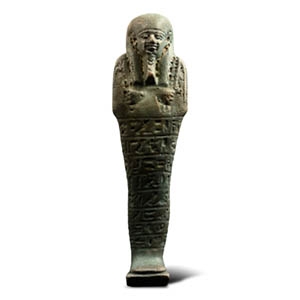
Large Egyptian Blue Glazed Hieroglyphic Shabti
26th Dynasty, 664-525 B.C.Estimate: £1,500 - 2,000 (+bp*)
Opening Bid: £700
Of mummiform type, wearing a tripartite wig and long plaited divine beard, with arms crossed and the left hand holding a pick, the right hand holding a hoe and the cord of a seed bag hanging over his left shoulder, with carefully rendered cosmetic lines around the eyes, narrow eyebrows, and slightly smiling lips giving it a serene expression characteristic of the finest ushabtis of the period; standing on an integral plinth from which a plain back pillar terminating at the base of the wig extends; eight horizontal rows of hieroglyphic inscription, the Sixth Chapter of the Book of the Dead; water worn. 235 grams, 18.6 cm
Acquired on the German art market, 1989-1995. with The Museum Gallery, 19 Bury Place, London, WC1, UK, 1998-2003. Property of a London based academic, 2003-present. -
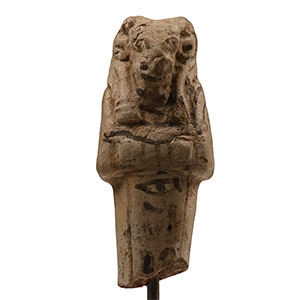
Egyptian Faience Bull-Headed Shabti from the Serapeum at Saqqara
New Kingdom, Ramesside Period, 1295-1069 B.C.Sold for (Inc. bp): £3,250
Pale faience figurine representing a bull-headed mummy adorned with a tripartite wig and human arms crossed over the chest with hands holding a pick and a hoe; only the lower legs and feet missing; the opening part of a central panel of hieroglyphic inscription reads: Wsir ͗ ḥp, 'the Osiris Apis'; mounted on a custom-made display stand. 152 grams total, 15 cm including stand
Probably found at the Serapeum at Saqqara in the 19th century. From the private collection of the late Mr M.S.C., Norfolk, UK, formed 1950s-1960s. Accompanied by an academic report by Egyptologist Paul Whelan.
While most shabtis served as substitutes or servants of the deceased and were placed in the tomb, some, like this example, were votive objects deposited in places of great sanctity. Virtually all known Apis shabtis come from excavations in the Serapeum catacombs led by Auguste Mariette from 1850 to 1853. They all belong to activity dating to the 19th and 20th Dynasties (circa 1295-1069 BC) and were unearthed in various chambers where they had been placed as votive offerings to honour the deified Apis bulls.
