
Loading, please wait...
LOT 0464
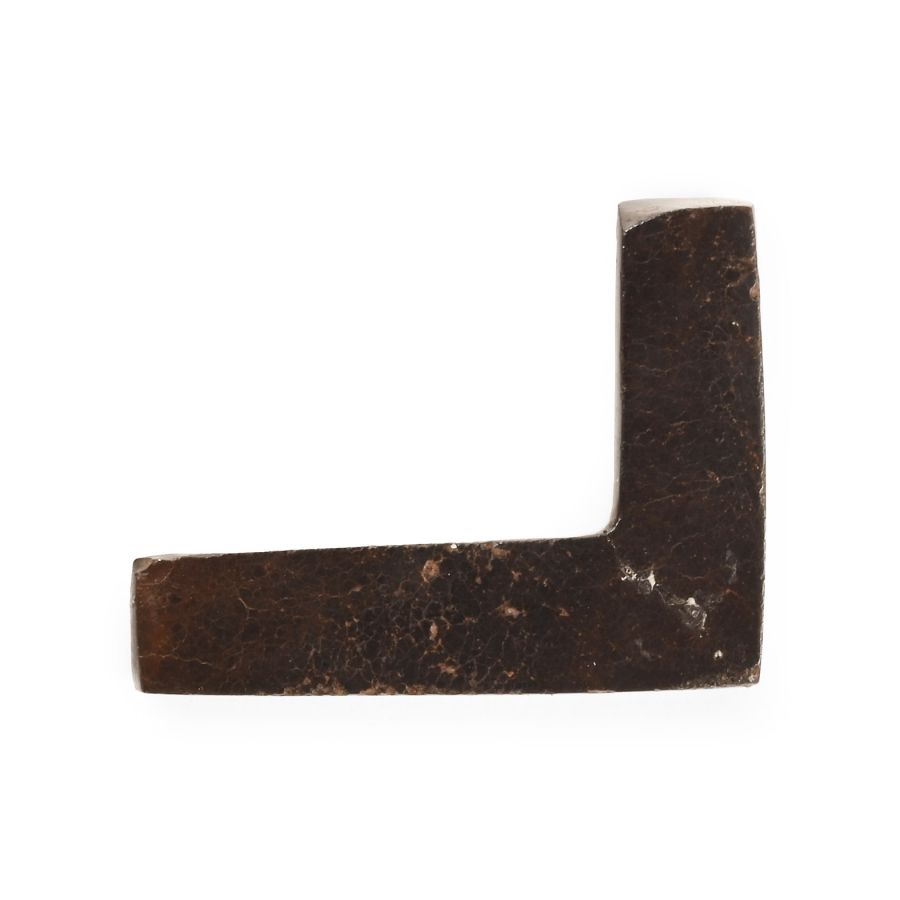
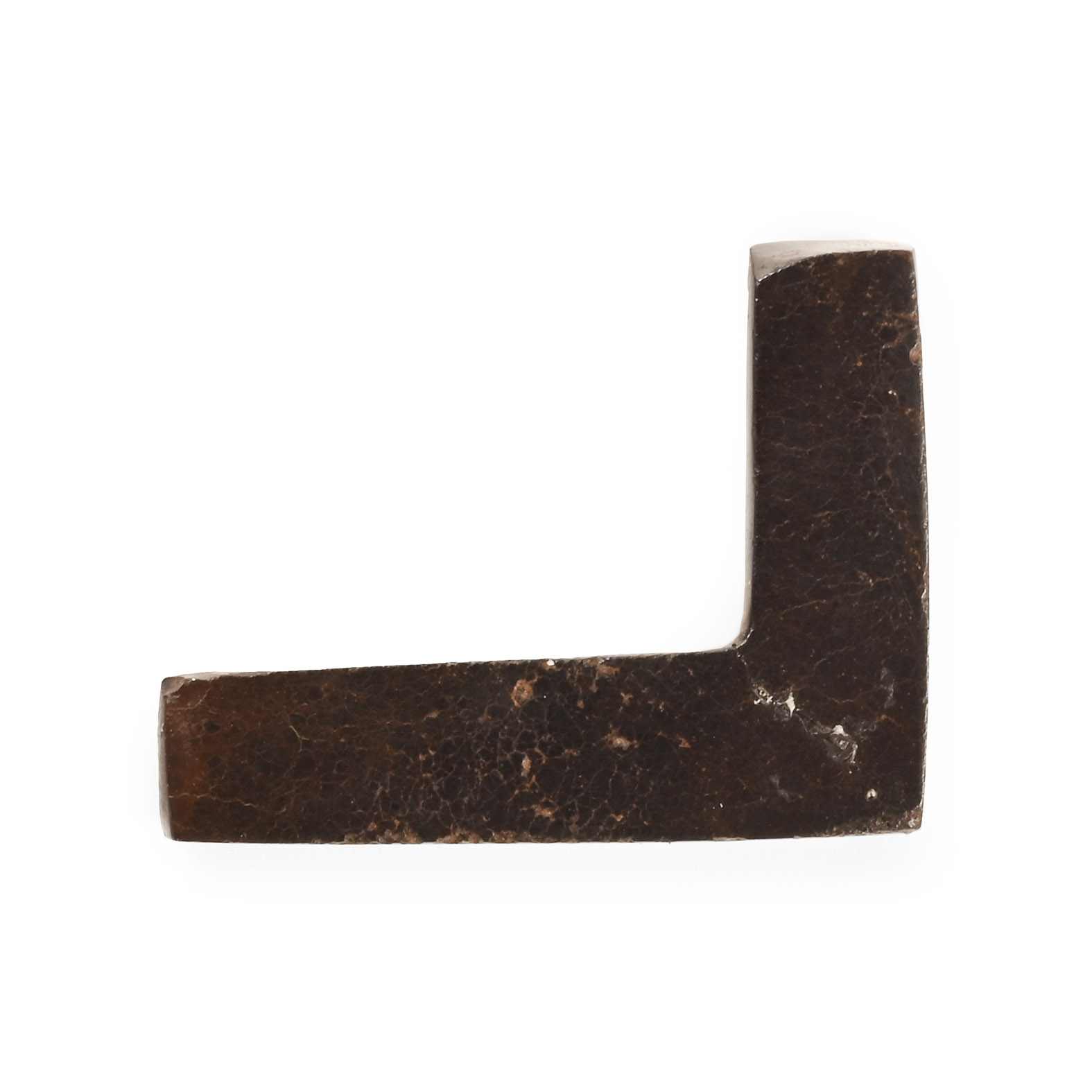
Egyptian Hardstone Architectural Amulet
LATE PERIOD, 664-332 B.C.
1 in. (3.15 grams, 24 mm).
Carved haematite representation of a carpenter's or stonemason's set-square.
Provenancewith Hotel des Ventes, Drouot, Paris, France.
From the collection of Mr H. Naudy, Paris, France.
Acquired at between 2004-2010.
Property of a French collector.
Cf. Andrews, C., Amulets of Ancient Egypt, London, 1994, p. 85, pl.87(c), for a similar haematite example.
FootnotesAmulets of the L-shaped carpenter's or stonemason's set-square, usually depicted as two rectangular strips of unequal lengths meeting at a right angle, were most frequently made of dark hard stones such as haematite, as this example. Set-square amulets were believed to bestow eternal moral uprightness upon their possessor.
CONDITIONTimeLine Auctions follows a vetting process to ensure the authenticity and legality of all items, reinforcing our commitment to integrity and responsible trading. Each antiquity, antique, and coin lot undergoes thorough examination by a vetting committee of at least ten external specialists, professional trade association members, scientists, and archaeologists: Our Vetting Process
AUCTIONS:
TimeLine is a leading auction house specialising in antiquities, ancient art, collectables, natural history, coins, medals, and books. Our auctions offer museums, collectors, historians, and enthusiasts the opportunity to acquire unique and historically significant pieces.
LOT 0464
Egyptian Hardstone Architectural Amulet
Estimate £200 - 300€230 - 350 (for guidance only)$270 - 410 (for guidance only)
-
Large Egyptian Blue Glazed Hieroglyphic Shabti
26th Dynasty, 664-525 B.C.Estimate: £1,200 - 1,700 (+bp*)
Opening Bid: £667
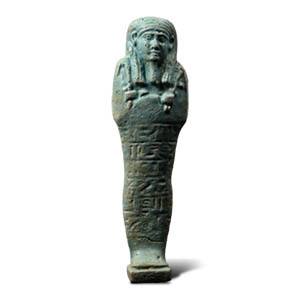
Of mummiform type, wearing a tripartite wig and long plaited divine beard, with arms crossed and the left hand holding a pick, the right hand holding a hoe and the cord of a seed bag hanging over his left shoulder, with carefully rendered cosmetic lines around the eyes, narrow eyebrows, and slightly smiling lips giving it a serene expression characteristic of the finest ushabtis of the period; standing on an integral plinth from which a plain back pillar terminating at the base of the wig extends; six horizontal rows of hieroglyphic inscription, the Sixth Chapter of the Book of the Dead; water worn and repaired. 248 grams, 18.5 cm
Acquired on the German art market, 1989-1995. with The Museum Gallery, 19 Bury Place, London, WC1, UK, 1998-2003. Property of a London based academic, 2003-present. -
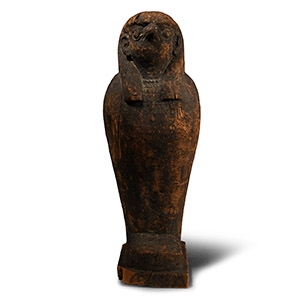
Egyptian Wooden Sarcophagus with Falcon Mummy
Late Period-Ptolemaic Period, 664-31 B.C.Sold for (Inc. bp): £8,190
Two-part wooden (sycamore?) falcon-headed mummiform coffin carved from a single piece of wood, with a tripartite wig and human ears, painted detailing to the eyes, and broad decorative collar; the whole covered with black paint with traces of yellow decoration and inscriptions; inside a mummified falcon wrapped in linen strips. 2.3 kg, 49.5 cm
Ex R. Liechti (1934-2010) Geneva, Switzerland, formed between 1950-1990s. Accompanied by a copy of an old collection inventory note. Accompanied by an academic report by Egyptologist Paul Whelan. This lot has been checked against the Interpol Database of stolen works of art and is accompanied by a search certificate number no.12074-218220.
This falcon-headed coffin once contained a so-called 'corn mummy' - a mummiform effigy impregnated with grain, which germinated. Such 'corn mummies' were associated with Osirian regeneration, fertility, and rebirth concepts. The falcon-headed coffin was associated with the powerful funerary deity Sokar-Osiris or Ptah-Sokar-Osiris. It seems that the original contents of this coffin were either lost or discarded and replaced with a mummified bird (falcon?). Interestingly, the most significant number of falcon-headed coffins come from Tuna el-Gebel, the site of an extensive animal mummy necropolis. -
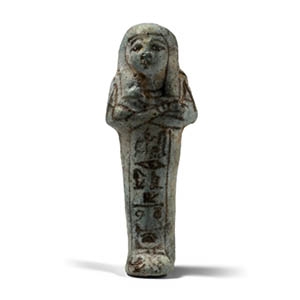
Egyptian Faience Shabti of Qenu-khayes
New Kingdom, 19th-20th Dynasty, circa 1292-1069 B.C.Estimate: £1,000 - 1,400 (+bp*)
Opening Bid: £550
Light blue faience mummiform shabti with details added in black line, adorned with a tripartite wig and collar, and the arms crossed over the chest with hands holding a pick and hoe, seed bag and water pots, the back decorated with a curved yoke with pots and a brick mould; a central panel of hieroglyphs on the lower half of the figure giving the dedication: sḥḏ wsı͗r ḳnw ḫꜤs mꜢꜤ ḫrw, ‘The illuminated one, the Osiris Qenu-khayes, true of voice’. 152 grams, 13 cm
Formerly in North American collection, 1990s. From the collection of a London, UK, gentleman.
