
Loading, please wait...
_900x900.jpg "Egyptian Green Glazed Somtous Seated on Lotus Flower")
_200x200.jpg "Egyptian Green Glazed Somtous Seated on Lotus Flower")
.jpg "Egyptian Green Glazed Somtous Seated on Lotus Flower")
LOT 0056
Egyptian Green Glazed Somtous Seated on Lotus Flower
LATE PERIOD, CIRCA 664-332 B.C.
2 5/8 in. (39.76 grams total, 68 mm high including stand).
Modelled in the round, the nude seated figure of the child Somtous, with one hand to his lips and a prominent sidelock, emerging from a lotus flower; mounted on a custom-made stand.
ProvenanceNoriuchi Horiuchi, Tokyo, Japan, 1993.
Private collection, London, UK.
See Gaber, H., Servajean, F., Du pays de Pount aux rives du Nil: parfums d’Égypte, Gand, 2024, pp. 196-197, for discussion and an example in bronze.
FootnotesThe earliest attestations of the cult of Somtous, known as Sematawy in ancient Egyptian, date back to the New Kingdom, although it became particularly popular during the Late Period. Associated with Horus (Horsomtous), the symbol of the child emerging from the lotus represented the (re)birth of the sun god. Thus, Somtous was regarded as a life-giving amuletic symbol, sometimes even referred to as 'Sematawy the child who gives life.'
CONDITIONTimeLine Auctions follows a vetting process to ensure the authenticity and legality of all items, reinforcing our commitment to integrity and responsible trading. Each antiquity, antique, and coin lot undergoes thorough examination by a vetting committee of at least ten external specialists, professional trade association members, scientists, and archaeologists: Our Vetting Process
AUCTIONS:
TimeLine is a leading auction house specialising in antiquities, ancient art, collectables, natural history, coins, medals, and books. Our auctions offer museums, collectors, historians, and enthusiasts the opportunity to acquire unique and historically significant pieces.
-
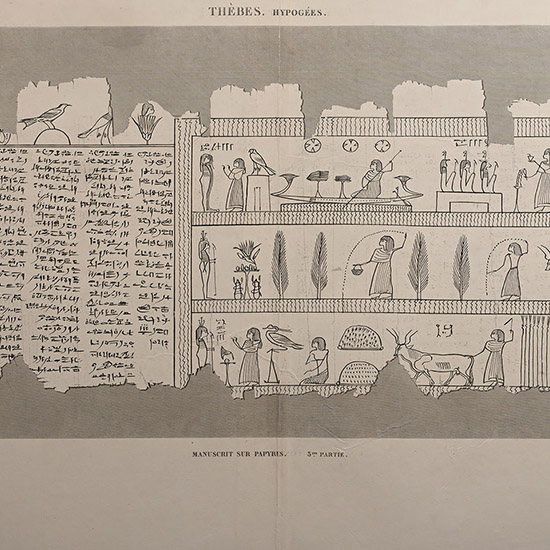
Very Large Egyptian Expedition Lithograph of the Hypogees Papyrus Manuscript from Thebes
Early 19th century A.D.Estimate: £80 - 100 (+bp*)
Opening Bid: £40
Proof etching on laid paper of plate 63 from Vol.II of Description de l'Égypte : ou, Recueil des observations et des recherches qui ont été faites en Égypte pendant l'expédition de l'armée française. entitled Thèbes. Hypogées. Manuscrit sur papyrus. 3eme partie. 272 grams, 103.5 x 69 cm
From the collection of a North American priest. Acquired between 1981-1996. Property of a North American collector.
Produced between February 1802 and 1830 on the orders of Napoleon Bonaparte; published between 1809 and 1828. Just 1,000 copies were distributed to various institutions, printed on laid paper with an 'Égypte ancienne et moderne' watermark. The book is subtitled Recueil des observations et des recherches qui ont été faites en Égypte pendant l’expédition de l’Armée française, publié par les ordres de Sa Majesté l’Empereur Napoléon le Grand (Gathering of observations and discoveries which were made in Egypt during the expedition of the French army, published on the orders of His Majesty the Emperor Napoleon the Great). It was the world's first encyclopedia devoted exclusively to the remains of ancient Egypt. The plates of this book are the first to present the archaeological sites of Thebes (Luxor). The papyrus manuscript was recovered from an underground tomb chamber (hypogeum). The scene depicts the Fields of Iaru, a verdant paradise in the ancient Egyptian afterlife, where the deceased could enjoy abundant harvests. -
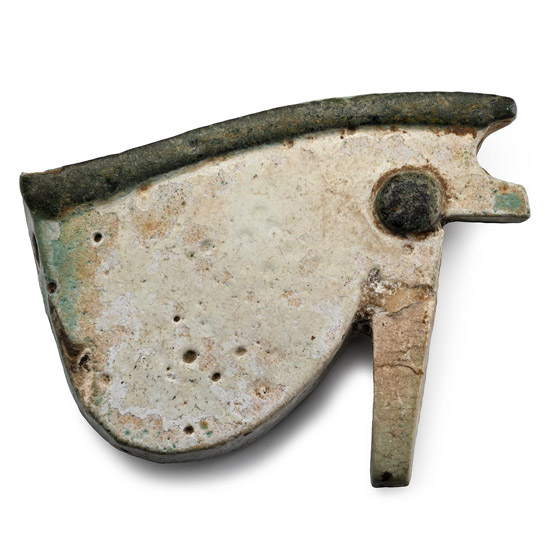
Large Egyptian Faience Eye of Horus Amulet
Third Intermediate Period, circa 1069-664 B.C.Estimate: £250 - 350 (+bp*)
Opening Bid: £120
Sizeable wedjat-eye amulet with applied black detailing to the pupil and brow. 16.5 grams, 50.4 mm
with Archaeologia, Switzerland, before 1983. Ex private North American collection. London private collection, 2016.
The wedjat-eye amulet symbolises the healed eye of the god Horus, representing both human and falcon elements. The name wedjat in ancient Egyptian means ‘the one that is sound.’ According to Egyptian mythology, Horus' eye was wounded or taken by the god Seth and later restored by Thoth. The wedjat-eye amulet was believed to protect its wearer and confer qualities of recovery and regeneration. It was highly popular and was used by both the living and the dead. -
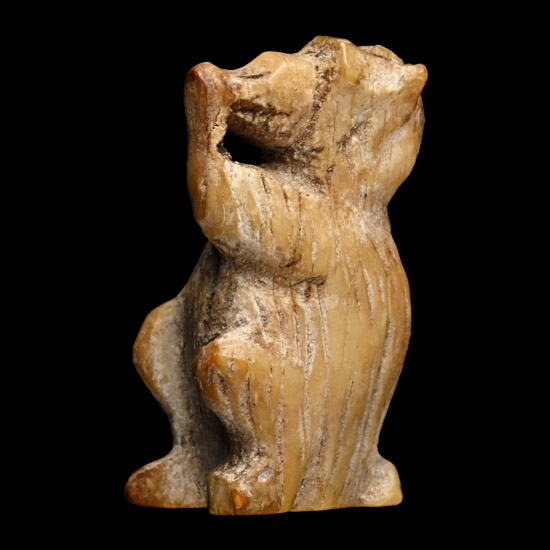
Egyptian Bone Baboon Amulet
Roman Period, 30 B.C.-323 A.D.Sold for (Inc. bp): £72
Modelled seated with its left front paw raised to its lips. 1.17 grams, 17.91 mm
From the private collection of a European gentleman (1942-2024), formed since the 1970s.
