
Loading, please wait...


LOT 0412
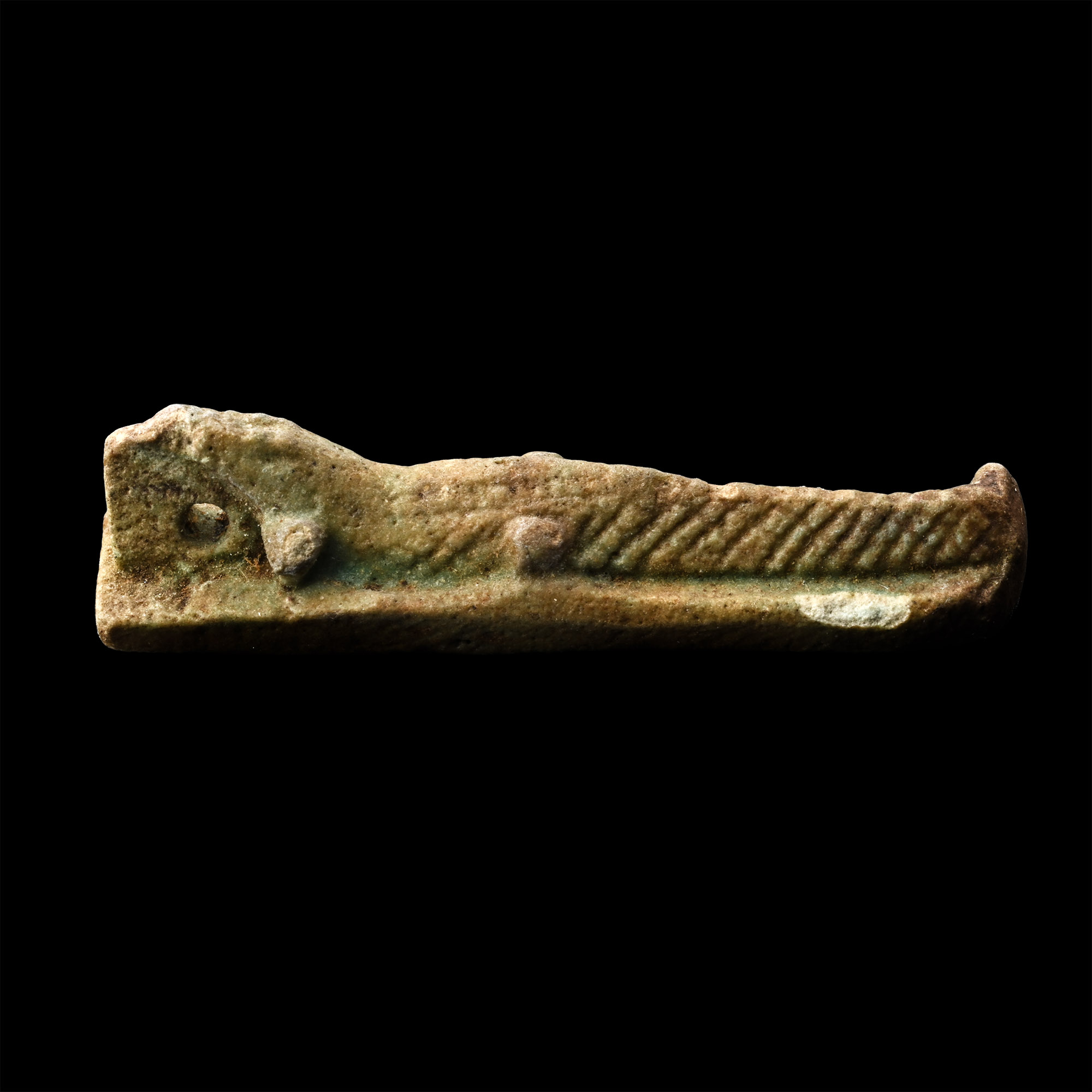
Egyptian Green Glazed Faience Crocodile God Amulet
LATE-PTOLEMAIC PERIOD, 664-30 B.C.
1 5/8 in. (3.07 grams, 41 mm).
An amulet featuring a crocodile with its tail curled, resting on a long, rectangular plinth; the reptile's scales are finely rendered, with an integral suspension hole beneath its chin. [No Reserve]
ProvenanceFrom the private collection of Peter Clayton, FCILIP, Dip, Arch, FSA, FRNS, Hemel Hempstead, Hertfordshire, UK; formed since the late 1950s.
FootnotesAlthough crocodiles were fearsome creatures, the Egyptian crocodile god Sobek was a benevolent god of water, fertility and rebirth in the afterlife.
CONDITIONTimeLine Auctions follows a vetting process to ensure the authenticity and legality of all items, reinforcing our commitment to integrity and responsible trading. Each antiquity, antique, and coin lot undergoes thorough examination by a vetting committee of at least ten external specialists, professional trade association members, scientists, and archaeologists: Our Vetting Process
AUCTIONS:
TimeLine is a leading auction house specialising in antiquities, ancient art, collectables, natural history, coins, medals, and books. Our auctions offer museums, collectors, historians, and enthusiasts the opportunity to acquire unique and historically significant pieces.
LOT 0412
Egyptian Green Glazed Faience Crocodile God Amulet
Estimate £80 - 100€93 - 116 (for guidance only)$108 - 135 (for guidance only)
Opening Bid
£5 (EUR 6; USD 7) +BP*
-
Egyptian Coptic Wooden Comb
Circa 4th-7th century A.D.Estimate: £500 - 700 (‡+bp*)
Opening Bid: £230
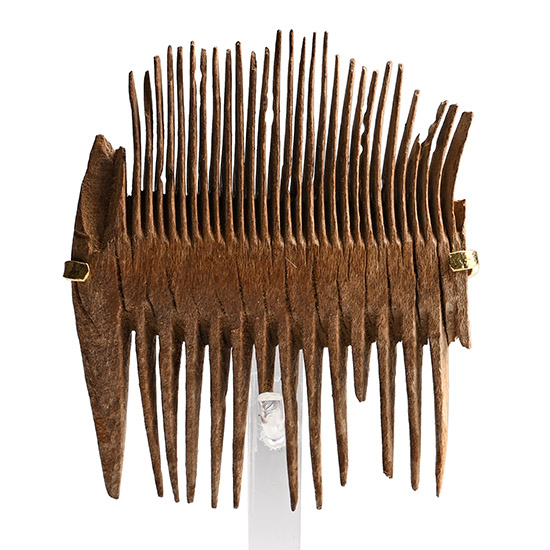
With fine teeth cut on one side and coarser teeth on the other; some absent; mounted on a custom-made stand. 12.62 grams total, comb: 51 mm, 85 mm high including stand
Ex Carl Leonhard Burckhardt-Reinhard (1902-1965), formed since 1922, Egypt. Inherited by his son Christopher Burckhardt in 1966, Switzerland. Since then in the possession of his wife, Switzerland.
The type is attested in Egypt, where it is particularly well documented in the Coptic Period. The lack of decoration makes a more precise chronological classification difficult. As evidenced by a wooden comb of the same type from Antinoë, the fine-toothed side was also used for removing head lice. In the present example, the comb continued on one side for an indeterminate length. -
Egyptian Green Glazed Faience Shabti of the Osiris Hori
Third Intermediate Period, 1069-860 B.C.Estimate: £400 - 600 (+bp*)
Opening Bid: £5
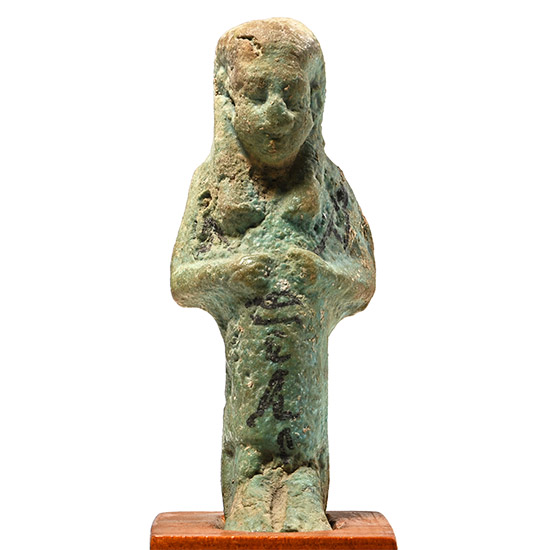
Mummiform figure wearing a lappet wig, hands placed knuckle-to-knuckle at the chest, holding black-painted hoes and a rudimentary seed bag on the back; a column of hieroglyphic inscription on the lower body: 'The Osiris. Hori(?)'; feet modelled in detail; mounted on a custom-made stand. 102 grams total, 12 cm including stand
Acquired from the Egyptian Exploration Society, 30th June 1965, for 2 shillings and sixpence. From the private collection of Peter Clayton, FCILIP, Dip, Arch, FSA, FRNS, Hemel Hempstead, Hertfordshire, UK; formed since the late 1950s. Accompanied by an old handwritten information card by Peter Clayton, collection no.117. -
Egyptian Blue Glass Inlay Collection
Late Period-Ptolemaic Period, circa 664-30 B.C.Estimate: £250 - 350 (+bp*)
Opening Bid: £139
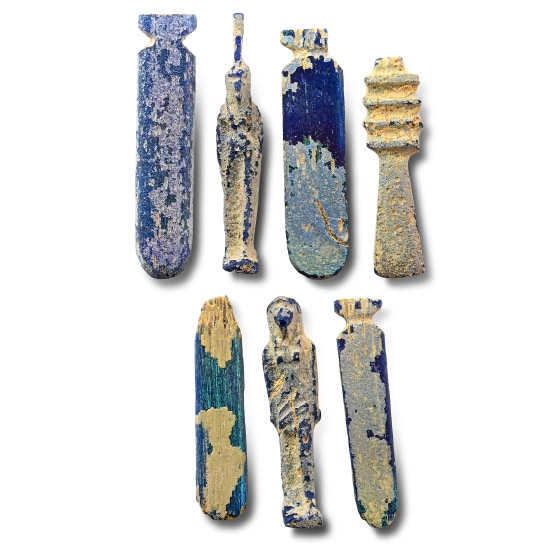
Comprising: three cartouche-shaped inlays, a djed pillar, two standing deities (possibly Isis and Horus), and a narrow, fragmentary inlay (possibly another cartouche). 8.98 grma total, 31-37 mm
From a 20th century UK collection.
