
Loading, please wait...
LOT 0019
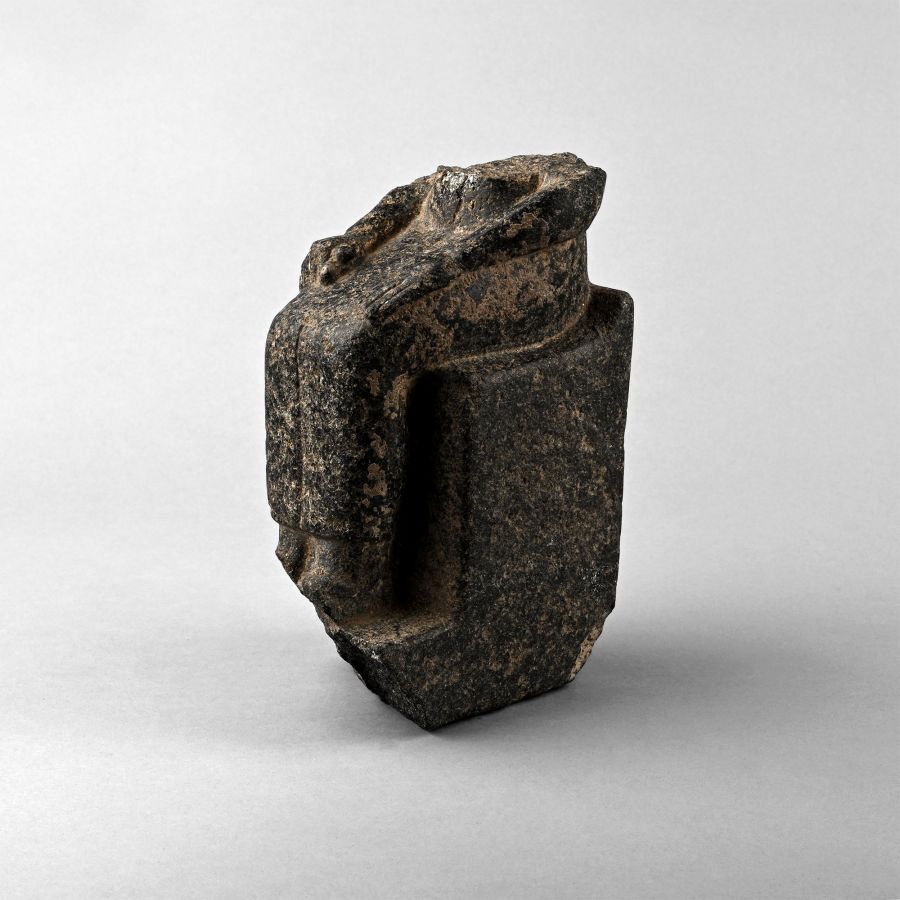
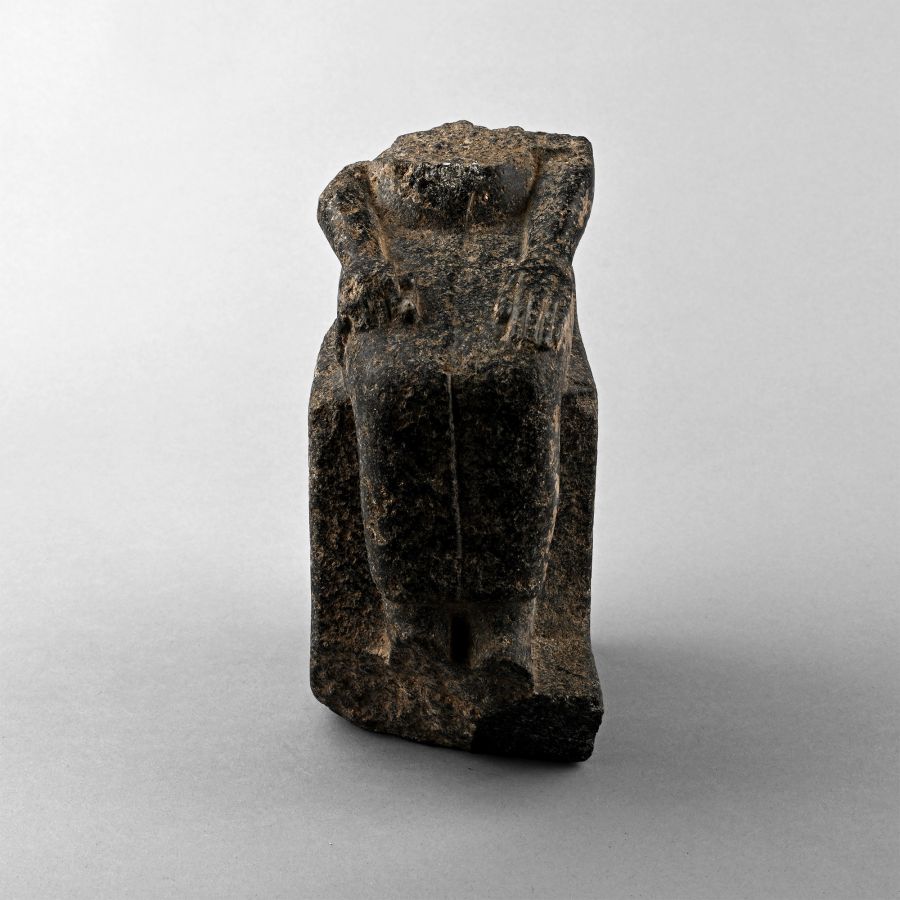
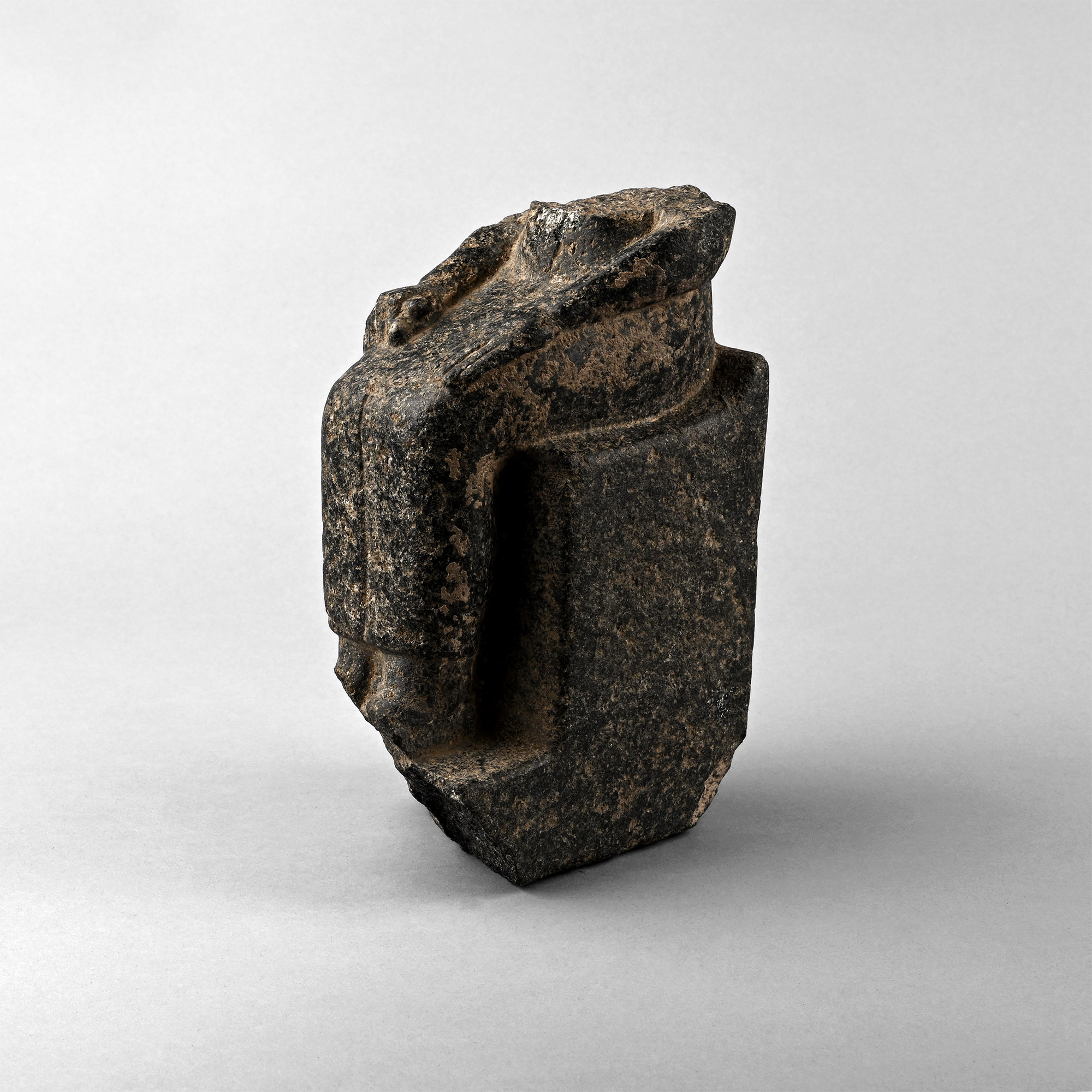
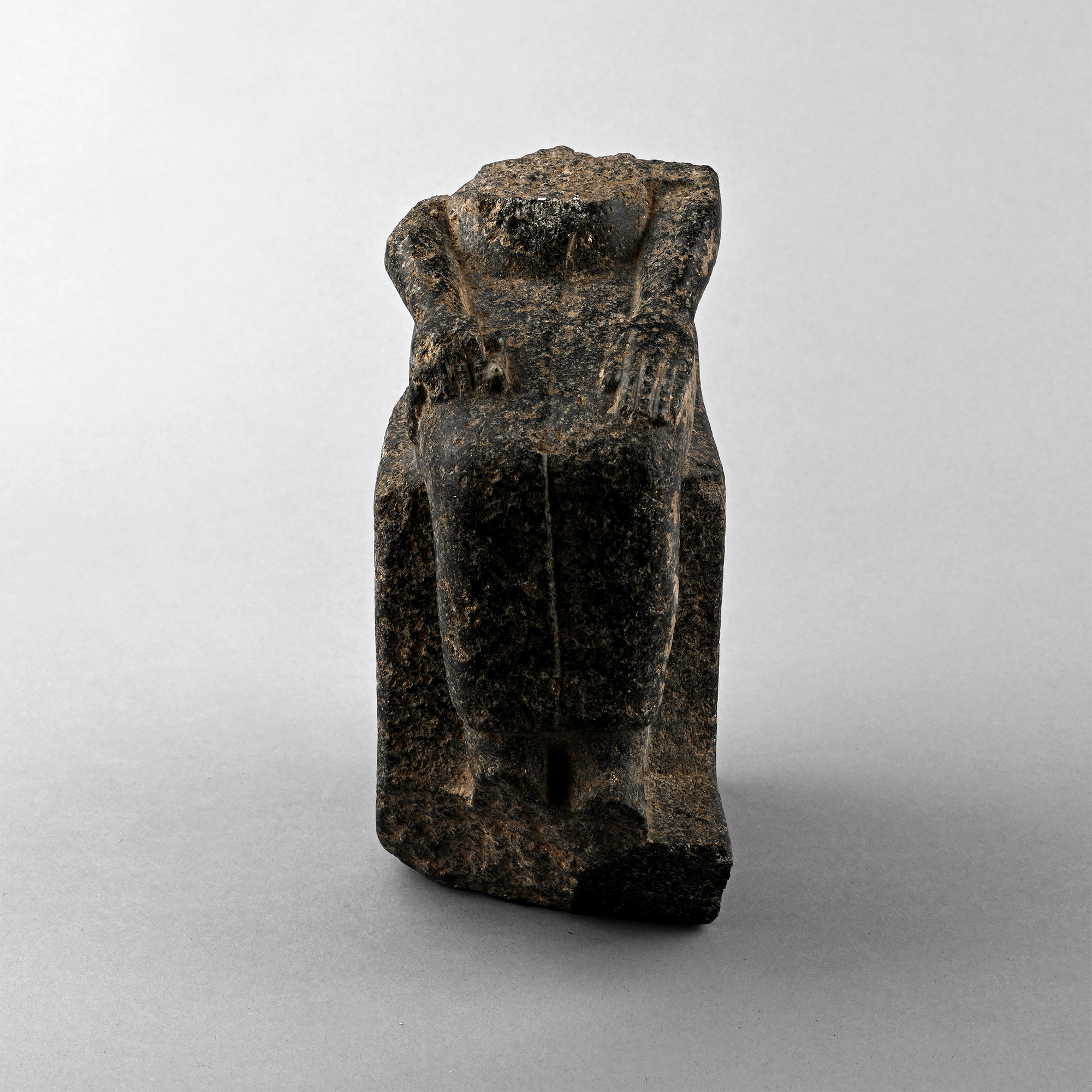
Egyptian Granite Seated Figure of an Official
MIDDLE KINGDOM, 2ND MILLENNIUM B.C.
7 3/8 in. (4.1 kg, 18.7 cm).
Comprising the torso and legs clad in an ankle-length robe and seated on a rectangular-section seat with stepped base and short, curved backrest and rear dorsal pillar; the left hand carved with the palm resting along the thigh; the right hand similarly placed but with the hand gripping a folded piece of cloth of which the ends are draped over the lower thigh above the knee; traces of an old label to reverse.
ProvenancePrivate collection, Europe.
with Bonhams & Brooks, 8th November 2001, no.265.
Private collection, Europe.
Accompanied by copies of the relevant Bonhams & Brooks catalogue pages.
This lot has been checked against the Interpol Database of stolen works of art and is accompanied by a search certificate number no.12584-232097.
Cf. Habachi, L., Elephantine IV: The Sanctuary of Heqaib II, pls. 39-41, for a complete statue from the time of Amenemhat II- Senwosret II with similar treatment of the lower portion of the garment; Oppenheim, A., et al (eds.), Ancient Egypt Transformed: The Middle Kingdom, pp.128-130, cat. 63, for an official from the reign of Senwosret III wearing a longer cloak-like garment and seated on a similarly shaped seat.
FootnotesThe official would have been shown wearing a longer cloak-like garment rather than a waist-height kilt, as the line of the folded edge is visible above where a waistband would typically be.
CONDITIONTimeLine Auctions follows a vetting process to ensure the authenticity and legality of all items, reinforcing our commitment to integrity and responsible trading. Each antiquity, antique, and coin lot undergoes thorough examination by a vetting committee of at least ten external specialists, professional trade association members, scientists, and archaeologists: Our Vetting Process
AUCTIONS:
TimeLine is a leading auction house specialising in antiquities, ancient art, collectables, natural history, coins, medals, and books. Our auctions offer museums, collectors, historians, and enthusiasts the opportunity to acquire unique and historically significant pieces.
LOT 0019
Egyptian Granite Seated Figure of an Official
Estimate £2,500 - 3,500€2,900 - 4,060 (for guidance only)$3,380 - 4,730 (for guidance only)
-
.jpg)
Egyptian Bronze Statuette of Young Horus
Late Period, 664-332 B.C.Sold for (Inc. bp): £1,430
Modelled in the round in striding pose with one arm resting along the body and the right hand raised to his mouth, wearing an elaborate side-lock of youth and Pschent crown fronted by uraeus; mounted on a display stand. 202 grams total, 12.8 cm including stand
with R.H. Blanchard's Egyptian Museum, Cairo, early 20th century. Private collection, London, UK. Accompanied by its original base, retaining the Blanchard label.
Harpocrates is the Greek equivalent of the Egyptian name Hor-pa-khered, which means 'Horus the Child'. This name refers to Horus as the divine infant of Isis and Osiris. Wearing an amulet of Harpocrates was believed to provide the same protection that Isis granted to her beloved son. Larger bronze statuettes, such as this, were probably votive offerings to Harpocrates, intended to secure his favour and protection. -
.jpg)
Egyptian Steatite Scarab Collection
Hyksos Period and New Kingdom, 18th-13th century B.C.Sold for (Inc. bp): £910
Each with a domed carapace, two with a figure on the underside surrounded by hieroglyphs, two inscribed with hieroglyphic signs. 15 grams total, 18-24 mm
Acquired in Europe before 1992. Ex private collection, UK.
The term ‘Hyksos’ comes from the Egyptian phrase ‘heka khasuwt’, which means ‘rulers of foreign (hill) lands’. The 15th Dynasty was governed by these Hyksos during the Second Intermediate Period. They were not of Egyptian origin but were believed to be Canaanites, and their names were carved on their scarabs. -
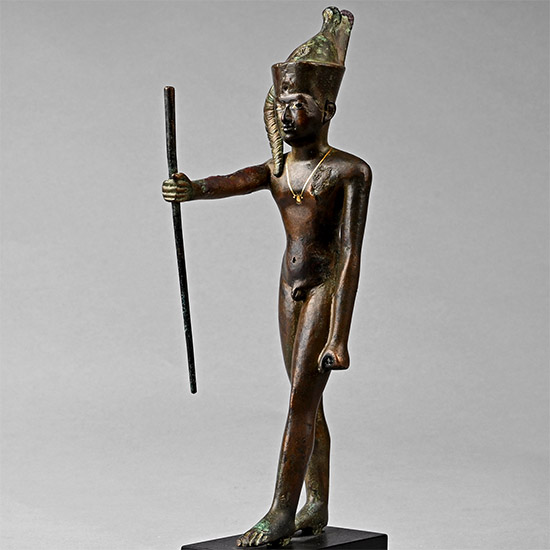
Large Egyptian Bronze Statue of the God Ihy with Gold Necklace and Silver Inlaid Eyes
Late Period, 664-332 B.C.Sold for (Inc. bp): £20,800
Depicted nude in an advancing pose; silver inlaid eyes, braided sidelock of youth; left hand by his side, drilled to accept a separate element, the other outstretched at a right angle to his body, holding a tapering cylindrical staff, not belonging; he may originally have held a sistrum, an ancient Egyptian percussion instrument, or a menat, both closely associated with the goddess Hathor; here, Ihy wears the Pschent crown with remains of uraeus, and an inlaid gold necklace suspended with an ib pendant around his neck; finely detailed facial features, with engraved Nekhbet vulture with outspread wings at the back of the crown; integral lugs on soles of feet; mounted on a custom-made stand. 899 grams total, 25 cm including stand
From the Singer family collection, Germany, acquired circa 1962. with A.A.L., Geneva, 1980. with Christie's, London, 25 April 2015, no.163 [£50,000-£70,000]. Private collection, London, UK. Accompanied by copies of the relevant Christie's catalogue pages. This lot has been checked against the Interpol Database of stolen works of art and is accompanied by search certificate number no.13309-258229.
Ihy was an Egyptian god associated with music, joy, and ritual celebrations, particularly as the divine child of Hathor and of Horus or Ra. He is typically depicted as a youthful figure, often naked or lightly clothed, wearing a sidelock of youth and carrying a sistrum or menat, both percussion instruments closely connected with ritual performances in Hathor's cult, especially at the temples of Dendera and Edfu. His name is generally understood to mean 'the musician' or 'the one who plays music,' although it may also mean 'calf', a reference to his relationship with the cow-goddess Hathor. Bronze statuettes of Ihy, such as this example, were probably produced as votive offerings dedicated in temples, especially those devoted to Hathor. Worshippers may have commissioned such figures in the hope of obtaining divine favour, protection, fertility, healing, or participation in the blessings linked with music and festivity. Some examples may also have served as cult images used in temple ceremonies or as protective objects placed in domestic or funerary settings.
