
Loading, please wait...
LOT 0053
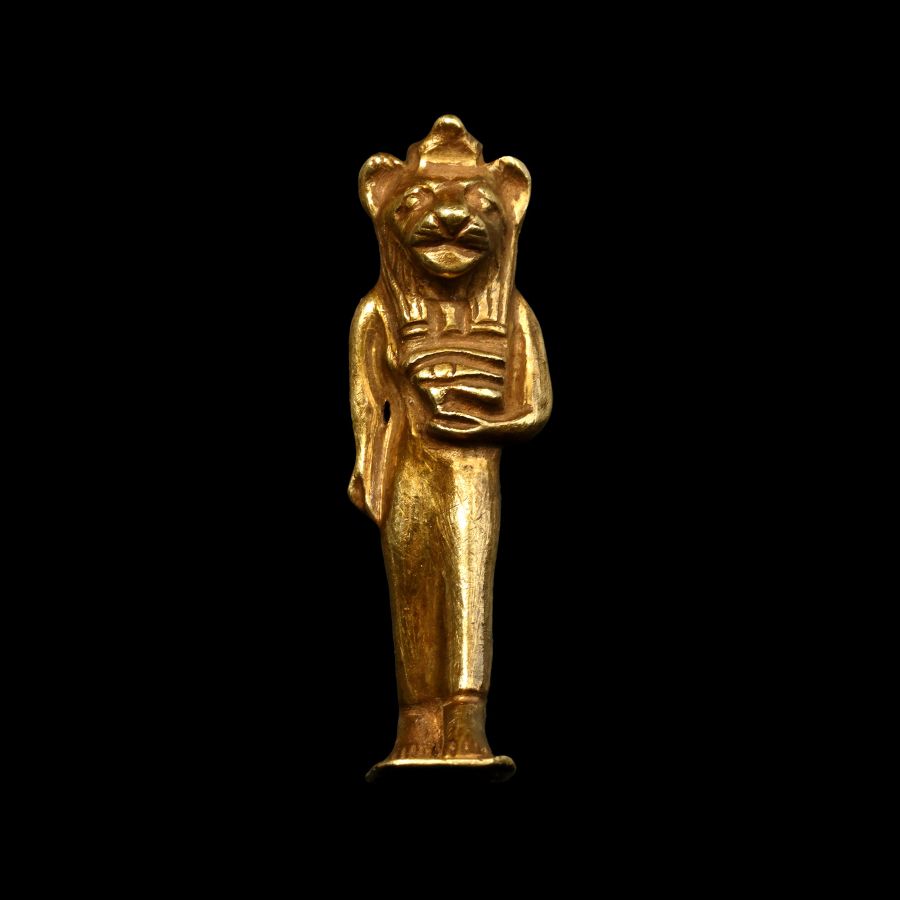
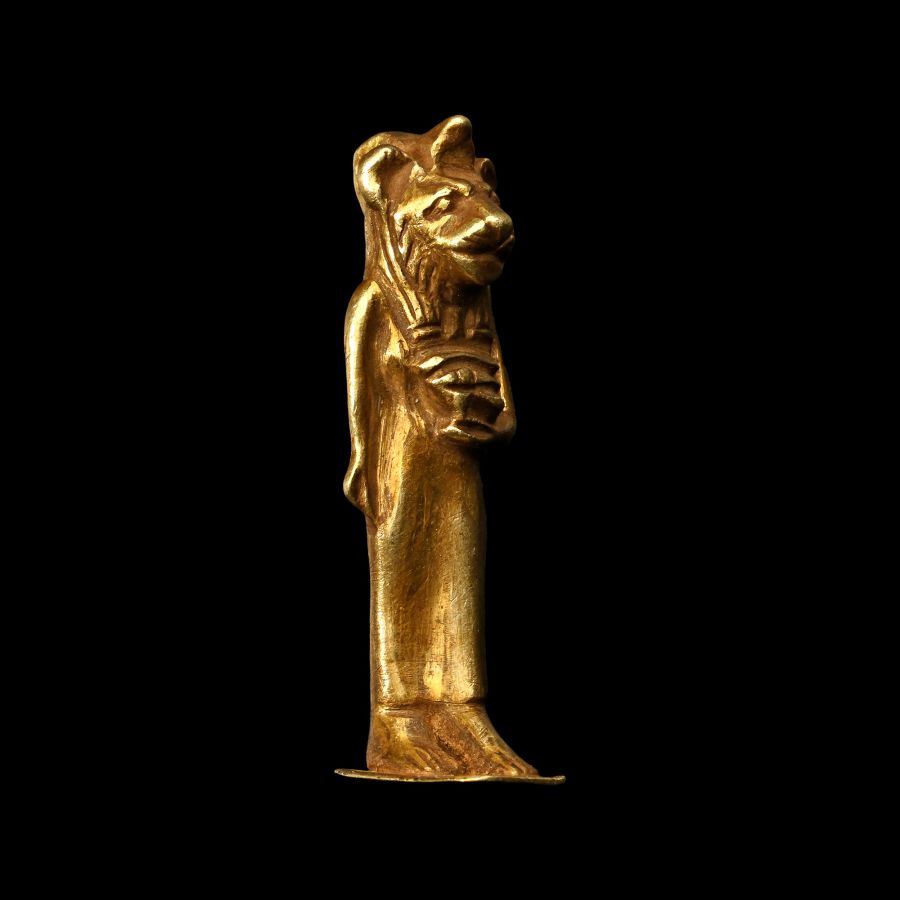
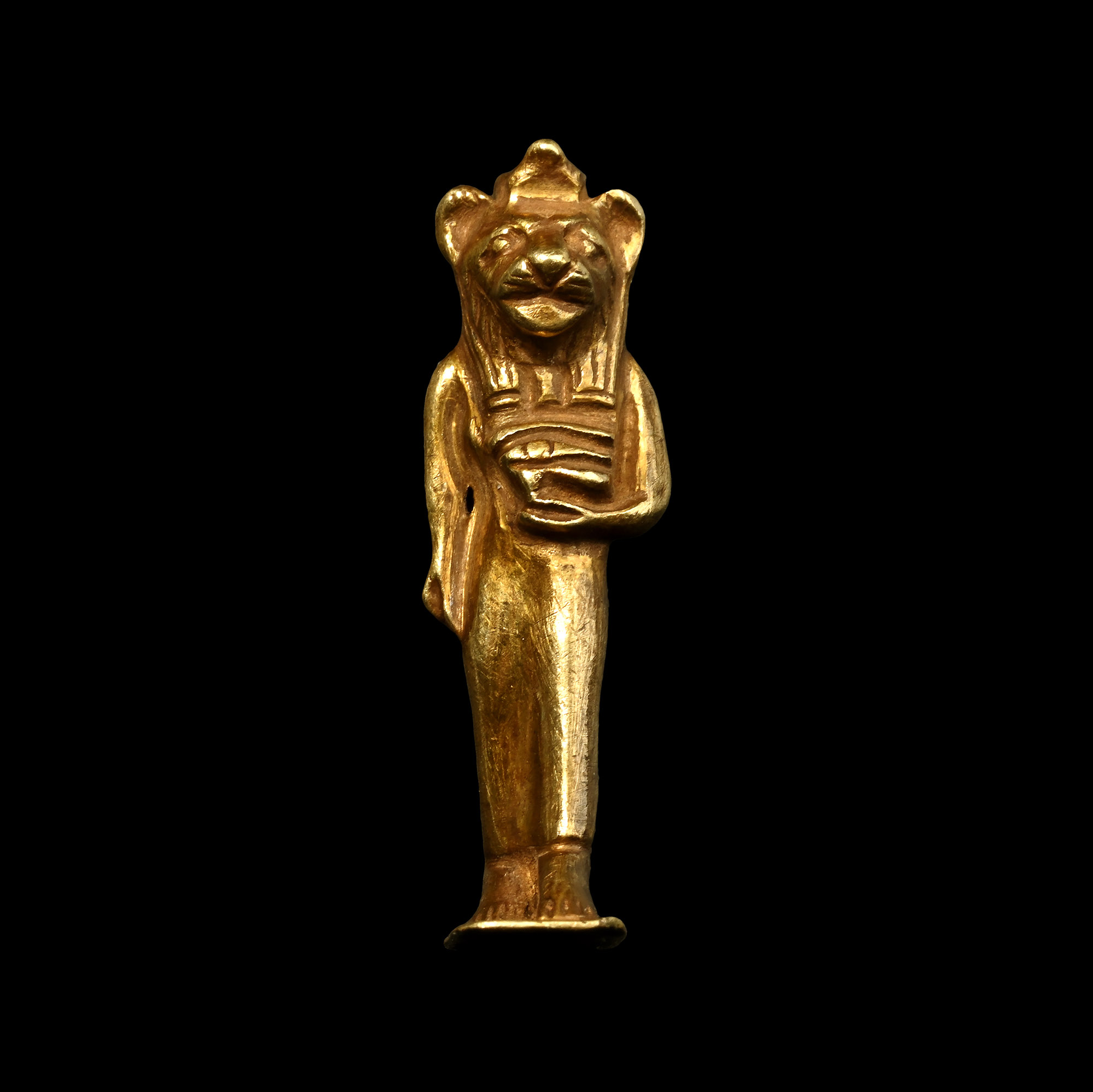
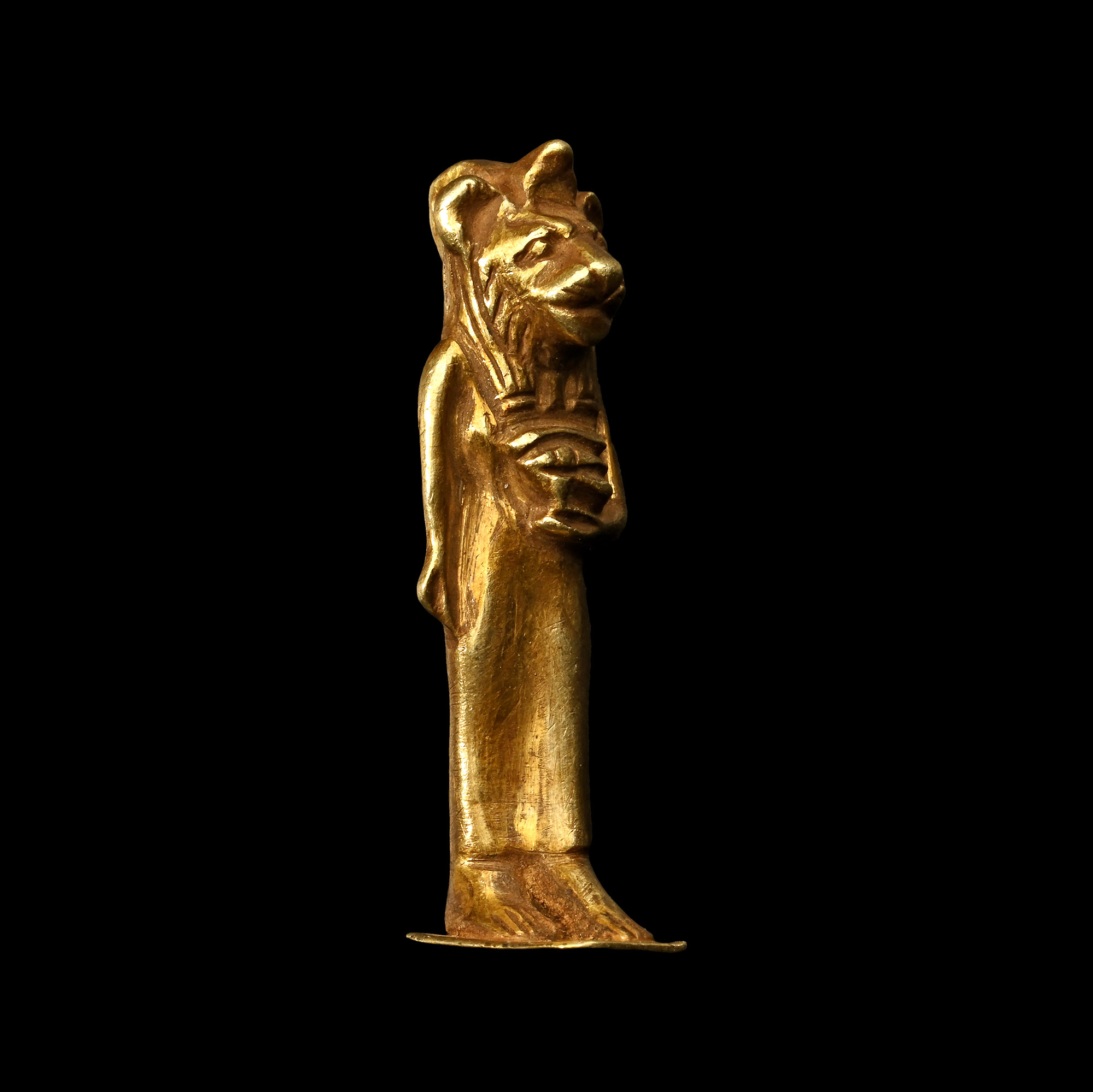
Egyptian Gold Sekhmet Statuette
LATE-PTOLEMAIC PERIOD, CIRCA 664-30 B.C.
1 1/8 in. (5.31 grams, 28 mm).
Figure of the lioness-headed goddess standing on a rectangular plinth, wearing a striated lappet wig with uraeus and an ankle-length, tight-fitting dress, her right arm extended down her side and her left hand holding a wedjat-eye symbol against her chest; a suspension loop behind her head.
ProvenanceFrom the collection of a UK gentleman, London, UK, by descent from his family collection 1970s.
This lot has been checked against the Interpol Database of stolen works of art and is accompanied by search certificate no.13544-263324.
The wedjat-eye and lioness are potent, often intertwined symbols in ancient Egyptian mythology. The wedjat, representing Horus’s healed eye, signifies protection and healing, while the lioness—linked to the goddesses Sekhmet and Wadjet—embodies power and fierce defence as the “Eye of Ra”. Together, in amulets and in Egyptian art, they convey healing, protection, and strength.
CONDITIONTimeLine Auctions follows a vetting process to ensure the authenticity and legality of all items, reinforcing our commitment to integrity and responsible trading. Each antiquity, antique, and coin lot undergoes thorough examination by a vetting committee of at least ten external specialists, professional trade association members, scientists, and archaeologists: Our Vetting Process
AUCTIONS:
TimeLine is a leading auction house specialising in antiquities, ancient art, collectables, natural history, coins, medals, and books. Our auctions offer museums, collectors, historians, and enthusiasts the opportunity to acquire unique and historically significant pieces.
LOT 0053
Egyptian Gold Sekhmet Statuette
Estimate £5,000 - 7,000€5,800 - 8,120 (for guidance only)$6,750 - 9,450 (for guidance only)
Opening Bid
£2,500 (EUR 2,900; USD 3,375) +BP*
-
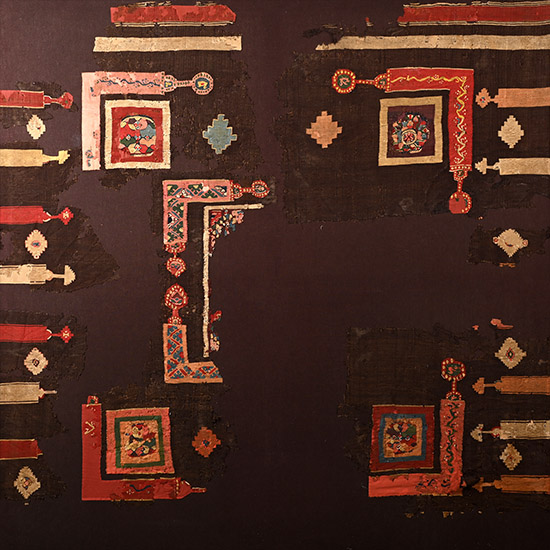
Very Large Egyptian Coptic Composition of Textile Tunic Fragments
Circa 560-700 A.D.Estimate: £4,000 - 6,000 (+bp*)
Opening Bid: £2,000
A composition of Roman-era Coptic textiles, assembled from various tunic and tapestry elements: 12 clavi, paired segmenta, and 4 tablia decorated with vegetal and floral motifs, framed by L-shaped elements composed of two clavi with orbiculi; geometric patterns wind along the clavi, while the orbiculi feature vegetal motifs and fish surrounded by small spheres; rhomboidal appliqués punctuate the surface; red, yellow, green, brown, pink, and indigo-blue wool, S-twist; mounted on a canvas with a wooden frame. 5.15 kg, 1.45 x 1.52 m
From the private antiquities collection of a Kensington collector. With a scientific report by RCD RadioCarbon dating from a sample taken in 2008. Property of a Huddersfield, UK, gentleman. This lot has been checked against the Interpol Database of stolen works of art and is accompanied by search certificate number no.13444-263431
The fragments are decorative parts of tunics or wall tapestries. These are fabrics of great decorative finesse, with some elements displaying an unusual and extremely well-preserved colour palette. The plant and animal designs are related to the so-called Nilotic decorative pattern, with Pagan elements persisting in the Christian Empire. Parts of this composition could also belong to a female shawl, like the famous Sabina's shawl found by Gayet in Antinoe. -

Egypto-Phoenician Period Haematite Scarab with Winged Figure
700-500 B.C.Estimate: £500 - 700 (‡+bp*)
Opening Bid: £250
Schematic scarab body with a scene on the underside of an advancing winged figure. 6.52 grams, 17 mm
Acquired in the mid 1980s-1990s. Private collection, Switzerland, thence by descent. Private collection, since the late 1990s. -
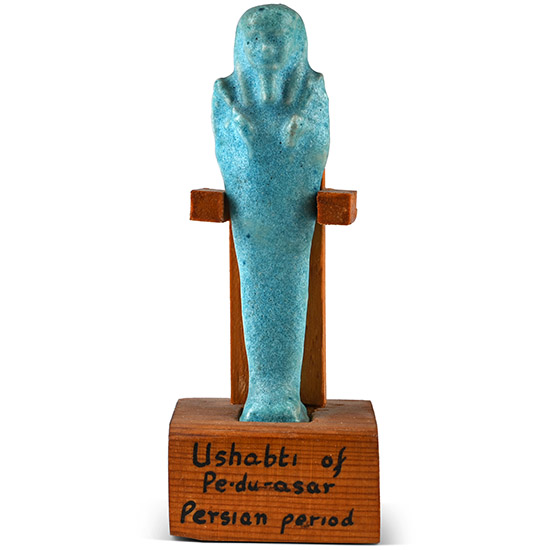
Egyptian Blue Glazed Faience Shabti
Ptolemaic Period, 323-30 B.C.Estimate: £200 - 300 (+bp*)
Opening Bid: £5
Typical mummiform type wearing a lappet wig, with arms crossed and hands holding agricultural implements; uninscribed; mounted on a custom-made stand marked 'Ushabti of Pe-du-asar Persian period'. 41.3 grams total, 99 mm
Acquired Church Street, 14th December 1957, for 10 shillings. From the private collection of Peter Clayton, FCILIP, Dip, Arch, FSA, FRNS, Hemel Hempstead, Hertfordshire, UK; formed since the late 1950s. Accompanied by an old handwritten information card by Peter Clayton, collection no.6.
The 'Pe-du-asar' on the label likely refers to the individual whose burial Flinders Petrie discovered at Abydos in 1902, which contained many blue-glazed, uninscribed shabtis. However, his shabtis have different hand positions and a glassier, often bichrome, glaze, suggesting that this example comes from a different burial.
