
Loading, please wait...
_900x900.jpg "Egyptian Gold Nefer Bead")
_200x200.jpg "Egyptian Gold Nefer Bead")
.jpg "Egyptian Gold Nefer Bead")
LOT 0467
Egyptian Gold Nefer Bead
LATE NEW KINGDOM, 1279-1070 B.C.
1/2 in. (0.20 grams, 12 mm).
Shaped as the nefer symbol (meaning "good", "beautiful"), with a loop at each end for use as a spacer in a multi-strand necklace.
ProvenanceEx French collection, early 20th century.
LiteratureCf, Andrews, C., Ancient Egyptian Jewellery, London, 1990, p. 26, fig. 17, for an 18th Dynasty necklace including a row of gold nefer spacer beads.
CONDITIONTimeLine Auctions follows a vetting process to ensure the authenticity and legality of all items, reinforcing our commitment to integrity and responsible trading. Each antiquity, antique, and coin lot undergoes thorough examination by a vetting committee of at least ten external specialists, professional trade association members, scientists, and archaeologists: Our Vetting Process
AUCTIONS:
TimeLine is a leading auction house specialising in antiquities, ancient art, collectables, natural history, coins, medals, and books. Our auctions offer museums, collectors, historians, and enthusiasts the opportunity to acquire unique and historically significant pieces.
-
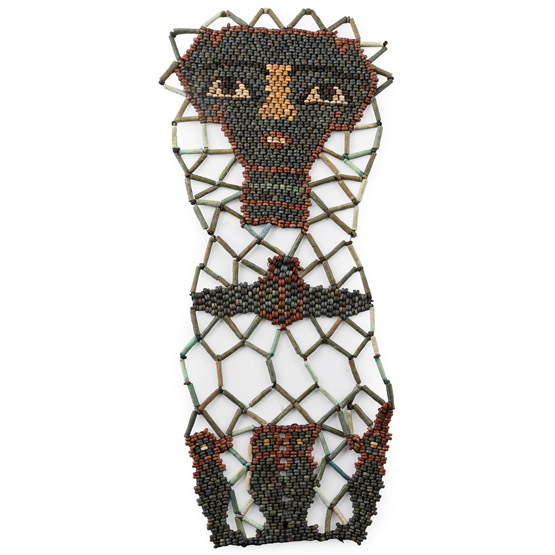
Egyptian Faience Mummy Bead Mask with Scarab and Four Sons of Horus
Ptolemaic Period, 332-30 B.C.Sold for (Inc. bp): £338
A restrung netted beadwork panel of annular and tubular glazed composition beads in blues, greens, black, cream and red-brown colours, depicting a mummy face mask with false beard, a scarab with extended wings below, the 'Four Sons of Horus’ beneath the scarab, joined together with areas of open netting of tubular beads. 63 grams, 28.2 cm
Ex Mariaud de Serres, Paris, 1990s. -
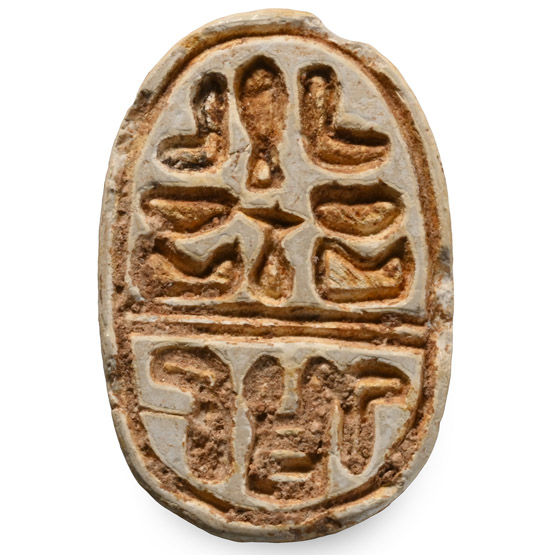
Egyptian White Stone Scarab with Hieroglyphs
Hyksos Period, 15th Dynasty, circa 1650-1550 B.C.Sold for (Inc. bp): £117
Plano-convex in section with scarab detailing to the upper face; underside featuring a hieroglyphic inscription, including addorsed stylised cobras, right-angled netjer and nefer signs; pierced longitudinally. 1.61 grams, 18 mm
Ex Constable collection, 1990s. Ex P. Morris collection. -
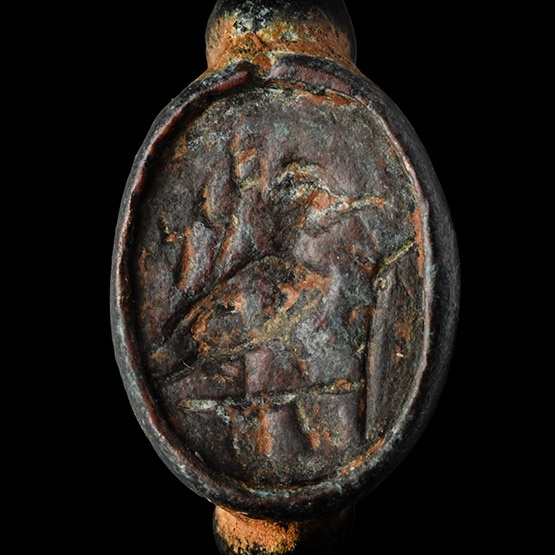
Phoenician Bronze Scaraboid Seal Matrix
Late 1st millennium B.C.Estimate: £260 - 360 (+bp*)
Opening Bid: £140
Ellipsoid in plan with domed upper face, lateral lobes and ribbed suspension bar; avian image; supplied with a museum-quality impression. 8.26 grams, 20 mm
From the collection of a gentleman, acquired on the London art market in the 1990s.
