
Loading, please wait...
LOT 0078
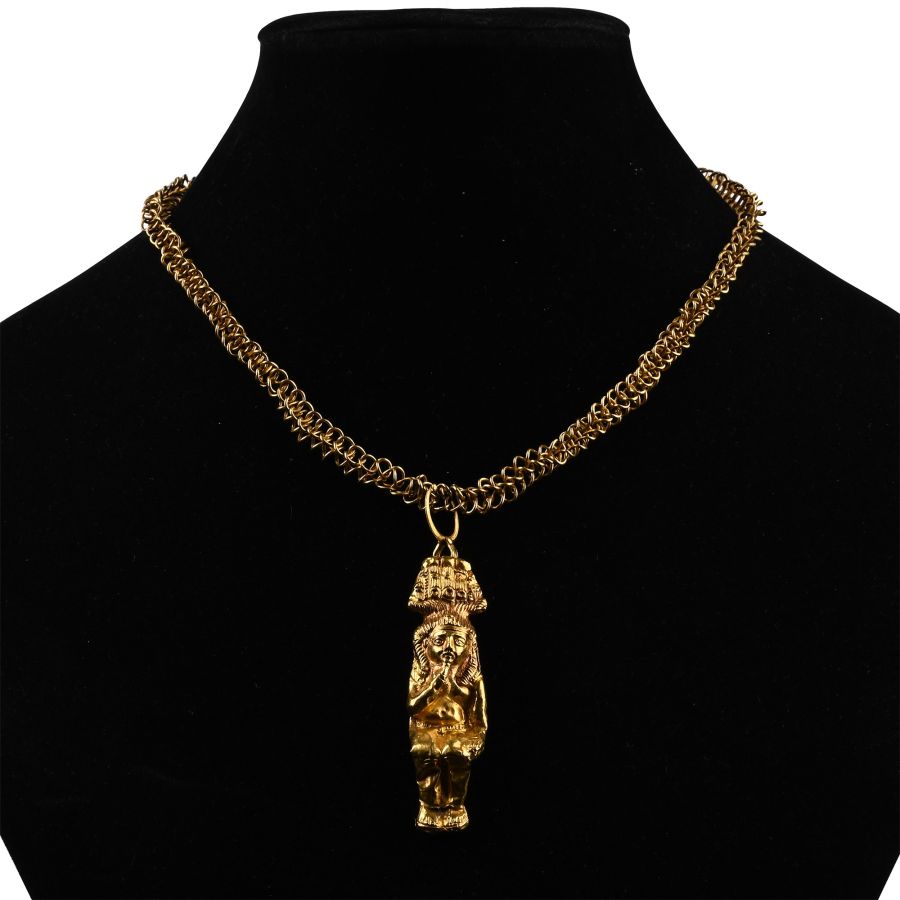
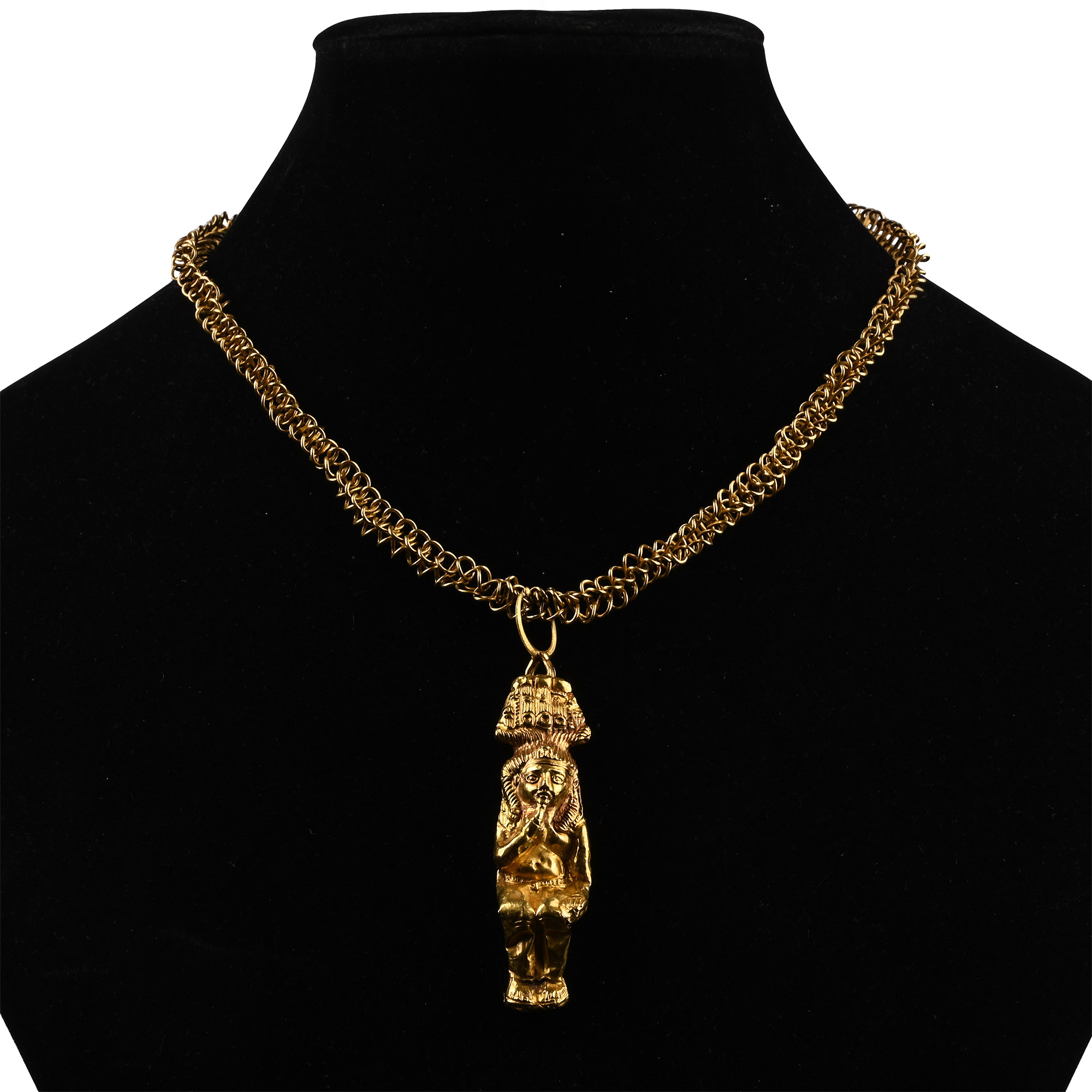
Egyptian Gold Necklace with Harpocrates Pendant
ROMAN PERIOD, 1ST CENTURY B.C.-1ST CENTURY A.D.
16 In. (49.80 grams, 40.5 cm).
Gold chain of double-looped links terminating in corrugated end elements, with hook-and-eye clasp; suspension ring embellished with applied granulation and a ribbed loop; hollow-formed sheet-gold pendant in the round depicting Harpocrates seated, his right forefinger raised to his mouth, wearing a finely detailed nemes headdress surmounted by a complex hemhem, crown incorporating multiple hedjet elements, flanking uraei, and ram's horns.
ProvenanceEx Elie Boustros collection, Lebanon.
Private collection, acquired in the late 1980s-early 1990s; thence by descent.
This lot has been checked against the Interpol Database of stolen works of art and is accompanied by search certificate number no.13203-249297.
See Swan Hall, E., 'Harpocrates and Other Child Deities in Ancient Egyptian Sculpture' in Journal of the American Research Center in Egypt, Vol. 14, 1977, pp.55-58, fig.1, pl.XXVII; fig.4, for discussion; for statuettes of Harpocrates with the same accoutrement see Roeder, G., Ägyptische Bronzefiguren II, Berlin, 1956, pl. 20e.
FootnotesThe fully three-dimensional modelling of the pendant aligns it with a group of high-quality Roman-period Egyptian goldwork characterised by pronounced plasticity and sculptural ambition. A pertinent comparison may be drawn with the gold diadem depicting Serapis from the Dush Treasure, discovered concealed within the wall of a Roman fort in the Baris Oasis (Reddé, M., Douch IV. Le trésor de Douch, DFIFAO 28, Cairo, 1992). That assemblage, plausibly associated with a nearby temple of Serapis and Isis, demonstrates a similarly bold treatment of divine imagery in precious metal. Comparable small-scale representations of Harpocrates in gold - often amuletic in function - are known from Roman Egypt, though examples combining such intricate crown iconography with fully rounded modelling remain relatively rare. The present piece therefore occupies an interesting position between personal adornment and cultic or apotropaic object, reflecting both Alexandrian iconographic synthesis and provincial workshop virtuosity.
Harpocrates is the Greek version of the Egyptian Hor-pa-khered, which means ‘Horus the Child’. This name refers to Horus as the divine infant of Isis and Osiris. Wearing an amulet of Harpocrates was believed to provide the same protection that Isis offered to her beloved son.
TimeLine Auctions follows a vetting process to ensure the authenticity and legality of all items, reinforcing our commitment to integrity and responsible trading. Each antiquity, antique, and coin lot undergoes thorough examination by a vetting committee of at least ten external specialists, professional trade association members, scientists, and archaeologists: Our Vetting Process
AUCTIONS:
TimeLine is a leading auction house specialising in antiquities, ancient art, collectables, natural history, coins, medals, and books. Our auctions offer museums, collectors, historians, and enthusiasts the opportunity to acquire unique and historically significant pieces.
LOT 0078
Egyptian Gold Necklace with Harpocrates Pendant
Estimate £15,000 - 20,000€17,400 - 23,200 (for guidance only)$20,250 - 27,000 (for guidance only)
-
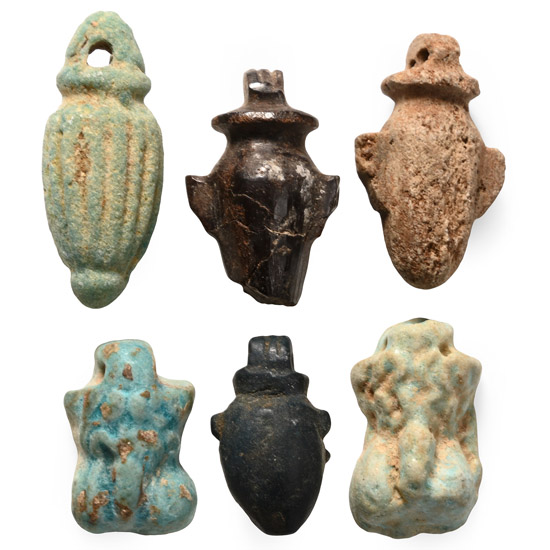
Egyptian Faience Amulet Group
Late Period, 664-332 B.C.Sold for (Inc. bp): £234
Comprising three heart amulets, two phallic amulets, and a ribbed fruit amulet. 11.6 grams total, 16-25 mm
From the collection of a gentleman, acquired on the London art market in the 1990s. -
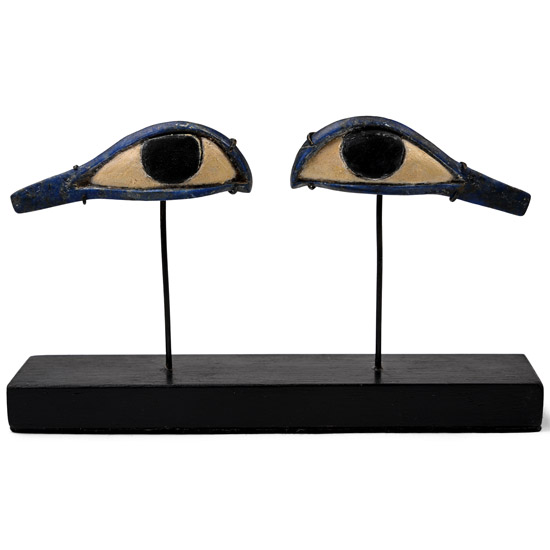
Egyptian Blue Glass Mummy Eye Pair
Late Period, 664-332 B.C.Sold for (Inc. bp): £2,340
Composed of overpainted white sclerae with obsidian irises, set into contoured blue glass lids with extending cosmetic lines; mounted on a custom-made display stand. 44.35 grams total including stand, 56 mm each
Property of a North American gentleman, London, UK, 1990-2010. This lot has been checked against the Interpol Database of stolen works of art and is accompanied by search certificate number no.13254-252260.
The eyes would have been applied to a mummy case. They were carefully bevelled and ground to fit the original mummy case. They could also have been used for the mummy masks. -
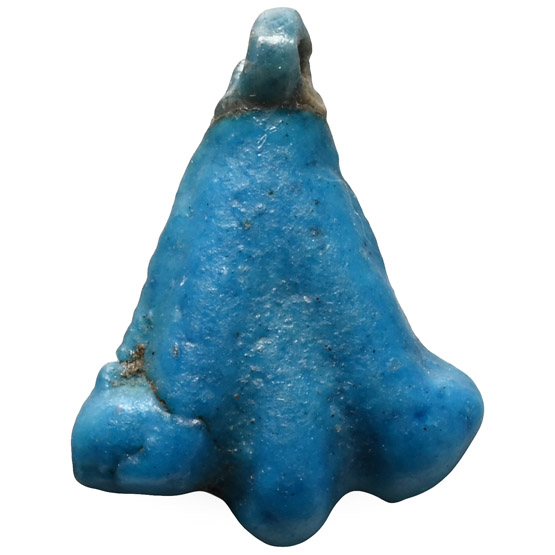
Egyptian Faience Lotus Flower Amulet
18th Dynasty, Amarna Period, 1353-1336 B.C.Sold for (Inc. bp): £59
A blue glazed composition pendant in the form of a lotus, with some repair to the suspension loop. 0.26 grams, 14 mm
Repaired.
Ex early 20th century London collection.
