
Loading, please wait...
_900x900.jpg "Egyptian Gold Mounted Scarab Bead")
_200x200.jpg "Egyptian Gold Mounted Scarab Bead")
.jpg "Egyptian Gold Mounted Scarab Bead")
LOT 0482
Egyptian Gold Mounted Scarab Bead
MIDDLE KINGDOM-SECOND INTERMEDIATE PERIOD, CIRCA 1900-1560 B.C.
3/4 in. (3.36 grams, 20 mm).
Comprising a faience scarab with a scroll-work border framing the vertically arranged hieroglyphs: kheper beetle, nwb sign for gold, and two nfr signs flanking an ankh sign, set in a gold funda with tubular collars.
ProvenanceFrom an early 20th century Home Counties, UK, collection.
This lot is accompanied by an illustrated lot declaration signed by the Head of the Antiquities Department, Dr Raffaele D’Amato.
See Ben-Tor, D., The Scarab: A Reflection of Ancient Egypt, Jerusalem, 1993, p. 31, for a discussion of this type of design scarab; Andrews, C., Ancient Egyptian Jewellery, London, 1990, pp.163-9, for discussion of finger rings.
CONDITIONTimeLine Auctions follows a vetting process to ensure the authenticity and legality of all items, reinforcing our commitment to integrity and responsible trading. Each antiquity, antique, and coin lot undergoes thorough examination by a vetting committee of at least ten external specialists, professional trade association members, scientists, and archaeologists: Our Vetting Process
AUCTIONS:
TimeLine is a leading auction house specialising in antiquities, ancient art, collectables, natural history, coins, medals, and books. Our auctions offer museums, collectors, historians, and enthusiasts the opportunity to acquire unique and historically significant pieces.
LOT 0482
Egyptian Gold Mounted Scarab Bead
Estimate £400 - 600€460 - 700 (for guidance only)$540 - 810 (for guidance only)
-
.jpg)
Egyptian Steatite Fragmentary Pectoral with Central Scarab Element
New Kingdom, 20th Dynasty, circa 1186-1069 B.C.Sold for (Inc. bp): £1,430
Obverse with scarab carved in high-relief and wing-case recessed to accept inlays (now absent), flanked by a small female goddess wearing a tall headdress, almost certainly Nephthys, with her arms raised in supplication; column with text to her rear, covered in gold foil and perhaps to be read as 'May my name be victorious: protection..'; reverse with the upper body of a male figure facing right with both arms raised towards the remains of a recumbent Anubis on a plinth above the top of a fragmentary shield-shaped plaque with incised text beginning 'Osiris Lord of Eternity forever..'; mounted on a custom-made stand. 53 grams, 69 mm (157 grams total, 11.5 cm including stand)
Eric Pascoe (d. 2019), Calenick House, Truro, Cornwall. Lodge & Thomas, Truro, Antiques & Fine Art Two Day Auction-Including the Ron Clifford Collection of Dinky & Britain's Toys, 26-27 September 2019, no.684. Acquired by the present owner at the above sale. with Bonhams, London, 8 December 2022, no.265. This lot is accompanied by an illustrated lot declaration signed by the Head of the Antiquities Department, Dr Raffaele D’Amato.
This fragment from an elaborate pectoral may exemplify an innovative design characteristic of the Ramesside Period, during which iconographic and textual elements began to diverge from the more conventional styles of earlier pectorals. For a discussion of some of these novel pectorals, refer to Whelan, P., 'An Epithet-Laden Pectoral,' Egitto e Vicino Oriente, 46 (2023), pp.7-28. -
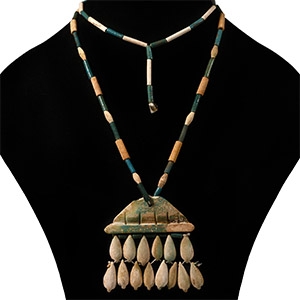
Egyptian Faience Necklace with Pendant
New Kingdom, 1400-1100 B.C.Estimate: £700 - 900 (‡+bp*)
Opening Bid: £350
Restrung group of tubular and fusiform faience beads with D-shaped pendant and two tiers of dangles beneath. 48 grams, 80 cm long
Acquired in the mid 1980s-1990s. Private collection, Switzerland, thence by descent. Private collection, since the late 1990s. This lot is accompanied by an illustrated lot declaration signed by the Head of the Antiquities Department, Dr Raffaele D’Amato. -
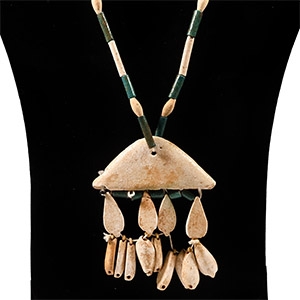
Egyptian Faience Necklace with Pendant
New Kingdom, 1400-1100 B.C.Estimate: £700 - 900 (‡+bp*)
Opening Bid: £350
Designer necklace composed of alternating white and turquoise tubular beads with oval spacer bead; a collar terminal as a central pendant with two rows of petal-shaped beads incorporating tubular and ring spacers suspended below. 41 grams, 76 cm long
Acquired in the mid 1980s-1990s. Private collection, Switzerland, thence by descent. Private collection, since the late 1990s. This lot is accompanied by an illustrated lot declaration signed by the Head of the Antiquities Department, Dr Raffaele D’Amato.
