
Loading, please wait...


LOT 0456
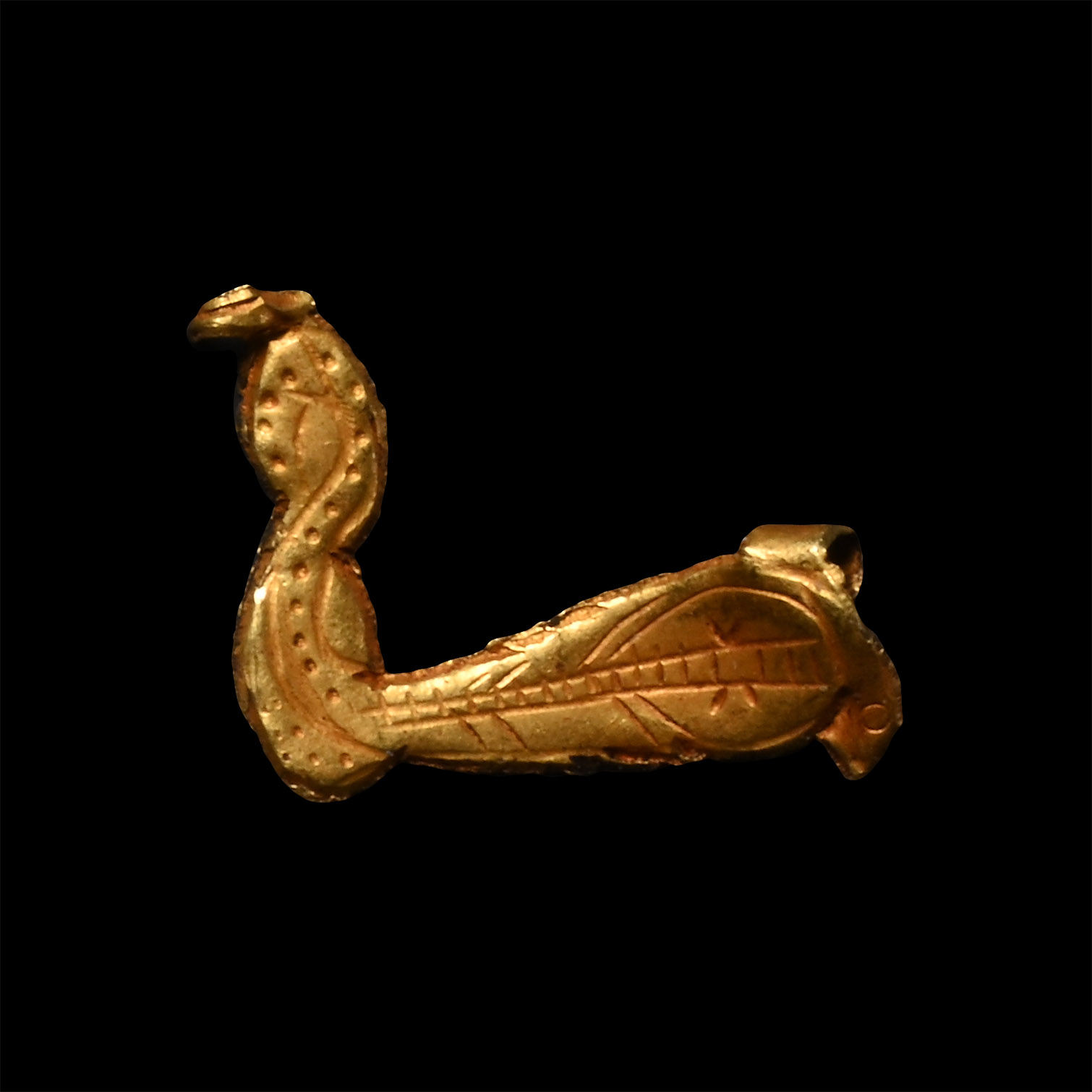
Egyptian Gold Cobra Amulet
LATE PERIOD, 664-332 B.C.
1/2 in. (0.17 grams, 11 mm).
Depicting a rearing cobra with incised detailing and a suspension loop behind the head.
ProvenanceFrom the private collection of the late Mrs Belinda Ellison, a long time member of the Egyptian Exploration Society, c.1940-2020.
CONDITIONTimeLine Auctions follows a vetting process to ensure the authenticity and legality of all items, reinforcing our commitment to integrity and responsible trading. Each antiquity, antique, and coin lot undergoes thorough examination by a vetting committee of at least ten external specialists, professional trade association members, scientists, and archaeologists: Our Vetting Process
AUCTIONS:
TimeLine is a leading auction house specialising in antiquities, ancient art, collectables, natural history, coins, medals, and books. Our auctions offer museums, collectors, historians, and enthusiasts the opportunity to acquire unique and historically significant pieces.
-
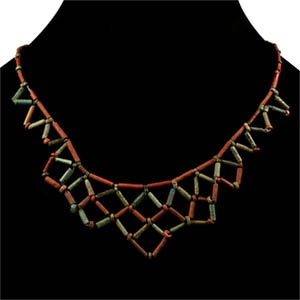
Egyptian Faience Bead Necklace
Late Period, 664-332 B.C.Sold for (Inc. bp): £140
A netted beadwork composed of red and blue tubular beads; restrung with a modern clasp. 7.93 grams, 40 cm
Ex John Moor galley, 1990s. From the H.W. collection, UK. Accompanied by a previous cataloguing card. -
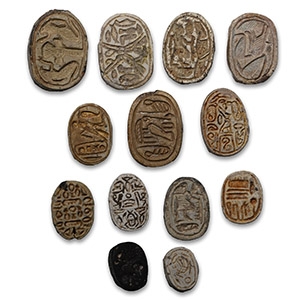
Egyptian Canaanite Limestone Scarab Group
Second Intermediate Period-New Kingdom, circa 17th-12th century B.C.Sold for (Inc. bp): £1,040
A group of thirteen scarabs with anatomical detailing to the carapace, comprising: 1) two kneeling hawk-headed figures with arms raised praise flank a central Hathoric fetish; 2) two facing falcons adorned with Red Crowns flanked by hieroglyphs, including netjer,hes-jars, and maat feathers; 3) standing human figure holding a staff atop a neb hieroglyph facing a highly stylised crocodile; 4) falcon atop a neb hieroglyph facing a striking cobra with another above; 5) the Re-Horakhty falcon standing before a hes-jar, with cartouche behind containing hieroglyphs and a verticalneb hieroglyph on the left; 6) central motif of a bird atop a neb hieroglyph with a rectangular sign above, a was- sceptre behind, flanked by stylised cobras; 7) falcon wearing the Red Crown atop a shrine with a winged sun disc above, flanked by cobras and Red Crowns; 8) central design consisting of hes-jars, a sun disc, a nub symbol (for gold), nefer signs, a kheper scarab beetle, and lotus flowers, all flanked by a border of en and ro signs; 9) central column of hes-jars, a sun disc, a kha rising sun hieroglyph, and scarab beetle, flanked by lions’ foreparts, Red Crowns, neb and hes-jar signs; 10) standing figure atop a neb hieroglyph holding a flower/branch; 11) hieroglyphs writing ‘Amun beloved of the living Ramesses’; 12) stylised bird with men hieroglyph behind; 13) scarab beetle with sun disc above. 27.1 grams total, 11-20 mm
Acquired in the mid 1980s-1990s. Private collection, Switzerland, thence by descent. Private collection, since the late 1990s.
The popularity of the scarab was so great that many of these scarab designs can be found outside Egypt at sites in the ancient Levant. -
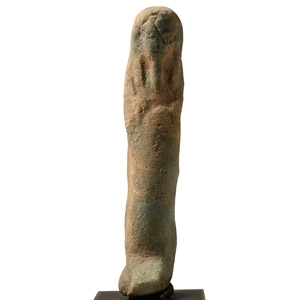
Egyptian Faience Blue Glazed Shabti
Ptolemaic Period, 323-30 B.C.Sold for (Inc. bp): £72
A typical mummiform figure with moulded facial detailing, a lappet wig, and hands holding a pick and hoe, the back with a possible hieratic inscription, mounted on a custom-made stand with label 'Ancient Egypt / (26th Dyn - Ptolem.) / circa 664-332 BC / Turquoise Faience / Ushabti Figure'. 91 grams total, 13 cm high including stand
Ex old UK collection. Acquired from Cestrian Antiques, Chester, UK, 2002. Ex Pemberton collection, Wales, UK. Accompanied by old information labels with collection reference C.234. Accompanied by the original Cestrian Antiques invoice.
