
Loading, please wait...
_900x900.jpg "Egyptian Gold Bird Amulet")
_200x200.jpg "Egyptian Gold Bird Amulet")
.jpg "Egyptian Gold Bird Amulet")
LOT 0520
Egyptian Gold Bird Amulet
NEW KINGDOM, 1550-1070 B.C.
1/2 in. (0.86 grams, 11 mm).
A bifacial gold amulet in the form of a perching bird, possibly a vulture, with stylised detailing to the head, wings and feet; pierced between tail and chest for suspension.
ProvenanceEarly 20th century French collection.
LiteratureCf. The Baron Empain collection, Christie's, 14 April 2011, lots 39 and 40, for similar.
CONDITIONTimeLine Auctions follows a vetting process to ensure the authenticity and legality of all items, reinforcing our commitment to integrity and responsible trading. Each antiquity, antique, and coin lot undergoes thorough examination by a vetting committee of at least ten external specialists, professional trade association members, scientists, and archaeologists: Our Vetting Process
AUCTIONS:
TimeLine is a leading auction house specialising in antiquities, ancient art, collectables, natural history, coins, medals, and books. Our auctions offer museums, collectors, historians, and enthusiasts the opportunity to acquire unique and historically significant pieces.
LOT 0520
Egyptian Gold Bird Amulet
Estimate £400 - 600€460 - 700 (for guidance only)$540 - 810 (for guidance only)
-
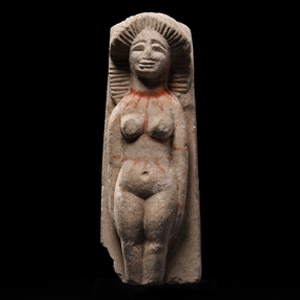
Egyptian Limestone Figure of Isis-Aphrodite
Ptolemaic-Roman Period, 332 B.C.-200 A.D.Sold for (Inc. bp): £483
A limestone figure modelled in the half-round, lying naked on a rectangular bed, executed with semi-naturalistic anatomical detailing, voluminous coiffed hair and painted necklace, armbands and distinctive ornamental girdle at the waist; accompanied by a custom-made display stand. 109 grams total, 11.5 cm including stand
Fine condition.
with Secret Eye Gallery, New York City, 1977. with Arte Primitivo, New York, USA, 8 October, 2003, lot 66. Private collection of Professor Kenneth Graham, London, UK. Accompanied by an original Arte Primitivo catalogue page. Accompanied by a scholarly note by Egyptologist Paul Whelan.
This syncretic figure combines the Egyptian goddess Isis and the Greek goddess Aphrodite, a deity popular from the 3rd century B.C. into the Roman Period, who embodied aspects of fertility, marriage, and childbirth. -
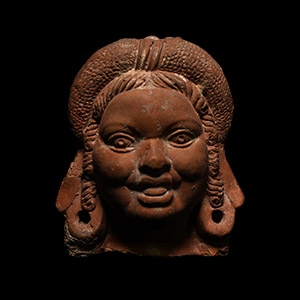
Graeco-Egyptian Head of Baubo Lamp
2nd century B.C.-2nd century A.D.Sold for (Inc. bp): £1,300
A terracotta oil lamp formed as the head of Baubo, with a smiling, plump face, wavy locks and taenia, two circular apertures at either side of her neck, expression formed with semi-naturalistic features and large extended earlobes accommodating circular apertures; circular hole to reverse and oval hole to top of head; trace remains of white gesso; vintage collection label to reverse. 245 grams, 10.4 cm
with ink inscribed label '1.2.27 CAS (22)'. From the deceased estate of N.A.C. Embiriscos, UK, 1950-1969. with Christie's London, 25 April 2001, lot 249. Accompanied by a copy of the relevant Christie's catalogue pages. -
.jpg)
Egyptian Shabti of Psamtek
Late Period, 27th-30th Dynasty, circa 525-343 B.C.Estimate: £600 - 800 (+bp*)
Opening Bid: £300
A pale green composition shabti standing on a rectangular base, the arms crossed over the chest, holding a pick and a hoe with a seed bag over the left shoulder, wearing a wig and false beard; two vertical columns of hieroglyphs to the dorsal pillar naming the Controller of the Estates, Psamtek. 41.8 grams, 96 mm high
From a Worcester deceased estate. Property of a Cambridgeshire gentleman. Accompanied by an academic report by Paul Whelan.
