
Loading, please wait...
_900x900.jpg "Egyptian Gold Seated Bastet Cat Amulet")
_200x200.jpg "Egyptian Gold Seated Bastet Cat Amulet")
.jpg "Egyptian Gold Seated Bastet Cat Amulet")
LOT 0013
Egyptian Gold Seated Bastet Cat Amulet
LATE NEW KINGDOM-THIRD INTERMEDIATE PERIOD, CIRCA 1069-900 B.C. OR LATER
1/8 in. (0.54 grams, 8 mm).
Modelled seated on a tongue-shaped base, with simple facial detailing and a suspension loop to the back.
ProvenanceEx French art market, 1920s.
LiteratureCf. Andrews, C., Amulets of Ancient Egypt, London, 1994, item 29(c).
FootnotesThe goddess Bastet was believed to be the daughter of the sun god and was shown with the features of a lion up until about 1000 B.C., when she was first portrayed as a cat or human with a cat head. As the daughter of Ra, she was associated with the rage inherent in the sun god's eye, which was considered to be his instrument of vengeance. Her development into a cat goddess occurred during the New Kingdom, but did not fully develop until the Late Period. She was still associated with the destructive power of the sun and was shown on the prow of the solar boat, decapitating the evil serpent Apophis in the Book of the Dead. The maternal, protective and hunting characteristics of the cat are obvious in Bastet, and she was seen as a protector of pregnant women and young children. In the Pyramid Texts, she is invoked by the deceased king to act as his protector and to help him reach the sky to join the sun god; the king proclaims that Bastet is his mother and nurse. Like her counterpart, Sekhmet, Bastet has an aggressive side and, in a text from Karnak, Amenhotep II described his enemies being slaughtered like the victims of Bastet. The goddess had a shrine at Karnak, where she is known as the 'Lady of Asheru', which aligns her closely with the goddess Mut, the consort of Amun-Ra. Her most famous shrine was in the north-east Delta region, at Bubastis, and was known as Per-Bastet or 'the House of Bastet.' Herodotus describes the festival of Bastet as one of the most elaborate in all of Egypt and identifies her with the Greek Artemis. Cemeteries of cats have been excavated at Bubastis, and at Saqqara and Memphis.
CONDITIONTimeLine Auctions follows a vetting process to ensure the authenticity and legality of all items, reinforcing our commitment to integrity and responsible trading. Each antiquity, antique, and coin lot undergoes thorough examination by a vetting committee of at least ten external specialists, professional trade association members, scientists, and archaeologists: Our Vetting Process
AUCTIONS:
TimeLine is a leading auction house specialising in antiquities, ancient art, collectables, natural history, coins, medals, and books. Our auctions offer museums, collectors, historians, and enthusiasts the opportunity to acquire unique and historically significant pieces.
LOT 0013
Egyptian Gold Seated Bastet Cat Amulet
Estimate £500 - 700€580 - 810 (for guidance only)$680 - 950 (for guidance only)
Opening Bid
£225 (EUR 261; USD 304) +BP*
-
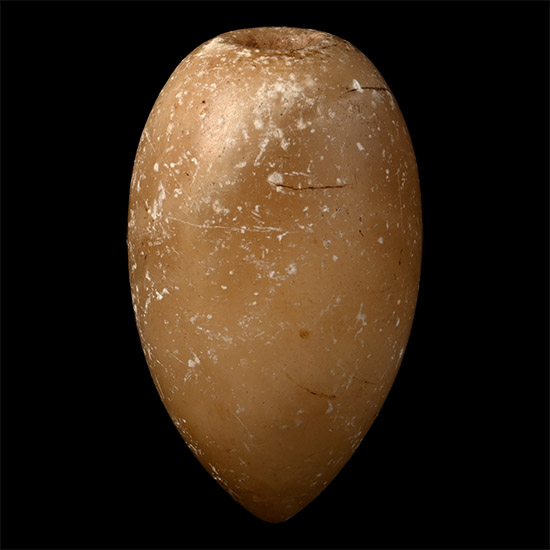
Egyptian Alabaster Miniature 'Torpedo' Flask
Middle Kingdom, 2nd millennium B.C.Estimate: £100 - 140 (+bp*)
Opening Bid: £5
Ovoid in profile with a pointed base, narrow opening, and hollowed interior. 62.6 grams, 57 mm
From a UK private collection since at least 1946. Property of a West London, UK, gentleman.
Ancient Egyptian cosmetics included volatile essential oils, animal fats, or scented plant resins. The ‘torpedo’ shape of the vessel required it to be positioned horizontally, ensuring the fluid remained in contact with the stopper or seal to prevent it from drying out or leaking. -
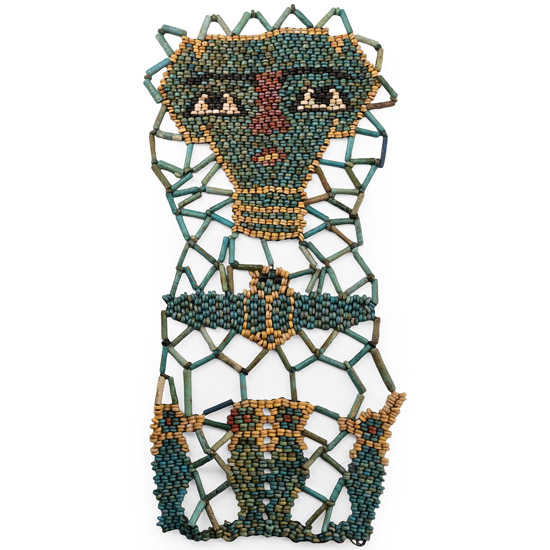
Egyptian Faience Mummy Bead Mask
Late Period-Ptolemaic Period, circa 664-30 B.C.Estimate: £300 - 400 (+bp*)
Opening Bid: £150
Openwork beaded panel depicting a mummy mask with tripartite beard, a winged scarab below with the Four Sons of Horus, Hapy, Imsety, Qebehsenuef, and Duamutef below; restrung. 40.7 grams, 22 cm
From the collection of Mariaud de Serres, Paris, France, 1980s-1990s. Accompanied by a previously illustrated catalogue card with provenance. -
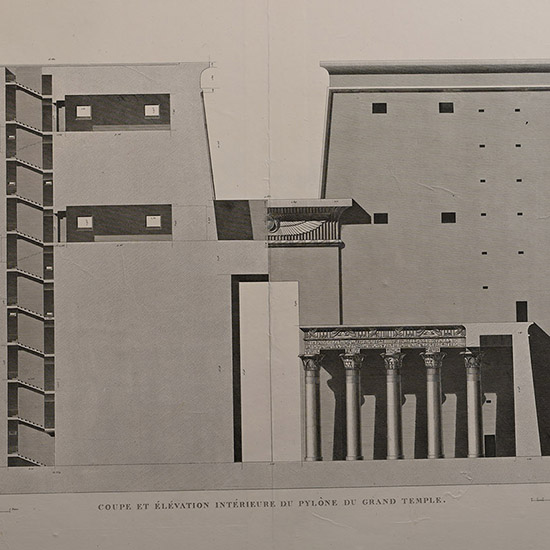
Very Large Egyptian Expedition Lithograph of the Temple of Edfou
Early 19th century A.D.Estimate: £80 - 100 (+bp*)
Opening Bid: £40
Proof etching on laid paper of plate 52 from Vol.I of Description de l'Égypte : ou, Recueil des observations et des recherches qui ont été faites en Égypte pendant l'expédition de l'armée française, titled Edfou (Apollinopolis Magna) Coupe et élévation intérieure du pylône du grand temple. 230 grams, 105.5 x 69 cm
From the collection of a North American priest. Acquired between 1981-1996. Property of a North American collector.
Produced between February 1802 and 1830 on the orders of Napoleon Bonaparte; published between 1809 and 1828. Just 1,000 copies were distributed to various institutions, printed on laid paper with an 'Égypte ancienne et moderne' watermark. The book is subtitled Recueil des observations et des recherches qui ont été faites en Égypte pendant l’expédition de l’Armée française, publié par les ordres de Sa Majesté l’Empereur Napoléon le Grand (Gathering of observations and discoveries which were made in Egypt during the expedition of the French army, published on the orders of His Majesty the Emperor Napoleon the Great). It was the world's first encyclopedia devoted exclusively to the remains of ancient Egypt. The plates of this book are the first to present the archaeological sites of Thebes (Luxor). The temple at Edfu in Upper Egypt is dedicated to Horus and was built during the Ptolemaic Period. It remains one of the best-preserved temples in Egypt.
