
Loading, please wait...


LOT 0460
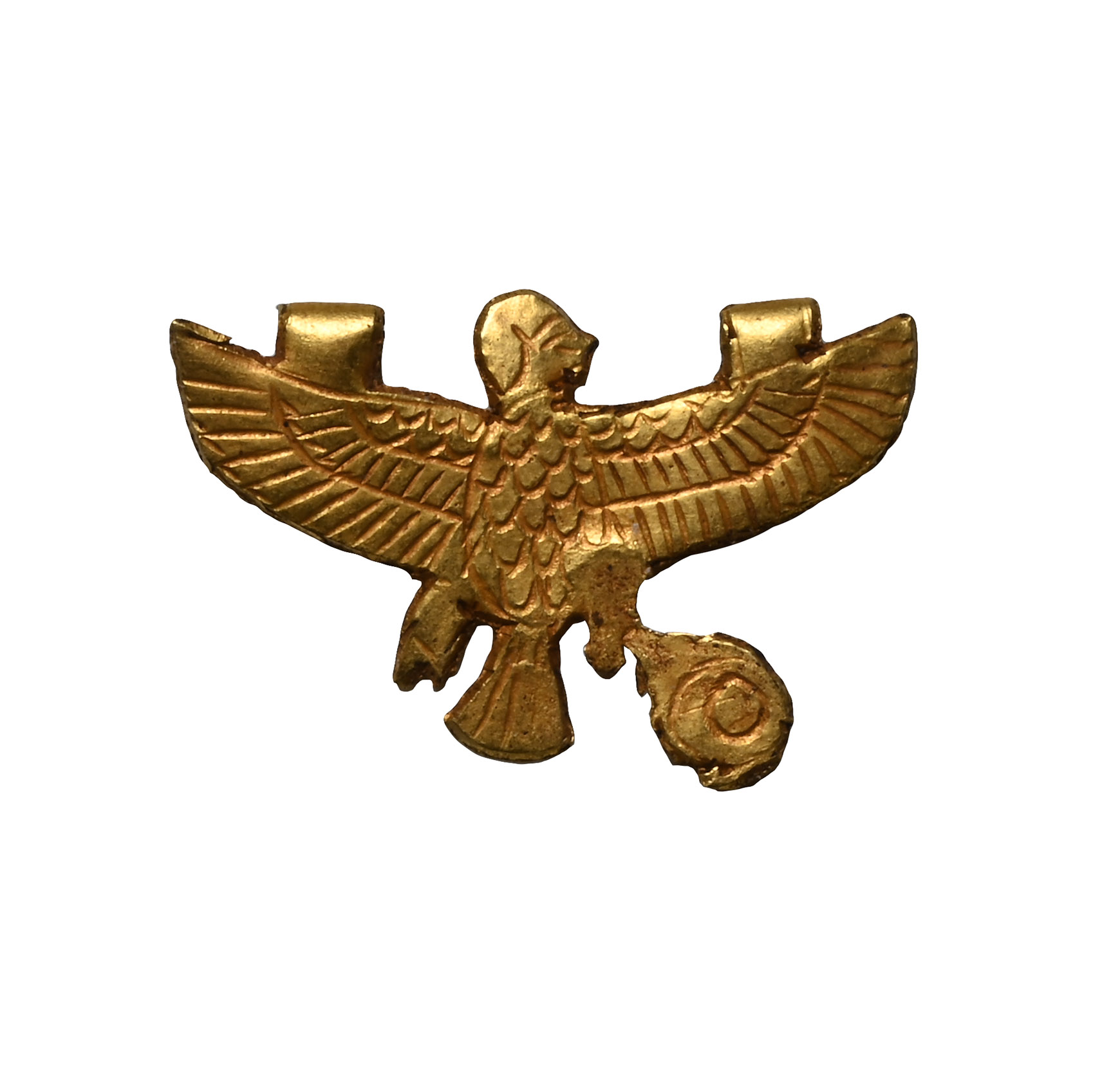
Egyptian Gold Ba-Bird Amulet
LATE PERIOD, 664-332 B.C.
5/8 in. (0.38 grams, 15 mm).
Finely detailed depiction of a human-headed ba-bird with outspread wings and the one preserved claw holding a shen ring.
ProvenanceFrom the private collection of the late Mrs Belinda Ellison, a long time member of the Egyptian Exploration Society, c.1940-2020.
LiteratureCf. Wilkinson, A., Ancient Egyptian Jewellery, London, 1971, for an example of a similar form.
FootnotesIn ancient Egyptian religion, the ba is one of the principal aspects of the human soul, along with the ka and the akh. It is often depicted in bird form, symbolising the soul's mobility after death.
CONDITIONTimeLine Auctions follows a vetting process to ensure the authenticity and legality of all items, reinforcing our commitment to integrity and responsible trading. Each antiquity, antique, and coin lot undergoes thorough examination by a vetting committee of at least ten external specialists, professional trade association members, scientists, and archaeologists: Our Vetting Process
AUCTIONS:
TimeLine is a leading auction house specialising in antiquities, ancient art, collectables, natural history, coins, medals, and books. Our auctions offer museums, collectors, historians, and enthusiasts the opportunity to acquire unique and historically significant pieces.
-
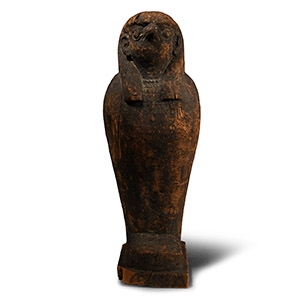
Egyptian Wooden Sarcophagus with Falcon Mummy
Late Period-Ptolemaic Period, 664-31 B.C.Sold for (Inc. bp): £8,190
Two-part wooden (sycamore?) falcon-headed mummiform coffin carved from a single piece of wood, with a tripartite wig and human ears, painted detailing to the eyes, and broad decorative collar; the whole covered with black paint with traces of yellow decoration and inscriptions; inside a mummified falcon wrapped in linen strips. 2.3 kg, 49.5 cm
Ex R. Liechti (1934-2010) Geneva, Switzerland, formed between 1950-1990s. Accompanied by a copy of an old collection inventory note. Accompanied by an academic report by Egyptologist Paul Whelan. This lot has been checked against the Interpol Database of stolen works of art and is accompanied by a search certificate number no.12074-218220.
This falcon-headed coffin once contained a so-called 'corn mummy' - a mummiform effigy impregnated with grain, which germinated. Such 'corn mummies' were associated with Osirian regeneration, fertility, and rebirth concepts. The falcon-headed coffin was associated with the powerful funerary deity Sokar-Osiris or Ptah-Sokar-Osiris. It seems that the original contents of this coffin were either lost or discarded and replaced with a mummified bird (falcon?). Interestingly, the most significant number of falcon-headed coffins come from Tuna el-Gebel, the site of an extensive animal mummy necropolis. -
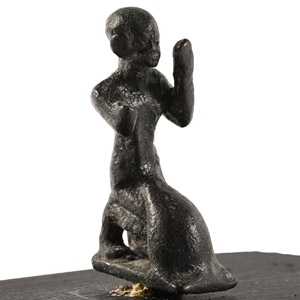
Egyptian Bronze Statue of a Kneeling Priest
Late Period, 664-332 B.C.Estimate: £250 - 350 (+bp*)
Opening Bid: £139
Kneeling on a rectangular platform with a wide apron covering his thighs, clean-shaven head and hands raised in adoration; tang on the underside for attachment; mounted on a display stand. 41 grams total, statue: 30 mm high
From an early 20th century Home Counties, UK, collection.
Priest figurines like this were commonly placed before a larger figurine of a deity, both attached to a base, e.g., Schulz, R., Seidel, M., Egyptian Art. The Walters Art Museum, London, 2009, for a kneeling priest before a standing figure of Anubis. -
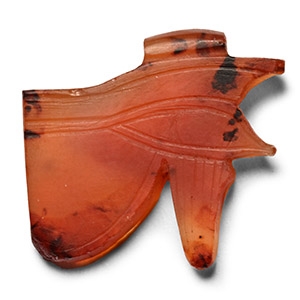
Egyptian Carnelian Eye of Horus Amulet
Circa 1000 B.C.Sold for (Inc. bp): £910
With exceptional eye detailing carved in low-relief to one face. 1.64 grams, 19 mm
Ex R. Liechti (1934-2010) Geneva, Switzerland, formed between 1950-1990s. Accompanied by a copy of an old collection inventory note.
The wedjat-eye amulet is a representation of the healed eye of the god Horus, featuring both human and falcon elements. The name wedjat in ancient Egyptian means ‘the one that is sound.’ According to Egyptian mythology, Horus' eye was wounded or taken by the god Seth and restored by Thoth. The wedjat-eye amulet was thought to protect its wearer and bestow the power of recovery and regeneration onto them. It was very popular and used by both the living and the dead.
