
Loading, please wait...
LOT 0464
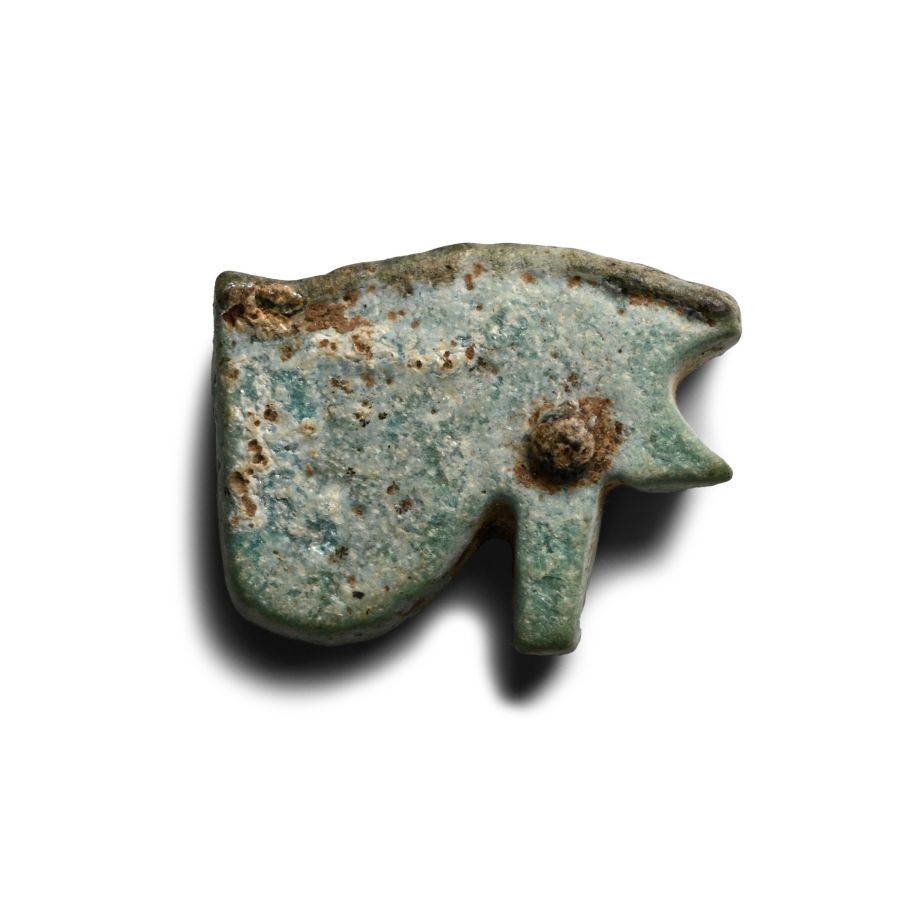
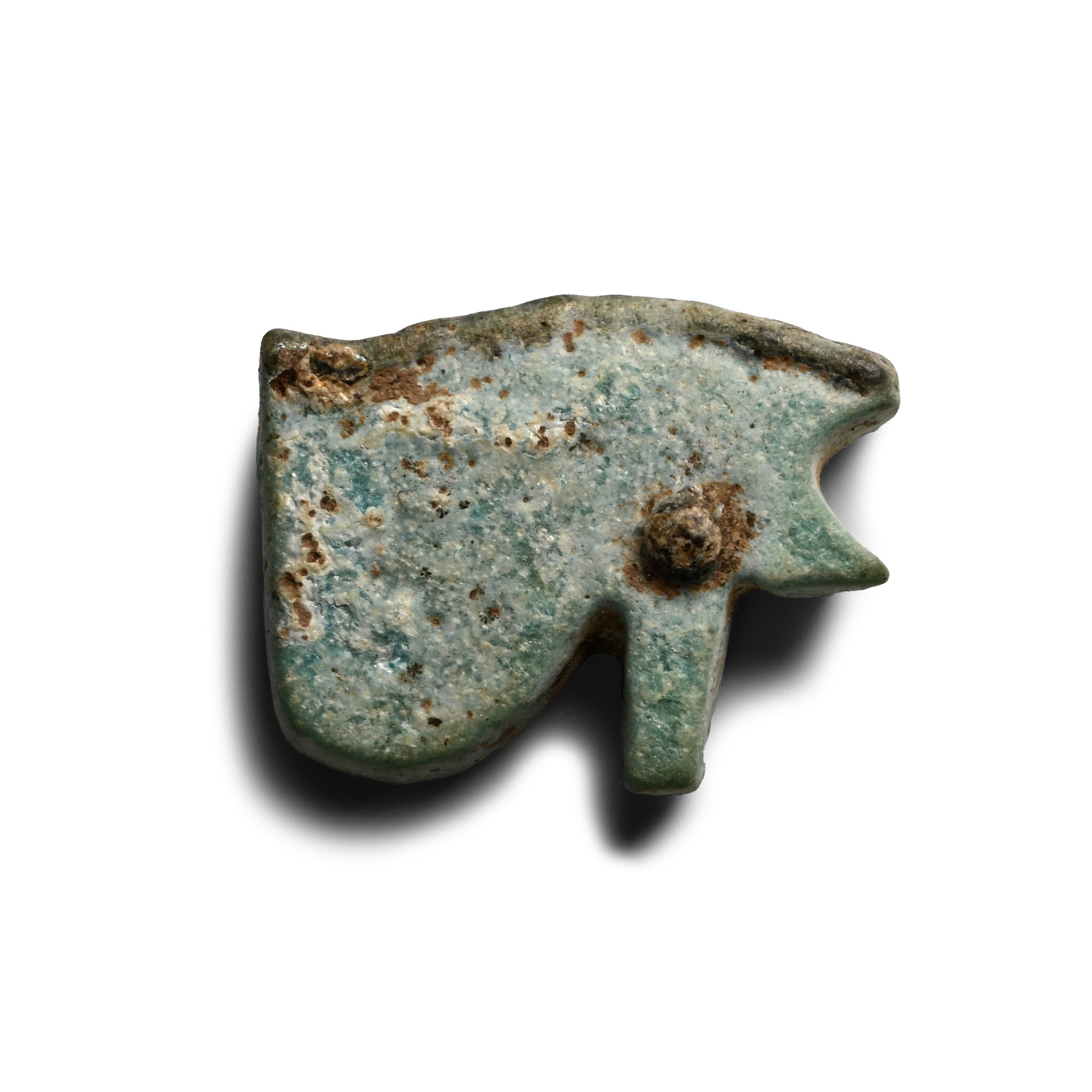
Egyptian Glazed Faience Horus Eye Amulet
PTOLEMAIC PERIOD, 332-30 B.C.
5/8 in. (1.18 grams, 17 mm).
Wedjat bead or amulet with applied black detailing to the pupil and brow.
ProvenanceMr F.D. collection, acquired on the European art market, 1975 to present.
This lot is accompanied by an illustrated lot declaration signed by the Head of the Antiquities Department, Dr Raffaele D’Amato.
Cf. Andrews, C., Amulets of Ancient Egypt, London, 1994, pl.46.
FootnotesThe wedjat-eye amulet is a representation of the healed eye of the god Horus, featuring both human and falcon elements. The name wedjat in ancient Egyptian means ‘the one that is sound.’ According to Egyptian mythology, Horus' eye was wounded or taken by the god Seth and restored by Thoth. The wedjat-eye amulet was thought to protect its wearer and bestow the power of recovery and regeneration onto them. It was very popular and used by both the living and the dead.
CONDITIONTimeLine Auctions follows a vetting process to ensure the authenticity and legality of all items, reinforcing our commitment to integrity and responsible trading. Each antiquity, antique, and coin lot undergoes thorough examination by a vetting committee of at least ten external specialists, professional trade association members, scientists, and archaeologists: Our Vetting Process
AUCTIONS:
TimeLine is a leading auction house specialising in antiquities, ancient art, collectables, natural history, coins, medals, and books. Our auctions offer museums, collectors, historians, and enthusiasts the opportunity to acquire unique and historically significant pieces.
-
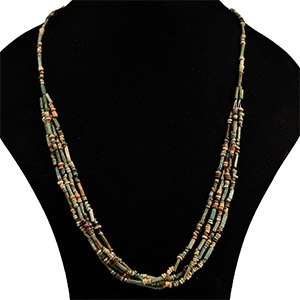
Egyptian Multi-Stranded Mummy Bead Necklace String
Late Period, 664-525 B.C.Sold for (Inc. bp): £143
A composition necklace composed of multiple strands of polychrome beads of mainly annular and tubular types. 28 grams total, 82 cm long
Acquired before 1979. From the private collection of Mr F. A., South Kensington, London, UK; thence by descent 2014. This lot is accompanied by an illustrated lot declaration signed by the Head of the Antiquities Department, Dr Raffaele D’Amato.
Red and yellow faience were among the new colours appeared in the 18th Dynasty, but they were in use until the Late Period. It was ideally formed from a core of sand and quartz and a vitreous alkaline glaze. It was the preferred medium of Egyptian jewellers even before the First Dynasty, because of its malleability and its ability to imitate other more expensive materials thanks to the colour of the glaze. -
.jpg)
Egyptian Wooden Cow Giving Birth Diorama with Two Figures
Middle Kingdom, 11th-12th Dynasty, 2023-1862 B.C.Sold for (Inc. bp): £3,380
Comprising three figures to represent a calving scene: a standing cow or other quadruped giving birth to its young, its head, neck and forelegs emerging from the mother's rear, both with a black and white speckled coat; a standing male figure with articulated arms and pierced hands, wearing a kilt and cropped wig and with stylised facial detailing; a kneeling figure also with articulated arms, open-palm hands, wearing a kilt and cropped wig, stylised facial features; extensive remains of polychrome pigment. 113 grams total, 9.5-16 cm
From an early 20th century Home Counties collection. This lot has been checked against the Interpol Database of stolen works of art and is accompanied by search certificate no.11597-199209. This lot has been cleared against the Art Loss Register database, and is accompanied by an illustrated lot declaration signed by the Head of the Antiquities Department, Dr Raffaele D’Amato.
Such models would have been deposited in tombs; the purpose of such a scene was probably to evoke the season of spring, when calves were born, and the floodplain where farmers lived and raised their livestock. -
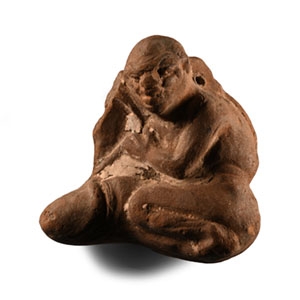
Egyptian Terracotta Ithyphallic Figurine of a Seated Male
Ptolemaic Period, 2nd-1st century B.C.Sold for (Inc. bp): £143
Representing a hunchback in a crouched position, leaning against his emphasised phallus and resting a triangular harp on it. 64 grams, 63 mm
The Erotica Collection Christian von Faber-Castell, Küsnacgt ZH, Switzerland, since the late 1970s. This lot is accompanied by an illustrated lot declaration signed by the Head of the Antiquities Department, Dr Raffaele D’Amato.
From the 4th century B.C. onwards, small-scale sculptures developed into a rich repertoire of grotesque types. These so-called grotesques were an enhancement of the Hellenistic interest in the human body and its weakness and imperfections by depicting disfigured individuals. According to some scholars, terracotta (and bronze) figurines of this kind were life-like representations of beggars and others who gathered at big feasts in temples or at the houses of the wealthy. In the latter case, they indicated the importance and wealth of the host as the more beggars an event attracted, the greater the fortune of the event organiser. By implication, the bronze and terracotta portraits of these marginal people could have become symbols and charms of good luck that would have been placed in private houses. Christian von Faber-Castell (born 1950) is a renowned German entrepreneur and art collector, best known as a member of the prominent Faber-Castell family, famed for their iconic writing instruments. A passionate advocate for art and culture, Christian von Faber-Castell curated an extensive and diverse private collection of erotica, spanning centuries and cultures. His collection reflects a deep appreciation for the interplay of beauty, sensuality, and artistic expression, bringing together rare and unique works that explore themes of intimacy and human connection. Pieces from this collection have been featured in notable exhibitions and are celebrated for their artistic and historical significance. This offering represents a rare opportunity to acquire works from one of the most fascinating and eclectic private collections of its kind.
