
Loading, please wait...


LOT 0005
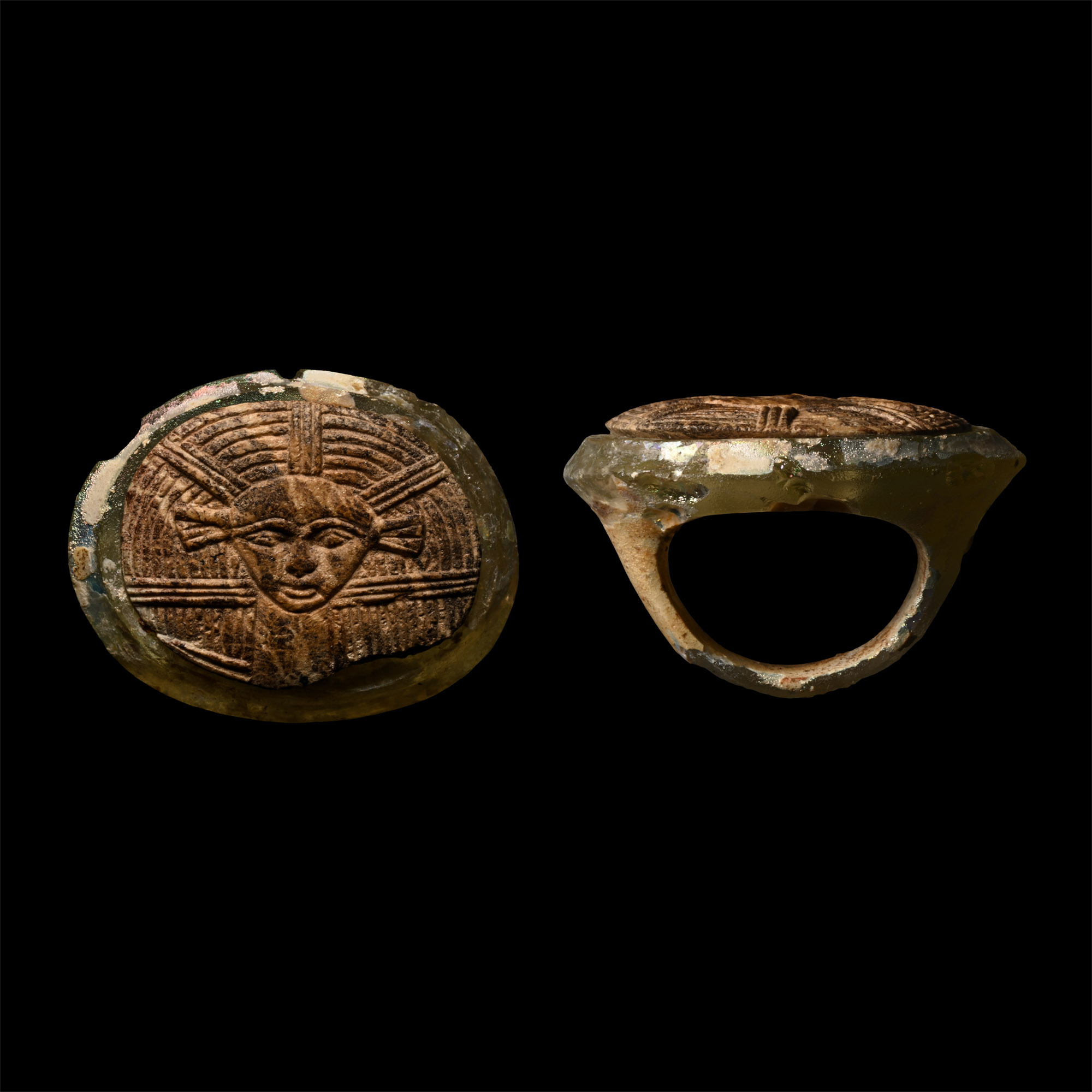
Egyptian Glass Ring with Hathor Cameo
PTOLEMAIC PERIOD, CIRCA 3RD CENTURY B.C.
1 1/2 in. (17.65 grams, 39.43 mm overall, 20.51 mm internal diameter (approximate size British J, USA 4 3/4, Europe 8.69, Japan 8)).
Pale green transparent glass hoop with ellipsoid bezel, bevelled edge inlaid with a darker glass low-relief facing mask of the goddess Hathor with cow's ears and banded hairstyle.
ProvenanceAcquired between 1965-2020.
Private collection, London.
This lot has been checked against the Interpol Database of stolen works of art and is accompanied by search certificate no.12484-229828.
This lot has been cleared against the Art Loss Register database, and is accompanied by an illustrated lot declaration signed by the Head of the Antiquities Department, Dr Raffaele D’Amato.
Cf. Chadour, A.B., Rings. The Alice and Louis Koch Collection, volume I, Leeds, 1994, items 16 & 24, for type.
FootnotesImages of Hathor with a human face and cow ears combine her human and bovine aspects. She is shown with a serene human face, symbolising her nurturing nature, while the cow ears emphasise her roles in fertility and motherhood.
Hathor was one of the most important deities in ancient Egypt, revered as the goddess of love, beauty, music, dance, fertility, and motherhood. She was also associated with joy, childbirth, and women’s health. Hathor was believed to protect and nurture, often depicted as a maternal figure. As such, she was closely linked with Isis. She was closely linked to the sun god Ra, acting as a cosmic force facilitating life. In funerary contexts, Hathor was also seen as a guide for the dead, helping them transition to the afterlife. Her multifaceted role made her one of Egypt's most widely worshipped goddesses.
TimeLine Auctions follows a vetting process to ensure the authenticity and legality of all items, reinforcing our commitment to integrity and responsible trading. Each antiquity, antique, and coin lot undergoes thorough examination by a vetting committee of at least ten external specialists, professional trade association members, scientists, and archaeologists: Our Vetting Process
AUCTIONS:
TimeLine is a leading auction house specialising in antiquities, ancient art, collectables, natural history, coins, medals, and books. Our auctions offer museums, collectors, historians, and enthusiasts the opportunity to acquire unique and historically significant pieces.
-
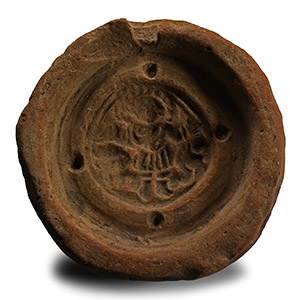
Coptic Terracotta Clay Mould
6th-7th century A.D.Sold for (Inc. bp): £72
Discoid receptacle with a military saint in Roman armour (Saint Menas), with muscular cuirass and pteryges, arms open in the manner of the orans pose, animals (camels?) on his side. 198 grams, 89 mm
Maurice Bouvier, Alexandrie, prior 1959. This lot is accompanied by an illustrated lot declaration signed by the Head of the Antiquities Department, Dr Raffaele D’Amato.
The majority of the terracotta ampullae come from Egypt and bear representations of St. Menas or Mennas, an Egyptian Christian officer decapitated during the persecutions of Diocletian's time. The legend relates that the saint's body was placed upon a camel which was let loose to follow what course it chose; in the place where the camel stopped, some miles from Alexandria, a grave and a shrine were subsequently built. In allusion to this legend, St. Menas is often represented as standing between two camels, though the animals are often of so fantastic a form as to be very difficult to recognise. -
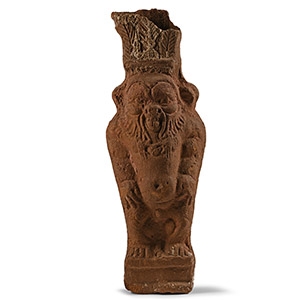
Egyptian Ceramic Statuette of the God Bes Wearing a Feather Crown
Roman Period, 2nd-3rd century A.D.Sold for (Inc. bp): £910
Standing on a pillar and wearing a feather crown and a panther skin cloak, his hands resting on his knees, large protruding ears and grimacing expression. 362 grams, 24 cm
The Erotica Collection Christian von Faber-Castell, Küsnacgt ZH, Switzerland, since the late 1970s. This lot is accompanied by an illustrated lot declaration signed by the Head of the Antiquities Department, Dr Raffaele D’Amato.
Christian von Faber-Castell (born 1950) is a renowned German entrepreneur and art collector, best known as a member of the prominent Faber-Castell family, famed for their iconic writing instruments. A passionate advocate for art and culture, Christian von Faber-Castell curated an extensive and diverse private collection of erotica spanning centuries and cultures. His collection reflects a deep appreciation for the interplay of beauty, sensuality, and artistic expression, bringing together rare and unique works that explore themes of intimacy and human connection. Pieces from this collection have been featured in notable exhibitions and are celebrated for their artistic and historical significance. This offering represents a rare opportunity to acquire works from one of the most fascinating and eclectic private collections of its kind. Bes became one of ancient Egypt's most popular apotropaic deities from the New Kingdom onwards. Despite his somewhat fearful appearance, Bes was the patron and protector of pregnant women and children and was also believed to protect from snakes. -
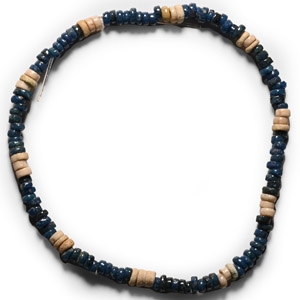
Egyptian Faience Bead Bracelet
Late Period, 664-332 B.C.Sold for (Inc. bp): £78
A restrung group of annular beads in shades of blue and white; mainly faience, but some possibly shell. 2.01 grams, 17.8 cm long
From the private collection of the late Mrs Belinda Ellison, a long time member of the Egyptian Exploration Society, c.1940-2020. This lot is accompanied by an illustrated lot declaration signed by the Head of the Antiquities Department, Dr Raffaele D’Amato.
