
Loading, please wait...
_900x900.jpg "Egyptian Glass Phial Group")
_200x200.jpg "Egyptian Glass Phial Group")
.jpg "Egyptian Glass Phial Group")
LOT 0510
Egyptian Glass Phial Group
1ST MILLENNIUM B.C.
1 3/8 in. (13.8 grams total, 35-37 mm).
Each is a tapering bulb shape with a flat-cut mouth. [2, No Reserve]
ProvenanceFrom the collection of Mr S.M., London, UK, formed from 1979-1999.
CONDITIONTimeLine Auctions follows a vetting process to ensure the authenticity and legality of all items, reinforcing our commitment to integrity and responsible trading. Each antiquity, antique, and coin lot undergoes thorough examination by a vetting committee of at least ten external specialists, professional trade association members, scientists, and archaeologists: Our Vetting Process
AUCTIONS:
TimeLine is a leading auction house specialising in antiquities, ancient art, collectables, natural history, coins, medals, and books. Our auctions offer museums, collectors, historians, and enthusiasts the opportunity to acquire unique and historically significant pieces.
-
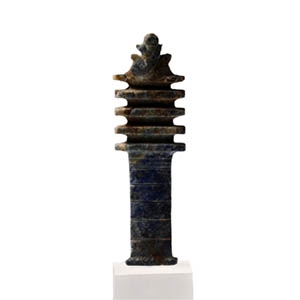
Egyptian Lapis Lazuli Amulet of a Djed Pillar
New Kingdom, 18th Dynasty, circa 1550-1295 B.C.Sold for (Inc. bp): £585
Carved as a square-section column with transverse ribs and a decorative finial, incised transverse lines to the body; mounted on a custom-made display stand. 4.84 grams, 49 mm (8.6 grams total, 64 mm including stand)
Ex R. Liechti (1934-2010) collection, Geneva, Switzerland. Private collection, Europe.
The djed pillar signifies the concepts of 'enduring' and 'stability' and was a common funerary amulet from the Old Kingdom onwards. It was first associated with the gods Ptah and Sokar but later became a symbol of Osiris, representing the god's backbone. In this context, the djed pillar appears in Chapter 155 of the Book of the Dead, concerned with the deceased's resurrection. R. Liechti was a distinguished collector of Egyptian antiquities, known for his discerning eye and passion for ancient artefacts. Active during the mid-20th century, Liechti's collection featured a wide range of objects that showcased the rich cultural heritage of ancient Egypt, from intricately carved statuettes to rare amulets and jewellery. His dedication to preserving and studying these relics earned him a respected reputation among scholars and collectors alike. Many pieces from his collection have since found their way into prominent museum collections and auction houses, further solidifying his legacy in the world of antiquities. -
.jpg)
Egypto-Phoenician Stone Scaraboid Group
1st millennium B.C.Sold for (Inc. bp): £52
One has an incuse falcon representing the god Re-Horakhty on the underside, the other in mottled hardstone. 4.69 grams total, 13-18 mm
From a collection acquired on the UK art market from various auction houses and collections mostly before 2000. From an important Cambridgeshire estate; thence by descent. -
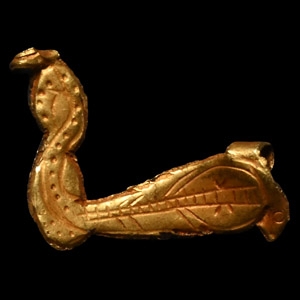
Egyptian Gold Cobra Amulet
Late Period, 664-332 B.C.Sold for (Inc. bp): £195
Depicting a rearing cobra with incised detailing and a suspension loop behind the head. 0.17 grams, 11 mm
From the private collection of the late Mrs Belinda Ellison, a long time member of the Egyptian Exploration Society, c.1940-2020.
