
Loading, please wait...

LOT 0391
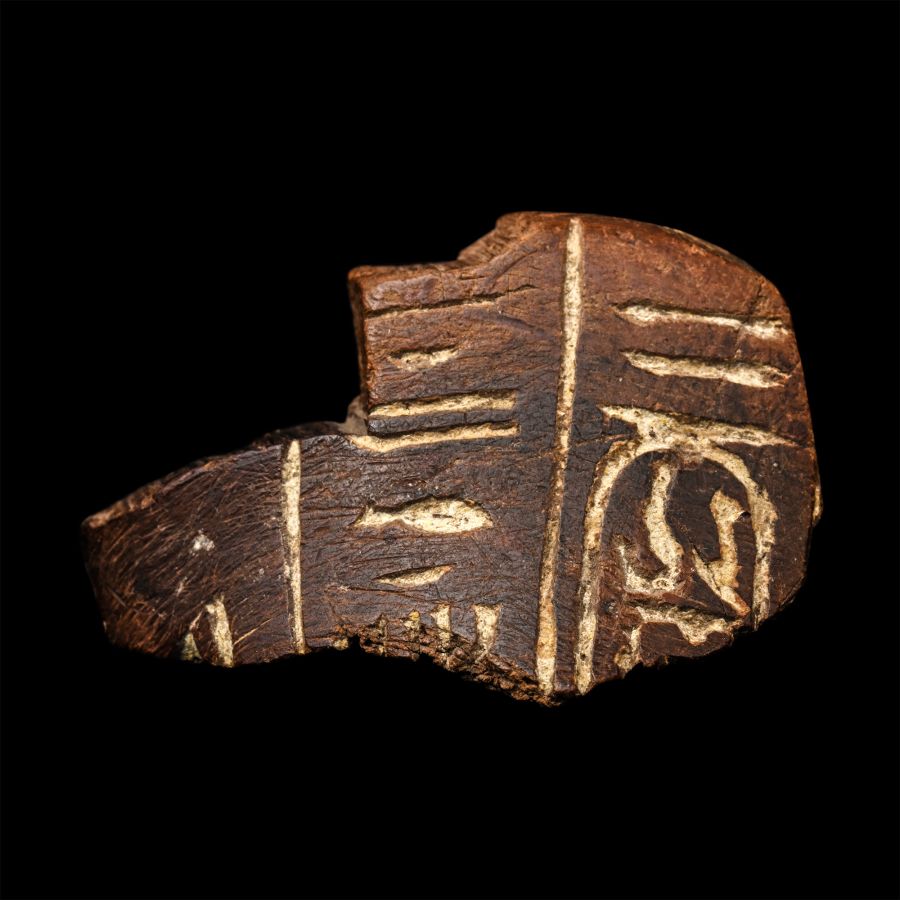
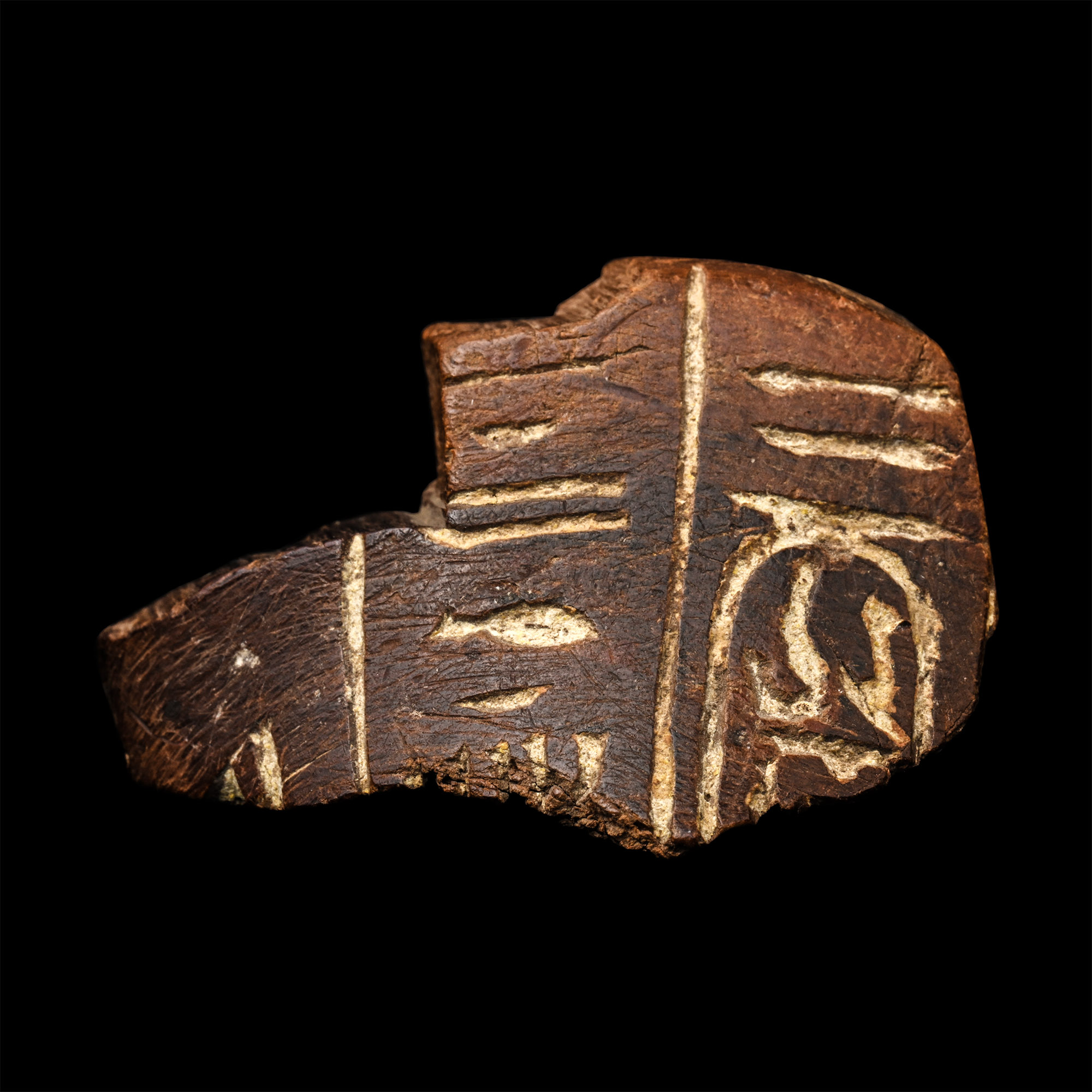
Egyptian Fragment from a Wooden Shabti of Pharaoh Amenhotep III
NEW KINGDOM, 18TH DYNASTY, 1386-1349 B.C.
1 5/8 in. (8.41 grams, 42 mm).
Fragment of chocolate-coloured wood with incised hieroglyphs inlaid with white paste, preserving the lower part of a cartouche containing Amenhotep III's birth name, with the epithet "Ruler of Thebes" still legible, and two fragmentary columns of hieroglyphs to the right, belonging to a version of the shabti spell. [No Reserve]
ProvenanceFrom the private collection of Peter Clayton, FCILIP, Dip, Arch, FSA, FRNS, Hemel Hempstead, Hertfordshire, UK; formed since the late 1950s.
LiteratureCf. Schneider, H.D., Shabtis. An Introduction to the History of Ancient Egyptian Funerary Statuettes with a Catalogue of the Collection of Shabtis in the National Museum of Antiquities at Leiden, Vol.3, Leiden, 1977, p.3, for a nearly complete wooden shabti for Amenhotep III in the Metropolitan Museum of Art (MMA 15.2.10); Loffet, H.C., La Collection Emmacha: Antiquités Égyptiennes 1 – Les shabtys et oushebtys, Paris, 2013, pp.22-23, no.3 for a wooden fragment; Bovot, J-L., Les serviteurs funéraires royaux et princiers de l’Ancienne Égypte, Paris, 2003, pp. 69-70, for fragmentary wooden examples in the Louvre.
FootnotesAmenhotep III was buried at Thebes in the Valley of the Kings (tomb KV22). His funerary equipment included shabtis in various hardstones and wood. The preserved text, ...ḫnt sḏm.t[n]... ('...forefront; and when you hear...'), belongs to a less common variant of the shabti spell found on other examples of Amenhotep III's shabtis.
CONDITIONTimeLine Auctions follows a vetting process to ensure the authenticity and legality of all items, reinforcing our commitment to integrity and responsible trading. Each antiquity, antique, and coin lot undergoes thorough examination by a vetting committee of at least ten external specialists, professional trade association members, scientists, and archaeologists: Our Vetting Process
AUCTIONS:
TimeLine is a leading auction house specialising in antiquities, ancient art, collectables, natural history, coins, medals, and books. Our auctions offer museums, collectors, historians, and enthusiasts the opportunity to acquire unique and historically significant pieces.
LOT 0391
Egyptian Fragment from a Wooden Shabti of Pharaoh Amenhotep III
Estimate £100 - 140€120 - 160 (for guidance only)$140 - 190 (for guidance only)
-
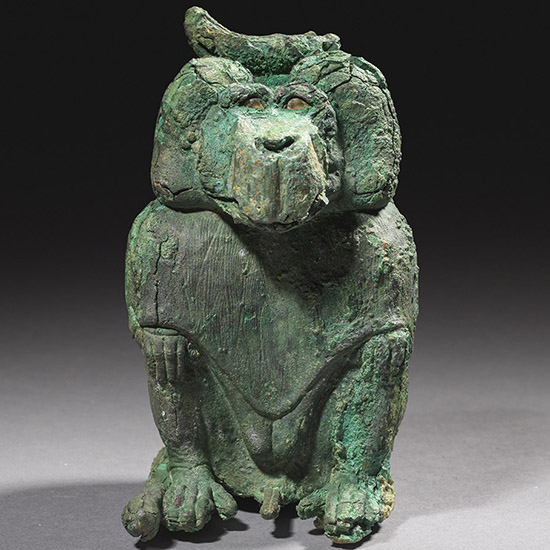
Large Egyptian Bronze Figure of Thoth
Late Period, 26th-30th Dynasty, 664-343 B.C.Estimate: £8,000 - 10,000 (+bp*)
Opening Bid: £4,000
Hollow-cast depiction of the baboon manifestation of the god Thoth, seated on its haunches, front paws resting on the knees of its back legs, genitalia exposed, a thick cowl of fur around its shoulders, and a long tail curling from the back; remains of a crescent moon sit on the crown of its head, preserving traces of gilding (this may originally have been surmounted by a full moon disc); the animal’s coat is rendered naturalistically with fine incised detailing, and the hands and feet are delicately portrayed, with knuckles and nails accurately defined; facial features are strongly modelled; the eye inlays, most likely glass or quartz, survive, with pupil and white differentiated; stabilised. 810 grams, 11.8 cm (1.59 kg total, 22.1 cm high including stand)
Condition: Some cracking of the original metal, particularly around the head, shoulders, and tail; much of the crown now lost; heavy corrosion and oxidisation, now stabilised.
Collection of Max Willborg (1933-2001), Stockholm, Sweden, acquired 1981. Accompanied by an Art Loss Register certificate, no.S00133604 This lot has been checked against the Interpol Database of stolen works of art and is accompanied by search certificate no.13521-263440.
Because of its curious behaviour at dawn, when it sits upright on its hind legs, waves its front paws in the air, and screeches, the baboon was regarded as a creature of the sun god, as if it had foreknowledge of the sun’s arrival. More commonly, however, it was associated with the moon, under whose light this performance takes place. As a result, the baboon (both Papio cynocephalus, the dog-headed baboon, and P. hamadryas) was the form adopted by the Egyptian lunar gods Khonsu of Thebes and Thoth of Hermopolis in Middle Egypt. Images such as this are assumed to represent Thoth unless an inscription specifically names Khonsu. Thoth was Lord of Time, inventor of writing, and patron of scribes. The original animal manifestation associated with Thoth may have been the ibis, and his baboon form may have been adopted only when the cult of the god was extended to Hermopolis, where a baboon known as the Great White was already adored. -
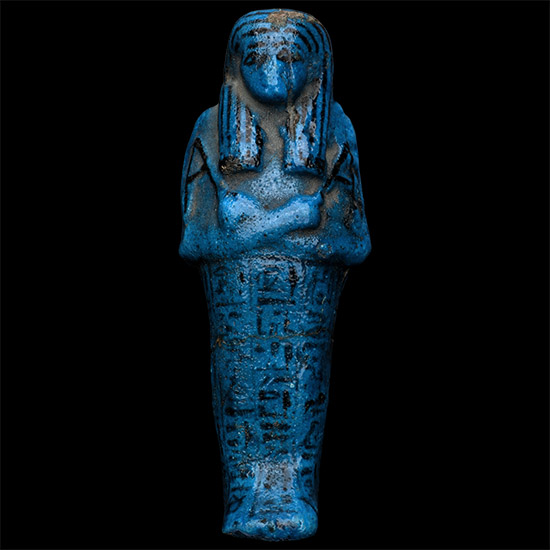
Egyptian Deir el-Bahari Bright Blue Glazed Faience Shabti of Nesitanebisheru, Daughter of Pinedjem II, High Priest of Amun, and Neskhons
Third Intermediate Period, 21st Dynasty, circa 980-935 B.C.Estimate: £6,000 - 8,000 (+bp*)
Bids: 8 | Current Bid: £310
Deep blue, lustrous-glazed mummiform shabti with a tripartite wig and modelled arms; each hand holding a hoe, with the implements, wig, and facial details rendered in black; on the back of the figure, below the wig, hangs a centrally positioned trapezoidal seed bag in black; the bottom half of the figure bears eight columns of hieroglyphic text in black, giving a version of the shabti spell. 229 grams, 15.1 cm
From the cache of mummies of the priests of Amun at Deir el-Bahari, found by the Abdul Rassoul family circa 1910. E.E.S. sale, November 1967, sold for £5.00. Acquired from Richardson, St Christopher’s Place, Wigmore Street. London, late 1960s, for £7.00 and 10 shillings. From the private collection of Peter Clayton, FCILIP, Dip, Arch, FSA, FRNS, Hemel Hempstead, Hertfordshire, UK; formed since the late 1950s. Accompanied by an academic report by Paul Whelan. Accompanied by an old handwritten information card by Peter Clayton, collection no.122. This lot has been checked against the Interpol Database of stolen works of art and is accompanied by search certificate no.13491-262881. -
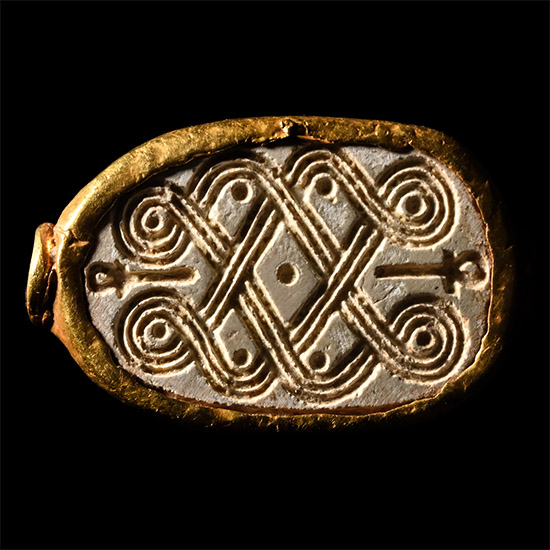
Egyptian Steatite Scarab with Interlocking Scrolls in Gold Mount
Second Intermediate Period, circa 1650 B.C. and laterEstimate: £200 - 300 (‡+bp*)
Opening Bid: £100
Comprising a carved scarab in a gold frame with mounting rings suitable for use as a ring bezel; the underside features a trilinear looped guilloche motif flanking two ankh motifs. 2.63 grams, 20 mm
Acquired from Derek Content, 20 May 1975. Private collection of Kal Noselson, New York, acquired between 1976 and the late 1990s; thence by descent. Accompanied by an original handwritten invoice from Derek Content, dated 20 May 1975.
