
Loading, please wait...
LOT 0725
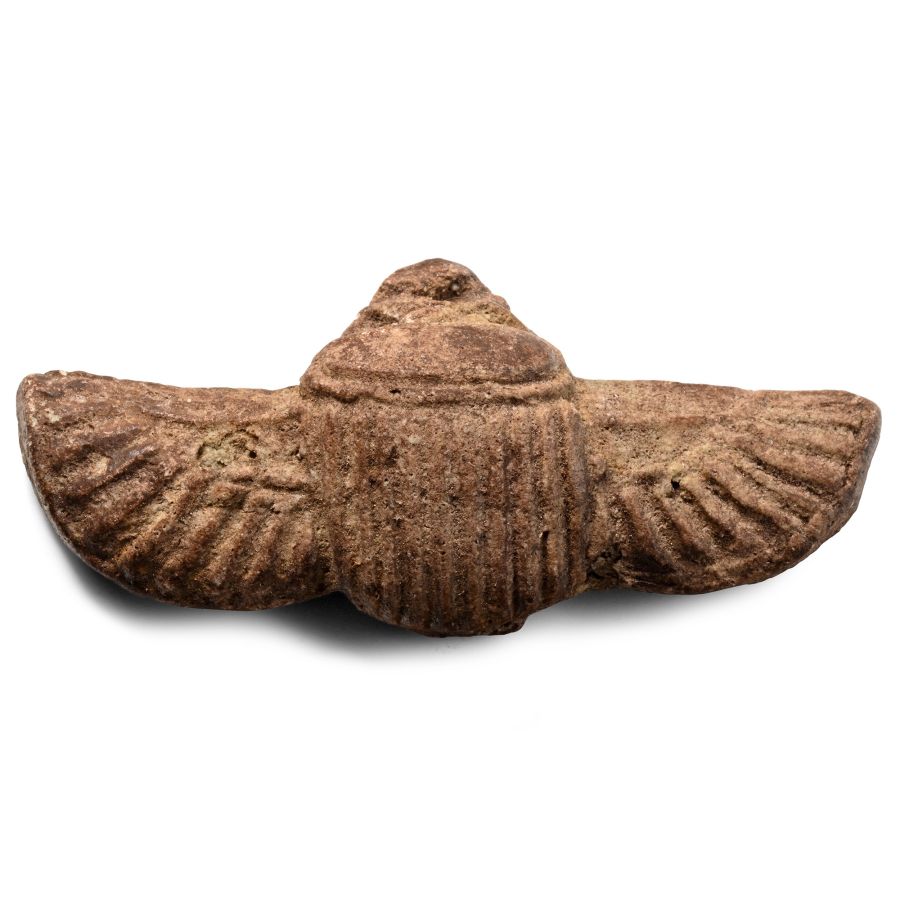
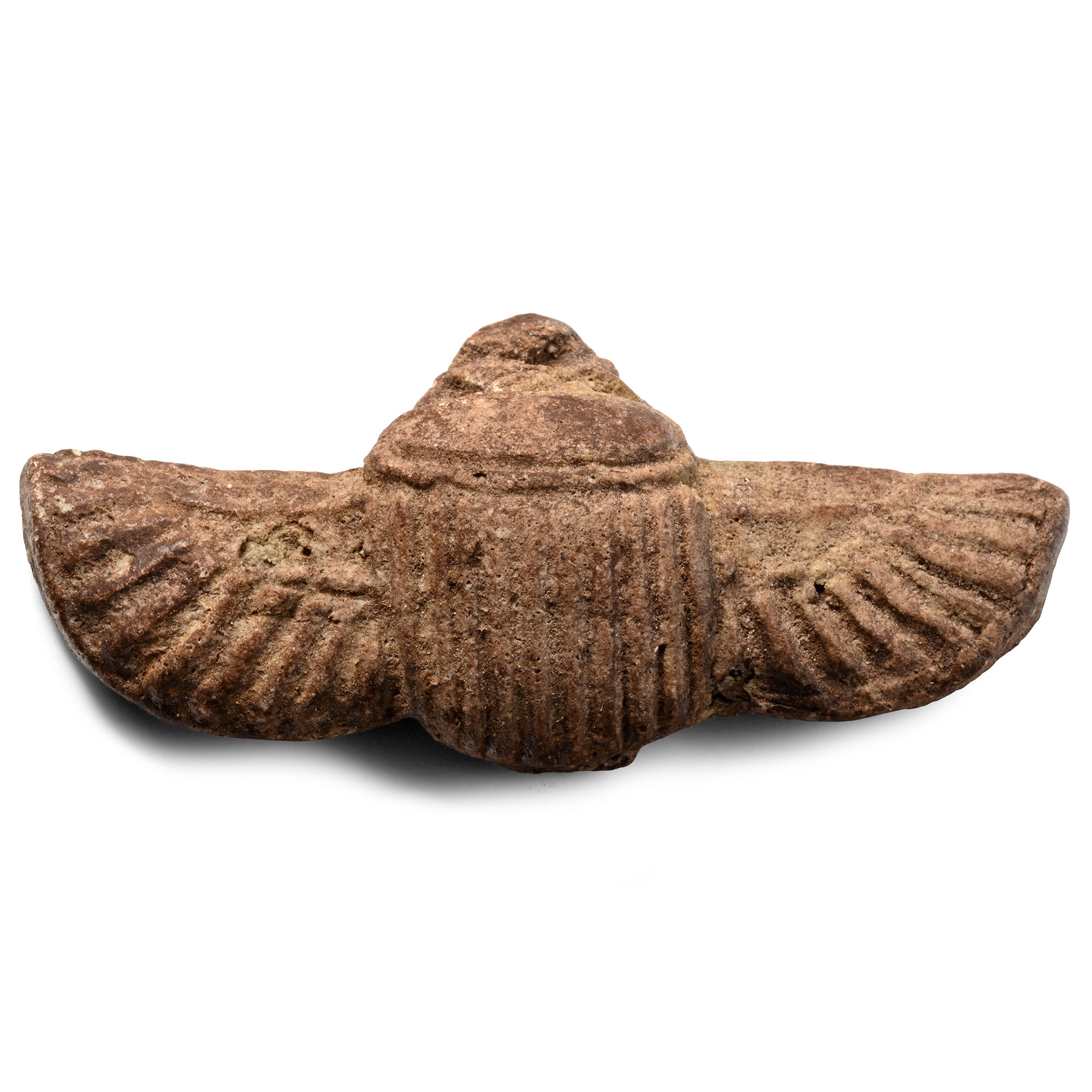
Egyptian Faience Winged Scarab
LATE PERIOD, 26TH-30TH DYNASTY, CIRCA 664-332 B.C.
2 3/8 in. (10.98 grams, 60 mm).
Comprising a winged scarab modelled with a ribbed carapace and two extended wings with feather detailing; a suspension hole runs transversely through the head. [No Reserve]
Provenancewith a privately curated collection, 1980s-early 2000s.
From the private collection and estate of Christine Simons (1943-2025), West Midlands, UK.
Cf. Petrie, W.M.F., Amulets. Illustrated by the Egyptian Collection in University College, London, 1914, pl. XI, nos. 93b, d-f, for examples of less-defined types of one-piece winged scarabs.
FootnotesWinged scarabs were often used as funerary amulets and were believed to symbolise the deceased's rebirth and regeneration.
CONDITIONTimeLine Auctions follows a vetting process to ensure the authenticity and legality of all items, reinforcing our commitment to integrity and responsible trading. Each antiquity, antique, and coin lot undergoes thorough examination by a vetting committee of at least ten external specialists, professional trade association members, scientists, and archaeologists: Our Vetting Process
AUCTIONS:
TimeLine is a leading auction house specialising in antiquities, ancient art, collectables, natural history, coins, medals, and books. Our auctions offer museums, collectors, historians, and enthusiasts the opportunity to acquire unique and historically significant pieces.
LOT 0725
Egyptian Faience Winged Scarab
Estimate £100 - 140€120 - 160 (for guidance only)$140 - 190 (for guidance only)
-
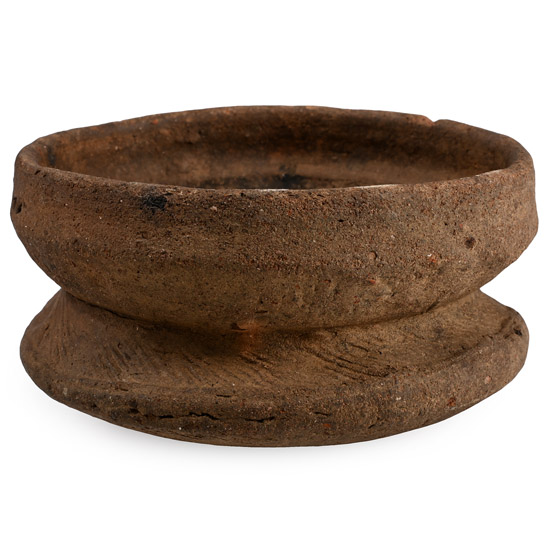
Egyptian Pinched Earthenware Bowl
Coptic, circa 4th-7th century A.D.Estimate: £80 - 100 (+bp*)
Bids: 1 | Current Bid: £5
With rounded underside, sharply waisted profile, vertical rim with inner rib. 410 grams, 13.7 cm
Acquired on the UK art market since the 1990s. From the property of a late Lincolnshire, UK, gentleman; thence by descent. -
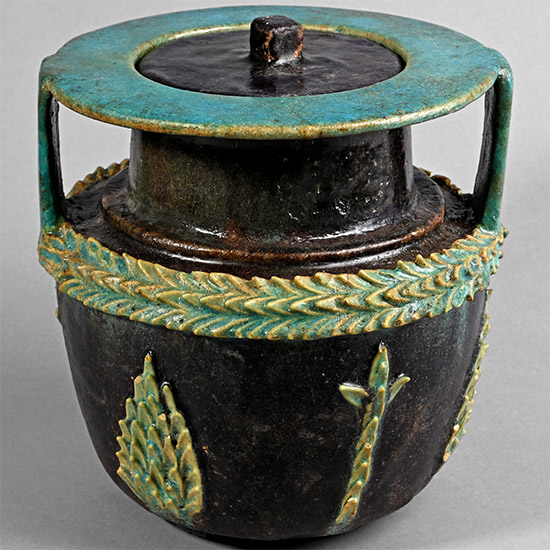
Egyptian Turquoise and Cobalt Blue Faience Amphora
Roman Period, circa 2nd century A.D.Estimate: £8,000 - 10,000 (+bp*)
Opening Bid: £4,000
Barrel-shaped in profile, with a stepped shoulder, wide neck, and broad, flared flange rim at the mouth, supported by two lateral strap handles; applied wreath decoration to the outer edge of the shoulder and vertical fronds to the lower body; restored. 1.48 kg, 17.8 cm high
Stift Neuberg (Neuberg Abbey) collection, Heidelberg, Germany, by 1893 and into the 20th century. Anonymous sale; Münzen und Medaillen, Auktion 41, 1972, no.151. Fiorella Cottier-Angeli collection, Geneva, 1981-2007. Herbert A. Cahn, acquired from the above. With Galerie Günter Puhze, Freiburg, 2007. Private collection, Midwest USA, acquired in 2007. This lot has been checked against the Interpol Database of stolen works of art and is accompanied by search certificate no.13477-262436.
Stift Neuberg was privately owned from 1798 until 1926. By 1893, a collection of antiquities had been assembled there, and its Greek and Roman holdings were published. It is believed that the amphora was acquired as part of this collection by Friedrich Alexander von Bernus (1838–1908), who inherited Stift Neuberg from his relative Johann Friedrich Schlosser (1780-1851), a nephew of Goethe. In 1926, the abbey was sold to the Benedictines and has remained a religious establishment ever since. -
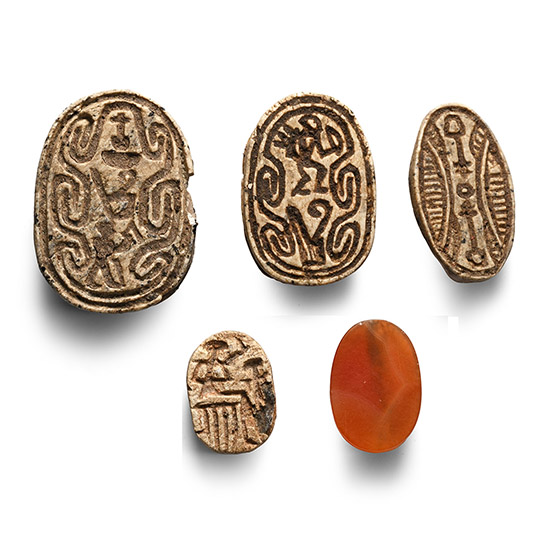
Egyptian Mixed Scarab Collection
2nd-1st millennium B.C. and laterEstimate: £400 - 600 (+bp*)
Opening Bid: £200
Comprising three faience scarabs with detailed bodies and decorated undersides, featuring: a scroll border with central design consisting of a nefer, neb, Red Crown, and a striding human figure holding a flail; a scroll border with a central figure of a bowman with a Red Crown beneath; a seated figure before an offering table(?); an oval scaraboid featuring a central sun disc with opposed nefer signs flanked by hatched panels; and a plain carnelian scarab. 22.75 grams total, 15-28 mm
From the collection of a gentleman, acquired on the London art market in the 1990s. This lot is accompanied by an illustrated lot declaration signed by the Head of the Antiquities Department, Dr Raffaele D'Amato.
