
Loading, please wait...
LOT 0011
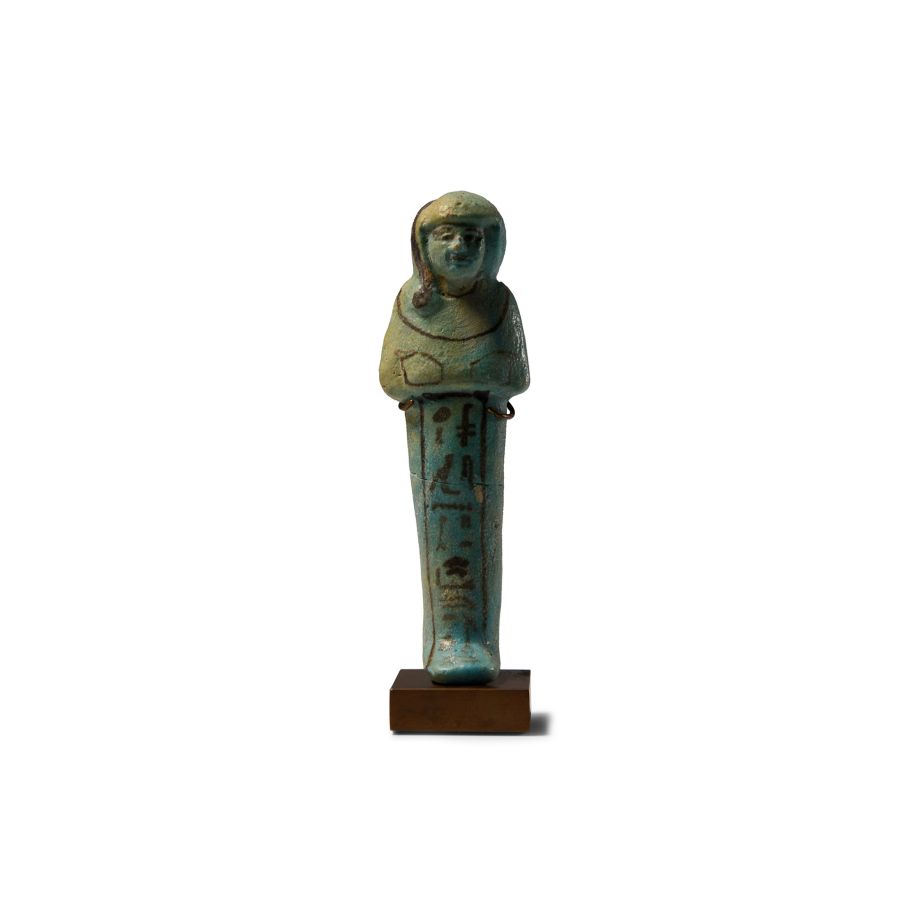
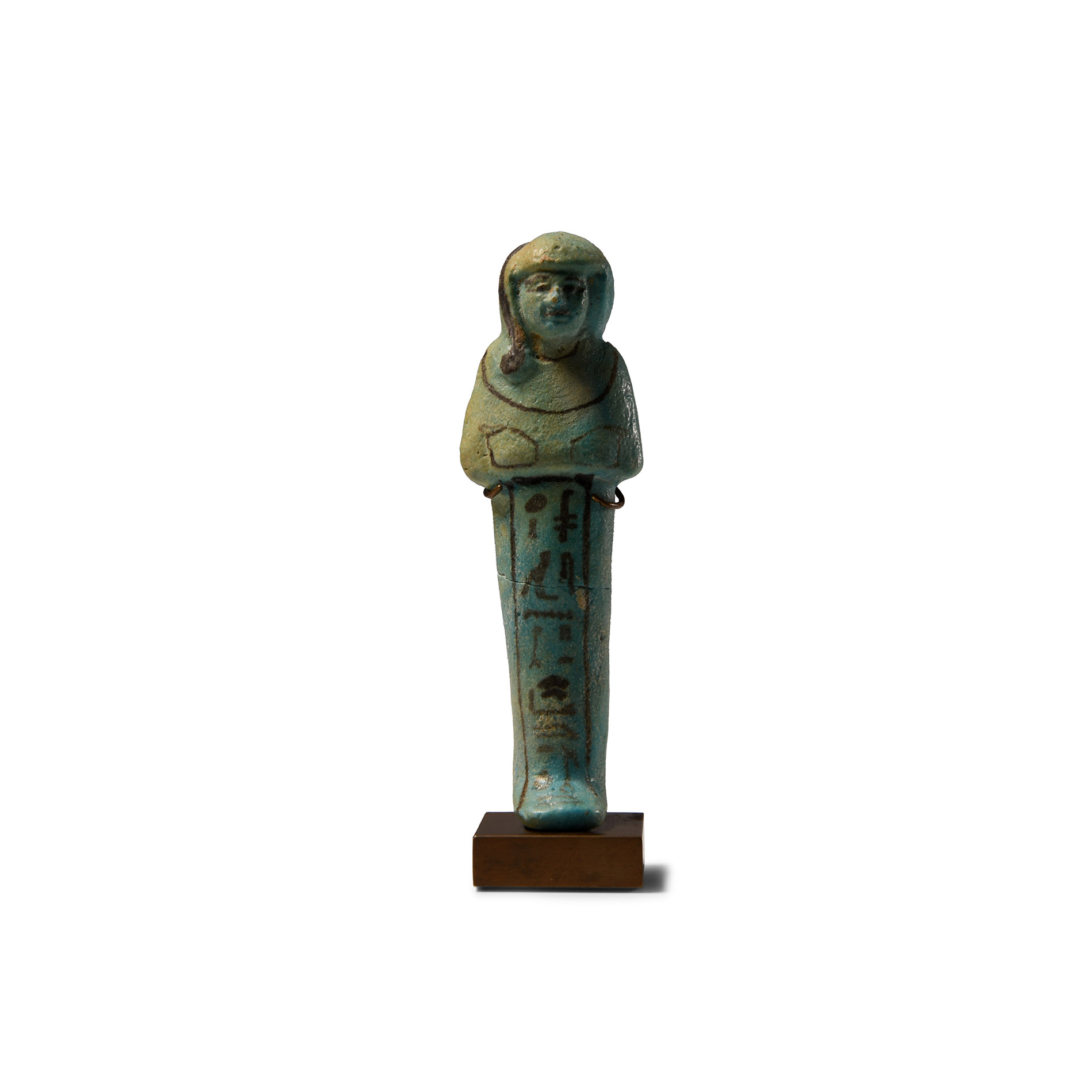
Egyptian Faience Ushabti of a Prince, Sem Priest of Ptah Khaemwaset
LATE NEW KINGDOM, 19TH DYNASTY, 1279 -1213 B.C.
4 1/2 in. (5 1/8 in.) (55 grams, 11.6 cm (159 grams total, 13 cm high including stand)).
Decorated using turquoise glaze and painted face, collar and hand detailing, wearing short wig and Sidelock of Youth (typical of a Sem priest); column of hieroglyphs to the lower body reading 'King's son, Sem priest of Ptah Khaemwaset, true of voice'; accompanied by a custom-made display stand.
ProvenanceAcquired on the London art market, early 1980s.
Private European collection.
Accompanied by an academic report by Egyptologist Paul Whelan.
This lot has been checked against the Interpol Database of stolen works of art and is accompanied by search certificate number no.11837-206506.
Cf. Michael C. Carlos Museum, Atlanta, inv.no. 2015.050.004, for a shabti of Hori showing similar hands and collar; Louvre Museum, Paris, inv.no.N2251 6, for another shabti of Khaemwaset for a similar type of inscription.
FootnotesThere are various short inscriptions found on faience shabtis of Khaemwaset. The inscription on this shabti is notable for including the uncommon possessive element 'of Ptah' following the writing of 'Sem(-priest)'. It features on none of the inscriptions on the 43 published faience shabtis in the Louvre, but is found on an alabaster shabti of Khaemwaset in the Vatican's Museo Gregoriano Egizio (inv.no.19332). Also, the arm sign serving as a phonetic complement in the writing of his name is fairly uncommon on his faience shabtis, although it is found, for instance, in the inscriptions on two in the Louvre (inv.nos. N 456 A and N 768.14) and on another in the Amasis Collection (inv.no.S-1577).
CONDITIONTimeLine Auctions follows a vetting process to ensure the authenticity and legality of all items, reinforcing our commitment to integrity and responsible trading. Each antiquity, antique, and coin lot undergoes thorough examination by a vetting committee of at least ten external specialists, professional trade association members, scientists, and archaeologists: Our Vetting Process
AUCTIONS:
TimeLine is a leading auction house specialising in antiquities, ancient art, collectables, natural history, coins, medals, and books. Our auctions offer museums, collectors, historians, and enthusiasts the opportunity to acquire unique and historically significant pieces.
LOT 0011
Egyptian Faience Ushabti of a Prince, Sem Priest of Ptah Khaemwaset
Sold for (Inc. bp): £2,600
-
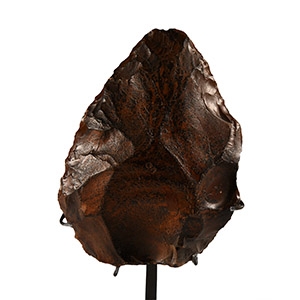
Stone Age Flint Hand Axe
Lower Palaeolithic Period, circa 400,000-200,000 B.P.Sold for (Inc. bp): £286
Finely knapped bifacial hand axe of triangular form with rounded butt; with printed and inked 'MADIJEN / EI:190M / THEBES / 1905' findspot label; with custom-made display stand. 480 grams total, 16.5 cm
Found Madijen, Thebes, 1905. Old German collection, before 1920. -
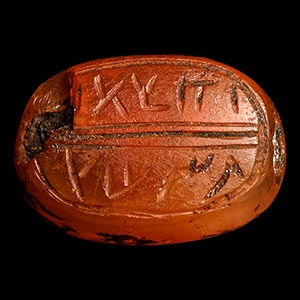
Phoenician Carnelian Scaraboid with Semitic Inscription
8th-7th century B.C.Sold for (Inc. bp): £520
With a domed upper face and bevelled side edge; base inscribed over two lines or columns separated by three lines; pierced for suspension; chip to base. 1.9 grams, 15 mm
From an old French collection, formed in the 1980s-1990s. Property of a North London antiquary. -
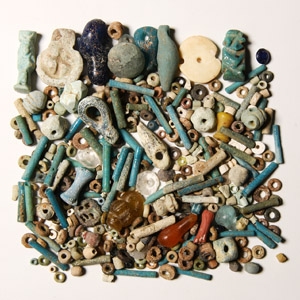
Egyptian and Other Faience Amulet and Bead Group
New Kingdom, 1315-1069 B.C. and laterSold for (Inc. bp): £286
Most covered in a coloured glaze; amulets including fruits and deities; beads of a range of types. 34 grams total, 2-20 mm
UK gallery, early 2000s.
