
Loading, please wait...
LOT 0462
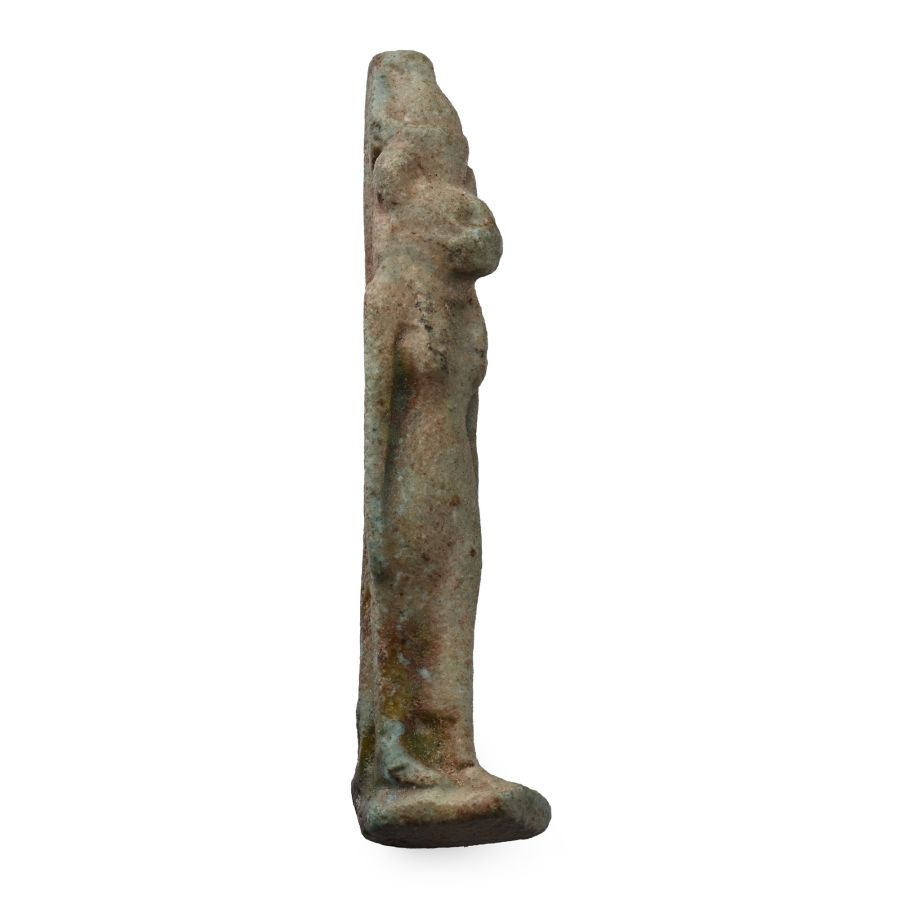
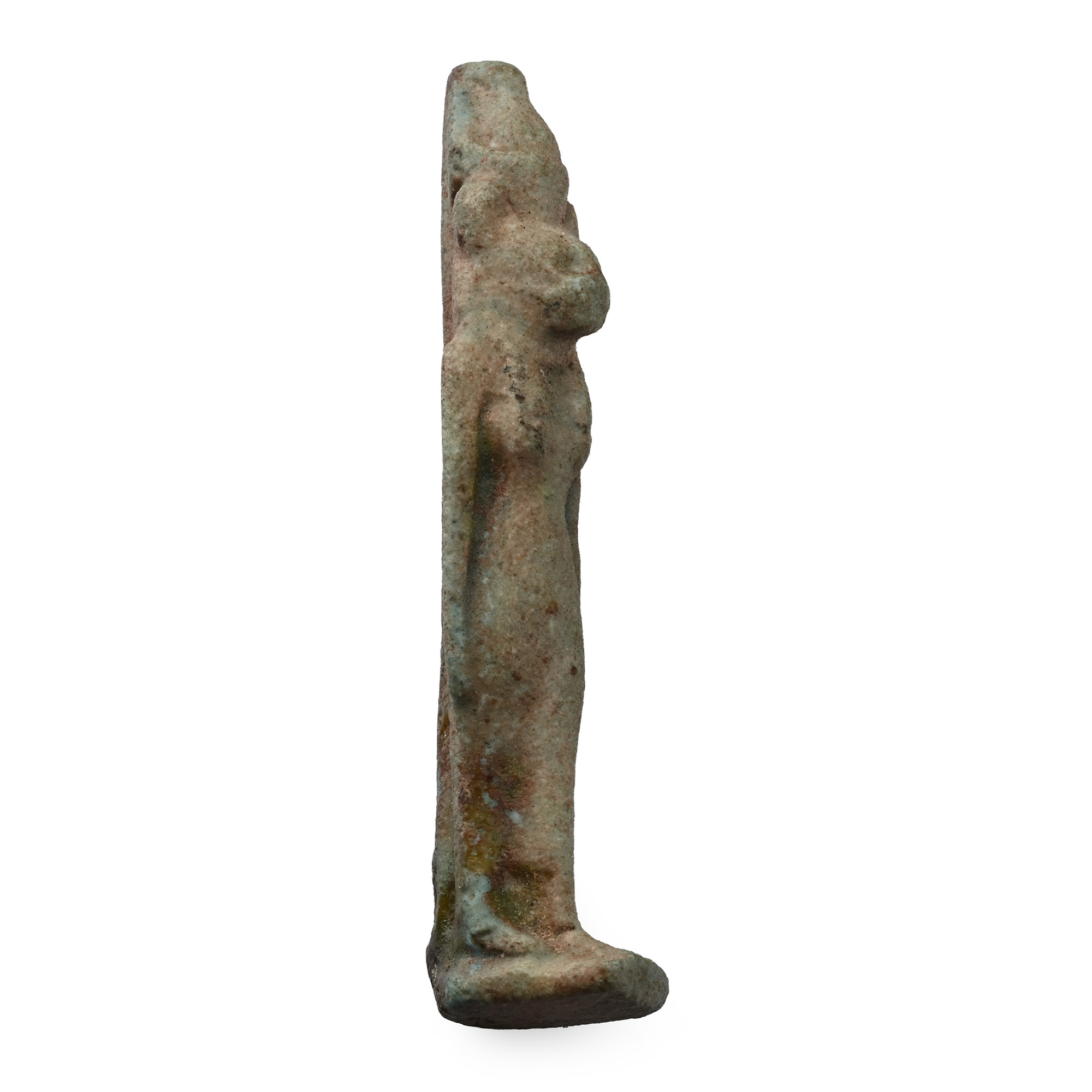
Egyptian Faience Standing Lioness Amulet
PTOLEMAIC PERIOD, 332-30 B.C.
2 1/4 in. (3.96 grams, 56 mm).
Standing figure of lioness-headed goddess in a striding pose with arms at the sides, sporting a black coloured tripartite wig surmounted by the double-crown; dorsal pillar. [No Reserve]
ProvenanceAcquired on the UK art market during the late 20th century.
From the private collection of David King (1940-2024), Hoddesdon, Hertfordshire, UK.
This lot is accompanied by an illustrated lot declaration signed by the Head of the Antiquities Department, Dr Raffaele D'Amato.
Cf. Andrews, C., van Dijk, J., Objects for Eternity: Egyptian Antiquities from the W. Arnold Meijer Collection, Mainz am Rhein, 2006, p.229, no.3.41, for similar.
FootnotesThroughout ancient Egyptian mythology, lion-headed goddesses played a significant role in the religious beliefs of the people. These goddesses, including Sekhmet, Wadjet, and Bastet, were revered as powerful and fierce protectors. Their presence was believed to ward off evil and safeguard the people from harm.
CONDITIONTimeLine Auctions follows a vetting process to ensure the authenticity and legality of all items, reinforcing our commitment to integrity and responsible trading. Each antiquity, antique, and coin lot undergoes thorough examination by a vetting committee of at least ten external specialists, professional trade association members, scientists, and archaeologists: Our Vetting Process
AUCTIONS:
TimeLine is a leading auction house specialising in antiquities, ancient art, collectables, natural history, coins, medals, and books. Our auctions offer museums, collectors, historians, and enthusiasts the opportunity to acquire unique and historically significant pieces.
-
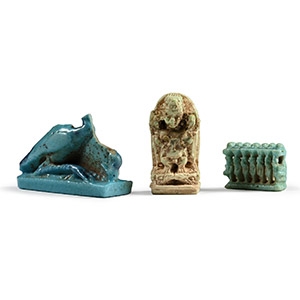
Egyptian Faience Amulet Collection
1st millennium B.C.Estimate: £500 - 700 (‡+bp*)
Opening Bid: £250
Comprising: an amuletic bead consisting of a row of seven Taweret figures on a rectangular base, pierced longitudinally; a seated ibis before a diminutive figure of Maat on a tongue-shaped base; a cippus amulet composed of the figure of Pataikos standing on two crocodiles, with two hawks perched on his shoulders, a scarab on his head, flanked by the figures of Isis and Nephthys, and on the back, a winged goddess standing on the crocodiles' tails. 6.5 grams total, 16-30 mm
Acquired in the mid 1980s-1990s. Private collection, Switzerland, thence by descent. Private collection, since the late 1990s. This lot is accompanied by an illustrated lot declaration signed by the Head of the Antiquities Department, Dr Raffaele D’Amato. This lot is accompanied by an illustrated lot declaration signed by the Head of the Antiquities Department, Dr Raffaele D'Amato. -
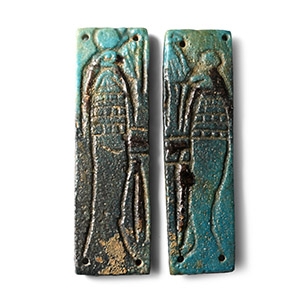
Egyptian Blue Faience Sons of Horus Plaques
Late Period, 664-332 B.C.Sold for (Inc. bp): £286
Two rectangular plaques, each depicting one of the 'Four Sons of Horus' - Qebehsenuef and Hapi - shown mummiform, wearing a tripartite wig and broad collar, both pierced at the upper and lower edges. 26.8 grams total, 79-80 mm
Professor Haeberlin collection, acquired in Egypt in the late 19th century. Acquired by E.S., Germany, in 1962. Private collection of Mr K.A., acquired in the 1990s-early 2000s. This lot is accompanied by an illustrated lot declaration signed by the Head of the Antiquities Department, Dr Raffaele D'Amato.
The Four Sons of Horus were deities tasked with protecting the internal organs of the deceased. The human-headed Imsety safeguarded the liver, the baboon-headed Hapy looked after the lungs, the jackal-headed Duamutef defended the stomach, and the falcon-headed Qebehsenuef protected the intestines. Amulets featuring these deities were included within the mummy wrappings. -
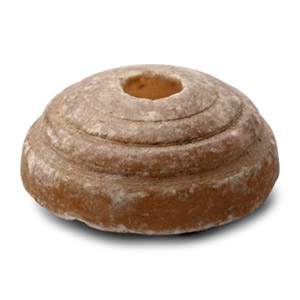
Phoenician Alabaster Spindle Whorl
1st millennium B.C.Sold for (Inc. bp): £52
Plano-convex in section with stepped profile to dome and underside. 16.52 grams, 32 mm
Found in Lebanon before 1980. From the private collection of Kenneth Machin (1936-2020), Buckinghamshire, UK; his collection of antiquities and natural history was formed since 1948; thence by descent. This lot is accompanied by an illustrated lot declaration signed by the Head of the Antiquities Department, Dr Raffaele D'Amato.
