
Loading, please wait...
LOT 0471
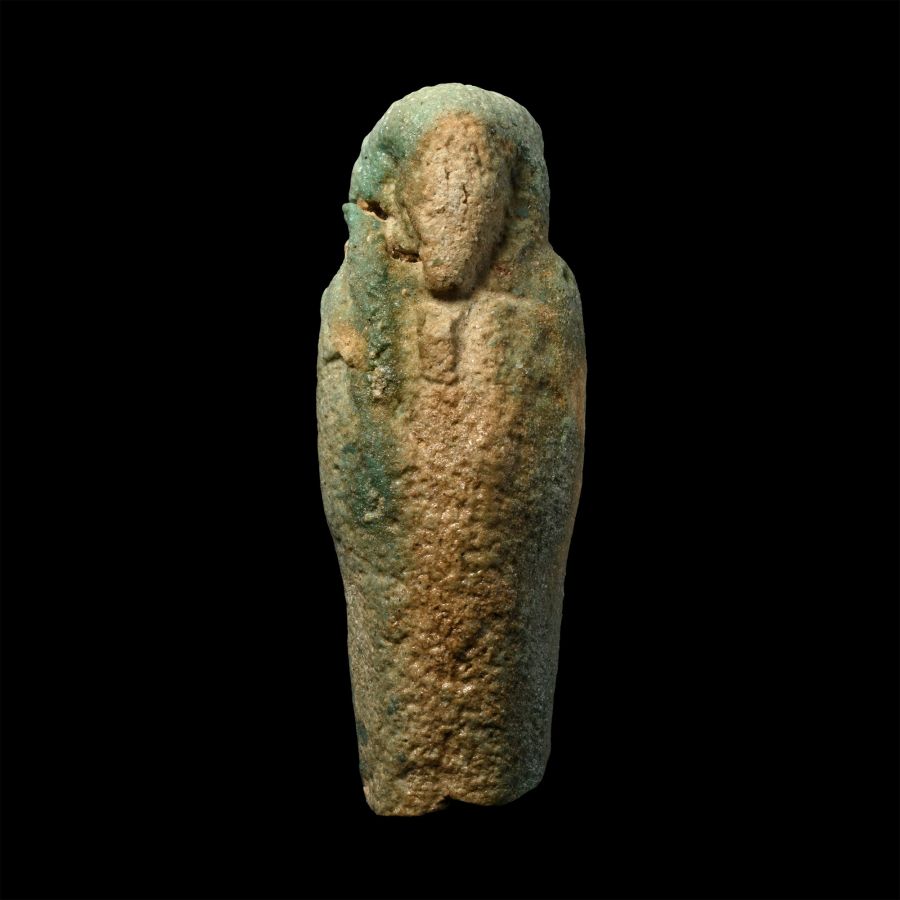
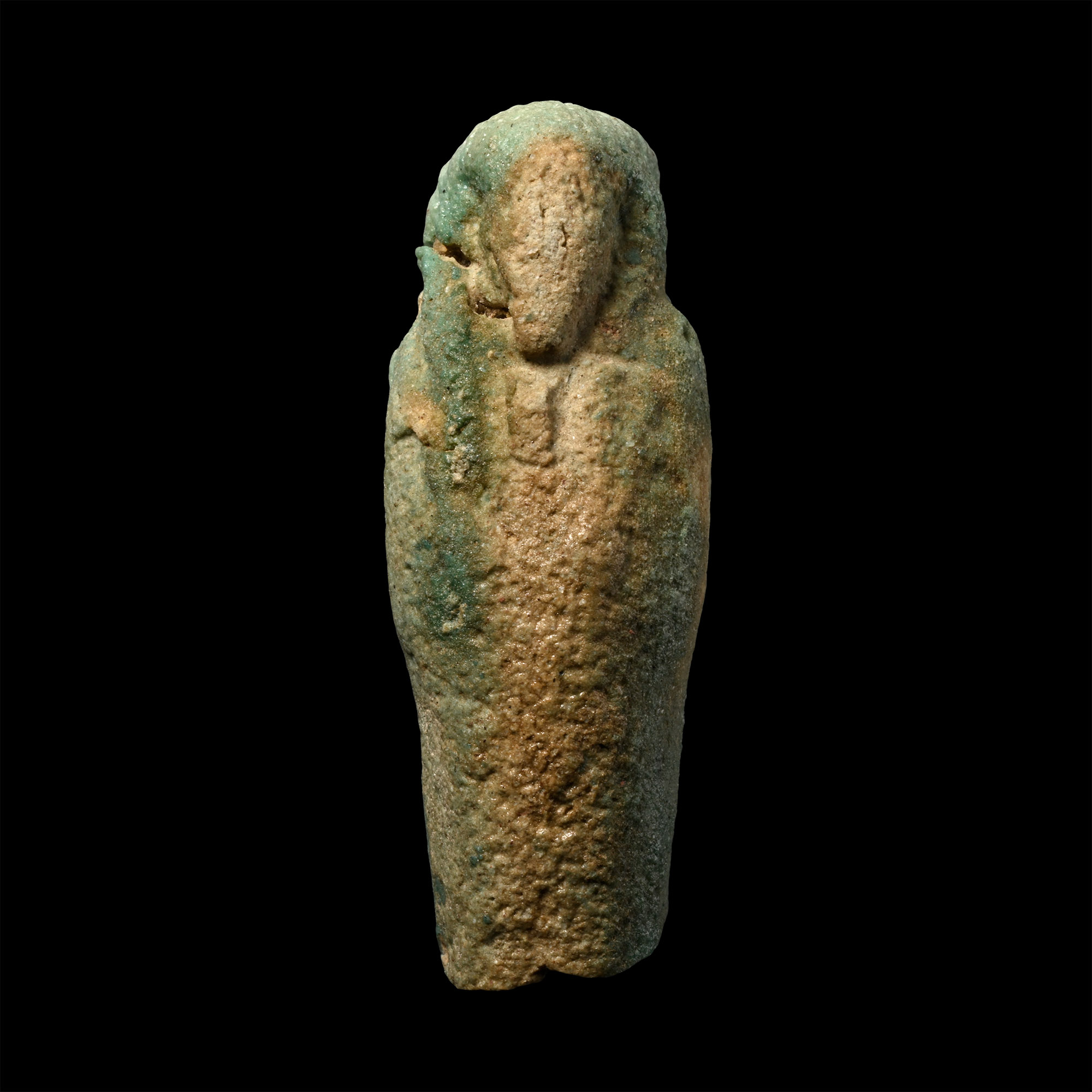
Egyptian Faience Shabti
LATE PERIOD, 664-332 B.C.
2 in. (10.5 grams, 49 mm).
Plano-convex in section with moulded piriform face and wig, tools in the crossed hands, accompanied by an old handwritten note 'faience. Ceramic composed of crushed quartz or quartz sand with small amounts of lime and plant ash or naron. Coated with a bright blue or green glaze or soda[...]' and to verso 'Late period 700-400 BC Ex Margaret Seton-Jones from Flinders Petrie'. [No Reserve]
ProvenanceEx Margaret Seton-Jones from Flinders Petrie.
From the private collection of a Canadian gentleman living in Essex, UK, formed since the 1920s-circa 1990.
Property of an Essex lady until the late 1990s; thence by descent.
From the private collection of an Essex gentleman since the late 1990s.
Accompanied by a handwritten slip with description and provenance.
TimeLine Auctions follows a vetting process to ensure the authenticity and legality of all items, reinforcing our commitment to integrity and responsible trading. Each antiquity, antique, and coin lot undergoes thorough examination by a vetting committee of at least ten external specialists, professional trade association members, scientists, and archaeologists: Our Vetting Process
AUCTIONS:
TimeLine is a leading auction house specialising in antiquities, ancient art, collectables, natural history, coins, medals, and books. Our auctions offer museums, collectors, historians, and enthusiasts the opportunity to acquire unique and historically significant pieces.
-
.jpg)
Egyptian Blue Glazed Faience Pectoral
Late Period, 664-332 B.C.Sold for (Inc. bp): £364
Large rectangular shrine-shaped pectoral with subtle cavetto cornice top; obverse with black-painted Anubis reclining on a low pedestal, the reverse with two stylised tyet flanking a djed pillar; four piercings through the rear edge. 20 grams, 45 mm
From a 20th century UK collection. -
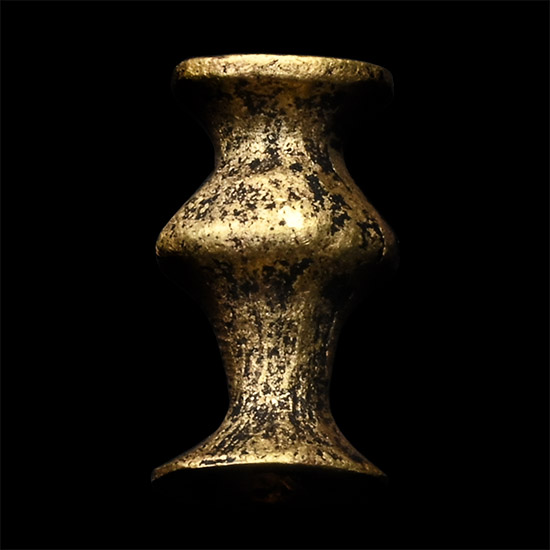
Egyptian Gold Bead Amulet
Late New Kingdom-Third Intermediate Period, circa 1069-900 B.C.Sold for (Inc. bp): £169
Formed as a poppy seed with flaring terminals. 0.91 grams, 9 mm
Ex French art market, 1920s. -
.jpg)
Monumental Egyptian Granite Statue Base For Prince Parahirwenemef
New Kingdom, 19th Dynasty, circa 1250 B.C.Sold for (Inc. bp): £52,000
The reddish granite base and lower part of a kneeling statue of Prince Parahirwenemef, preserving the feet and lower legs with finely detailed sandals and well-modelled toes; part of the kilt survives, with a line of sunken hieroglyphs on either side; a broad front pillar and narrower back pillar rise from the base, both inscribed, while hieroglyphic inscriptions continue around all four sides of the plinth; the mirrored base inscriptions comprise offering formulae invoking Amun-Ra on behalf of the prince together with a series of his royal and military titles, including "royal scribe", "overseer of horses", "troop commander", "group marshaler", and the previously unattested title tpy n mšꜥ ("chief of troops"); a separate inscription on the rear of the plinth names the noblewoman Wadjet-khayty as sn.t=f mr=f ("his sister/wife, his beloved"), providing the first substantial evidence for her relationship with the prince and strongly suggesting that she was his wife. 140 kg, 58.5 cm
Private collection of Mr A., acquired circa 1983-1984. Thence by descent, private collection since the late 1990s. This lot has been checked against the Interpol Database of Stolen Works of Art and is accompanied by a search certificate, no. 12887-241732. An article on this significant piece is currently being prepared by the Egyptologist Paul Whelan. The lot has been cleared against the Art Loss Register and is accompanied by a confirmation letter to that effect. This lot is accompanied by an illustrated lot declaration signed by the Head of the Antiquities Department, Dr Raffaele D'Amato.
Prince Parahirwenemef, the third son of Ramesses II and Queen Nefertari, is depicted in several relief scenes and two colossal statues associated with Ramesses II's temples, as well as in two smaller statues, both surviving only in fragmentary form. The inscriptions on this previously unrecorded statue base preserve the previously unattested military title tpy n mšꜥ ("chief of troops"), expanding the known titulary of Parahirwenemef and reinforcing his close association with the Ramesside chariot corps. The monument also provides the first substantial evidence concerning the noblewoman Wadjet-khayty, previously known only from a brief reference to a lost Karnak monument, strongly supporting her identification as the prince's wife. Together, the inscriptions make an important contribution to the study of Ramesside royal genealogy, military administration, and princely sculpture.
