
Loading, please wait...
LOT 0470
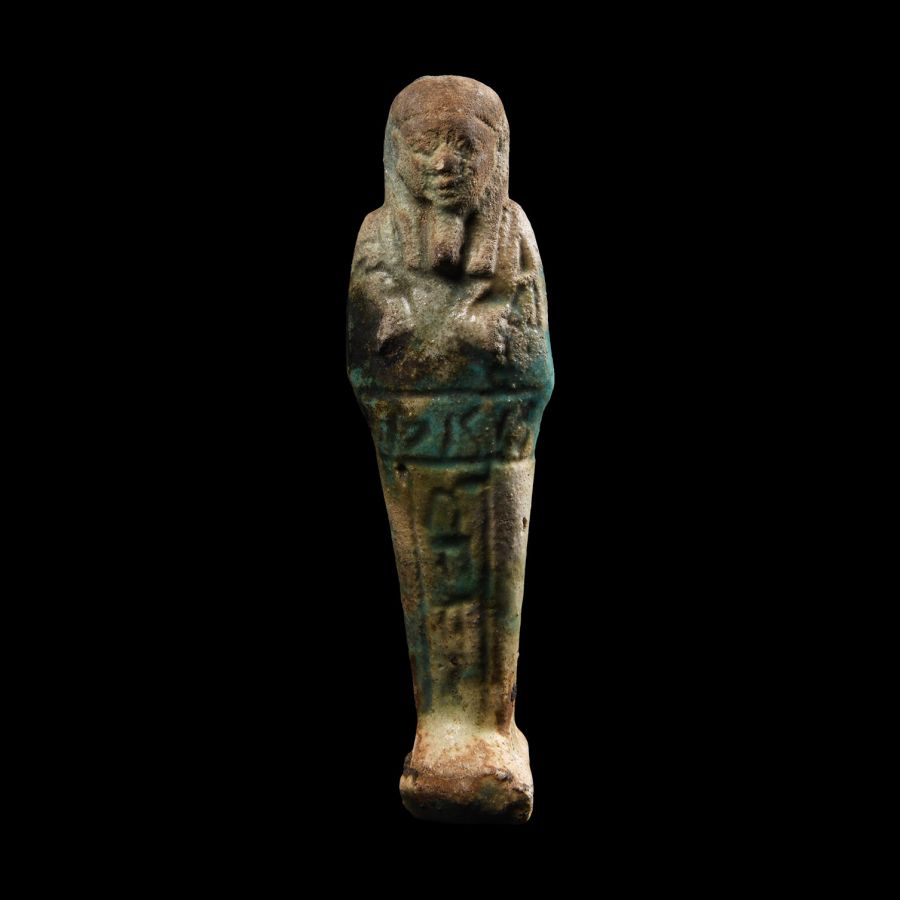
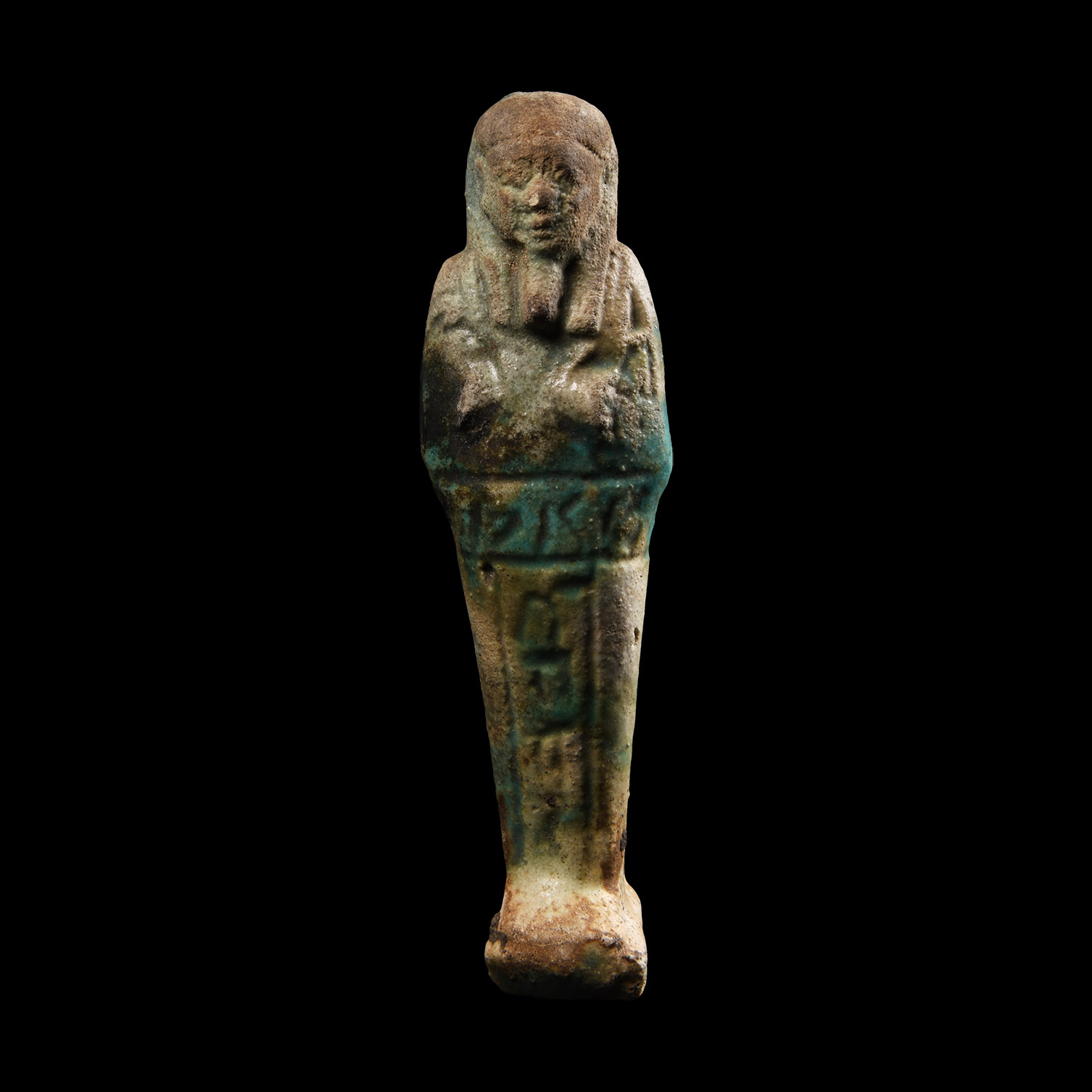
Egyptian Faience Shabti
LATE PERIOD, 30TH DYNASTY, CIRCA 380 B.C.
5 in. (68.5 grams, 12.5 cm high).
A mottled green and white glazed composition shabti with dorsal pillar, tripartite wig, horizontal and vertical panels hieroglyphic (or Demotic?) text to the lower body with scribe sign.
ProvenanceAcquired early 1990s.
Ex private American collection; thence by descent.
Private Swiss collection since 1998.
TimeLine Auctions follows a vetting process to ensure the authenticity and legality of all items, reinforcing our commitment to integrity and responsible trading. Each antiquity, antique, and coin lot undergoes thorough examination by a vetting committee of at least ten external specialists, professional trade association members, scientists, and archaeologists: Our Vetting Process
AUCTIONS:
TimeLine is a leading auction house specialising in antiquities, ancient art, collectables, natural history, coins, medals, and books. Our auctions offer museums, collectors, historians, and enthusiasts the opportunity to acquire unique and historically significant pieces.
-
.jpg)
Egyptian Faience Scaraboid of Seti I and Thutmose III
New Kingdom, 19th Dynasty, 1314-1304 B.C.Sold for (Inc. bp): £1,040
A blue glazed bifacial scaraboid; one side bearing the cartouche of Thutmose III and the legend “Enduring image of Re” and the other side Seti I’s throne name Men-Maat-Re (meaning “Eternal is the Justice of Re”) with other signs for an epithet that perhaps reads as “truly praised (of Re)”; pierced for suspension. 4.11 grams, 23 mm
From an old UK collection. From the private collection of Alf Baxendale (1941-2016) part 2, keen Egyptologist, member of the Egyptology Society, trustee of the Amarna Trust; thence by descent. Accompanied by an identification display card. Accompanied by a copy of his obituary published in Horizon, The Amarna Project and Amarna Trust newsletter, Issue 18, 2017, p.21, by Barry John Kemp, CBE, FBA, Professor Emeritus of Egyptology at the University of Cambridge and directing excavations at Amarna in Egypt.
Seti I's reign saw the production of many scarabs, scaraboids and plaques bearing his name as well as that of Thutmose III - who was considered a great warrior king. -
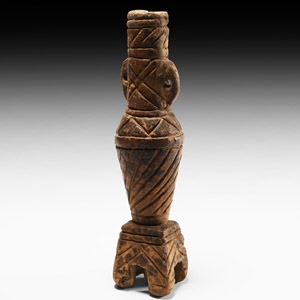
Coptic Kohl Container
6th-7th century A.D.Estimate: £1,200 - 1,700 (+bp*)
Opening Bid: £600
A heavily carved wooden kohl vessel, tubular with pierced lateral flanges and rectangular base with a stub foot to each corner; with old collector's label reading 'Coptic kohol container VI-VIII C. OFRA10P / Q Louvre Cat. des Bois de l'Egypte Copte, Paris 1986 no.39-41'. 129 grams, 19.5 cm
Acquired in the late 1980s-early 1990s. Important North West London collection. -
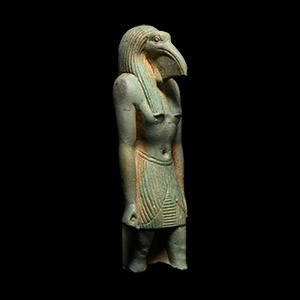
Egyptian Faience Figure of Thoth
26th Dynasty, 664-525 B.C.Estimate: £4,000 - 6,000 (‡+bp*)
Opening Bid: £2,000
A pale green glazed composition figure of Thoth in ibis-head form, plain dorsal pillar, pleated kilt, tripartite wig; old collector's inked accession number 'E.1000' to the reverse; repaired. 44.7 grams, 88 mm high
Ex Roger Liechti collection, Geneva, Switzerland. This lot has been checked against the Interpol Database of stolen works of art and is accompanied by search certificate no.11595-199013.
One of the most prominent of the ancient Egyptian gods, Thoth was associated with writing, magic and wisdom, and was credited with founding a number of branches of knowledge including law, religion and science. He is believed to have been self-created or grown from the seed of Horus from the forehead of Set. As the son of the gods of order and chaos, he was also the god of equilibrium. As such, he was considered a just and infallible judge. Worshipped from the Pre-Dynastic to the Ptolemaic Period, Thoth was one of the longest, continuously worshipped gods from any civilisation. Thoth's Egyptian name was Djehuty (also dhwty) meaning ‘He Who is Like the Ibis’, a sacred bird in ancient Egypt as well as a popular pet associated with wisdom.
